Showing posts with label infant/toddler. Show all posts

April 30, 2012

Babybug Magazine

Babybug Magazine
Publishers of Cricket
www.cricketmag.com
0-3 Preschool Cricket 22 pp.
1 year subscription $33.95
Magazine

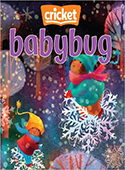
From the publishers of Cricket magazine and Ladybug magazine comes Babybug magazine, a publication especially for for babies and toddlers (ages 6 months -3 years). The recipient of multiple awards, including the 2012 Parents' Choice Silver Honor, Babybug features stories, nursery rhymes, poems and illustrations from some of the world's best children's writers and artists, including its own serial entitled "Kim and Carrots" about a little girl and and stuffed rabbit, Carrots. All of the content is designed to be read aloud by parents and grandparents, while the extra-heavy pages, non-toxic ink, rounded corners, and staple-free binding make Babybug safe for little ones to explore on their own. Babybug does not contain the games and activities featured in many magazines for slightly older toddlers and preschoolers - its content is entirely literary, specifically designed to provide toddlers and their caregivers with a variety of illustrated stories and poems to share. It is literally a baby's first literary magazine and a great introduction to short stories, as well as a source for light, age appropriate material.

April 27, 2012

My First ABC

My First ABC
The NY Metropolitan Museum of Art
http://www.metmuseum.org/
0-3 Preschool LB Kids 32 pp.
 978-0316068178 Board $8.99
Non Fiction

The Metropolitan Museum of Art had great success with Museum ABC, an alphabet book featuring each letter of the alphabet paired with a quartet of famous works containing a word associated with that letter. It's a beautiful book, but one more suitable to older preschoolers and kindergartners already familiar with the alphabet and able to grasp the sometimes abstract concepts pictured in the artwork (light, zigzag etc.). My First ABC is a simplified version of Museum ABC, with artwork specifically chosen to illustrate the letters to children just learning their ABC's. Each letter is shown in both capital and lowercase forms next to the representative word, so that connections between the images and letters are easy to make. Instead of the panel of four paintings for each letter featured in Museum ABC, My First ABC features only one image per letter making it visually easier to see and distinguish each object. But though the format is simplified, My First ABC is not dumbed down - famous works by Cezanne (A for apples) and Matisse (D for dancers) share space with ancient Egyptian paintings (H for hair), exposing even the littlest ones to the artwork and culture on display in the museum. My First ABC is a beautiful book and an excellent adaptation of Museum ABC well suited to the cognitive capabilities of very little ones. Highly recommended, it teaches the ABC's to modern toddlers with style and classical grace.

April 25, 2012

Dear Zoo

Dear Zoo: A Lift the Flap Book
By Rod Campbell; illus. by author
http://www.rodcampbell.co.uk/
1-4 Preschool Little Simon 18 pp.
978-1416947370 Board $6.99
Fiction

Dear Zoo is 25 years old. In honor of its silver anniversary, Rod Campbell refreshed and updated the original illustrations. Happily, they remain as classically appealing as the originals, (nothing substantial was changed). The patterned text is simple and almost universally appealing to toddlers and preschoolers. An unseen narrator, (presumably a child), tells the reader that he wrote to the zoo to send him a pet. So the very obliging zoo-keepers send him a series of animals, each hiding behind a flap. There are clues on each flap as to which animal is in the box, (the elephant's box is labeled "very heavy", the lion is partially visible between the slats, etc.), while below the illustration is the reason that each particular animal won't do, (the giraffe is too tall, the monkey too naughty, and so on). Finally, the zoo sends the perfect pet - a puppy - which the narrator happily keeps.

Dear Zoo is a classic example of an interactive book for toddlers and preschoolers. Great for storytime at libraries or at home, it provides pre-verbal listeners with the opportunity to manipulate the flaps and reveal the surprise of each animal, while slightly older toddlers and preschoolers can guess at the occupant of each box, read the simple text and practice their animal sounds. A classic for a reason, the reissued board book is sturdy enough to withstand the repeated readings and constant handling it will no doubt (deservedly) receive.

Tails Are Not For Pulling

Tails Are Not For Pulling
By Elizabeth Verdick
http://www.freespirit.com
Illustrated by Marieka Heinlein
http://www.mariekaheinlen.com/
1-4 Preschool Free Spirit 24 pp.
1575421801 Board $7.95
Non Fiction

Part of Free Spirit's Best Behavior series, Tails Are Not For Pulling is as straightforward as the title suggests. Verdick's approach to introducing little ones to the proper way of treating pets is simple. As the foundation of her approach, she asks the reader, "if pets could talk, what do you think they'd say?", introducing the concept that meows, barks and squeaks are the primary way that pets communicate. She then goes on to ask the reader, "but what does that mean?" before positing pet-friendly answers, like "fur is for petting" and "tails are not for pulling". She also mentions that pets, unlike stuffed animals, have feelings and can often get scared or angry. She advises the young reader to watch and listen to pets when they hiss or growl, because this is how animals warn you to stop. Finally, the text ends by reminding the reader that "pets are for loving, not teasing" a message underscored by an illustration of a boy and a girl snuggling with their obviously happy dog and cats. As an added bonus, the final two-page spread contains "Tips for Parents and Caregivers" on how to use the book (interactively) and how to help children be good friends to animals.

Verdick's message is clear, transcending the sometimes clunky prose and rocky rhyme scheme. Heinlein's illustrations are simple and appealing, with broad-faced kids interacting with expressive, sympathetic looking pets. Though a bit moralizing in tone, it remains an effective introduction to the proper treatment of animals and a good way to broach the topic of how animals communicate with toddlers and preschoolers.

April 23, 2012

Where Are Maisy's Friends?

Where Are Maisy's Friends?
By Lucy Cousins; illus. by author
http://www.maisyfunclub.com
0-3 Preschool Candlewick 12 pp.
978-0763646691 Board $5.99
Non Fiction

Where Are Maisy's Friends? invites toddlers and preschoolers to play a game of hide-and-seek with Lucy Cousins's famous mouse. The book features Cousins's standard illustrative style with bold primary color acrylics outlined in black on clean white backgrounds. Meanwhile, the text follows a pleasantly predictable question-answer pattern. The book begins with an explicitly stated invitation to play, so that young readers know exactly what to expect when they turn the page, and the repetition of the phrase "Who's that hiding [under the bed, in the closet, etc.] provides beginning readers with a narrative foundation on which to build their understanding of the text. Even pre-readers will benefit from hearing the repeated words and sounds followed by the surprise of discovery. All of the characters are hiding in easily recognizable household objects, (under tables and beds, in closets), and the flaps are sturdy enough to withstand rough handling. The exclamation points that accompany the discovery of each of the hiding characters ("it's Charley!"; "It's Eddie!" etc.) gives the book a sort of real life Surprise!!! quality that kids will no doubt love. A good, interactive title for pre-readers and beginning readers, Where Are Maisy's Friends? offers developmentally appropriate fun for these young seekers.

April 22, 2012

But Not the Hippopotamus

But Not the Hippopotamus
By Sandra Boynton; illus. by author
http://www.sandraboynton.com
0-4 Preschool Primary Little Simon 12 pp.
978-0671449049 Board $5.99
Fiction

It's easy to feel out of step with the world, especially when you're a shy hippopotamus. Once again, Sandra Boynton addresses a serious topic - in this case, feeling left out - in terms of such fun and silliness that toddlers will have their emotional horizons gently broadened without even realizing it's happened.

The eponymous hippopotamus looks on alone as different pairs of animals engage in variety of activities. "A hog and a frog to a dance in the bog" and "a moose and a goose together have juice" and on and on. But just when it seems that she is destined to loneliness simply because it's hard to rhyme "hippopotamus", the other animals come back and say, "hey! Come join the lot of us!" And after a moment's hesitation, the hippopotamus does... but "not the armadillo."

The rhyme scheme and illustrations make But Not the Hippopotamus a solid choice, even for pre-verbal babies. Though rhythmically less predictable than some of her other stories, But Not the Hippopotamus scans poetically and is, if anything, more interesting because its rhymes don't fall into the sing-songy pattern of many baby books. Meanwhile, the titular key phrase guides the reader through and provides an element of narrative structure. The way that Boynton ends up rhyming "hippopotamus" with "the lot of us", (thus ensuring her hippo's inclusion), is nothing but terribly clever.

As with many of her books, Boynton uses humor a vehicle for genuine emotion. Her hippopotamus looks lonely and unsure, garnering the sympathies of young readers and engendering a sense of relief when she's finally included - but only if a child is emotionally mature enough to do so. But Not the Hippopotamus works on multiple levels. For younger toddlers, the tale is just funny, which is fine too, and even very little ones will enjoy hearing the rhythms and seeing the pictures. But Not the Hippopotamus is silly and funny and surprisingly deep. A lovely surprise of a book, it has as much to offer a baby as it does a toddler, and will grow with a baby as the baby grows up.

Global Babies

Global Babies
By The Global Fund for Children
http://www.globalfundforchildren.org/
0-2 Preschool Charlesbridge 18 pp.
 978-1580891745 Board $6.95
Non Fiction

Global Babies is simple in its message - that babies, regardless of culture, are united by the fundamental fact that they are loved - and straightforward in its presentation. Taking into account that babies love to look at faces, particularly the faces of other babies, Global Babies features 17 color portraits of babies from around the world, (in many cases wearing the traditional garb of their countries). Each portrait is also labeled with the baby's country of origin, places that range in diversity from Greenland and India to Rwanda and the United States. The accompanying text is likewise straightforward, ("wherever they live, wherever they go[...] babies everywhere are beautiful, special and loved"), just patterned enough to be rhythmic without feeling false or forced. Unlike many board books that are really picture books for older children mushed into board book form, Global Babies is specifically designed with infants and toddlers in mind. It is a beautiful and colorful introduction to the idea that there are many different kinds of faces and people, but that, while the faces may be different, love is still the fundamental connection between them all.

Duck and Goose: How Are You Feeling?

Duck and Goose: How Are You Feeling?
By Tad Hills; illus. by author
http://tadhills.com/
0-4 Preschool Schwartz & Wade 22 pp.
978-0375846298 Board $6.99
Non Fiction

Duck and Goose: How Are You Feeling? is the third installment of Tad Hills's popular Duck and Goose series. This time, the duo is back in board book form to address the subject of feelings. Unlike the previous two Duck and Goose books (Duck and Goose and Duck, Duck, Goose), How Are You Feeling? does not feature a plot. Rather, each page contains a one-word feeling ("selfish", "angry", "happy") and an illustration modeling that emotion. It's a well-used conceit and one that mostly works here. I say mostly because, though effective with concrete emotions like "scared" (Duck and Goose huddled together in the dark during a thunderstorm), it is less effective with abstract emotions like "hopeful" (Duck and Goose staring at a tiny green plant with their bills open, presumably watching it grow). Toddlers will undoubtedly recognize feelings like "happy", "frustrated" and "sad", all of which Duck and Goose model well, but emotions like "hopeful" and "selfish" may be slightly beyond their conceptual reach. That said, there's no harm in introducing the concepts and using the pictures to talk about them.

Though Duck and Goose, being water fowl, have a limited repertoire of facial expressions, Hills  illustrates them in such a way that they manage to communicate a wide variety of feelings. He also uses the trick of making the environment mirror the featured emotion, ("sad" features a cloudy day, "happy" has sunshine and butterflies), providing the reader with even more context - especially helpful for toddlers just learning to recognize and name emotions. It also serves as a nice beginning reader for preschoolers, as sight words, ("sad" and "happy") appear with challenging words, ("loving") and all are paired with illustrations designed to interpret the words. Overall, Duck and Goose: How Are You Feeling? is a friendly introduction to the complicated territory of feelings and one that will likely appeal.


April 18, 2012

Toddler Two-Step

Toddler Two-Step
By Kathi Appelt
http://www.kathiappelt.com/
Illustrated by Ward Schumaker
http://warddraw.com/
1-2 Preschool Harper 24 pp.
978-0694012442 Hardcover $9.95
Non-Fiction

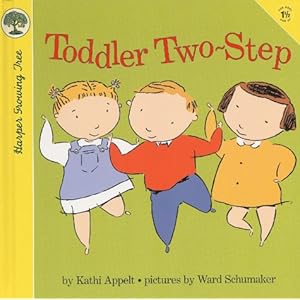
Toddler Two-Step is a counting book designed for 1-2 year olds in every possible way. Appelt's jaunty poem guides young counters from 1-10 and then back down from 10-1 as Schumaker's round, balloon-shaped toddlers (and one very unsure cat) dance and move to the poem's predictable rhythm. The text is simple and straightforward ("Three, four, clippity-clop. Cross the floor, hippity-hop"), providing instructions for a literal toddler two-step, while the illustrations fill in the movements that the text leaves out. The rhythm and action ramp up energetically all the way to 10, which arrives with a conga line and a huge JUMP. But from there, Appelt gradually slows things back down for 10-1, organically bringing the reader back to a (relatively) calm, cool stop. Schumaker mirrors the rise and fall in energy as his toddlers spin, circle, bounce and sway until they return to the same positions they were in when the book began, a clever way to bring the reader full-circle along with the numbers at the center of the action. The reader is left with a kinetic sense of 1-10 and 10-1, both numerically and as a pair of related number series that mirror the rise and fall of dance's energy. It's a clever conceit and one that is very well executed. Great for toddler storytimes as either a story or as an interstitial activity, Toddler Two-Step packs an unexpected punch for a counting book, (and parents will no doubt appreciate the exhaustion that will no doubt follow a really good reading).

April 17, 2012

Hop on Pop

Hop on Pop
By Dr. Seuss; illus. by author
http://www.seussville.com/
0-4 Preschool Primary Random House 72 pp.
978-0394800295 Hardcover $8.99
Fiction

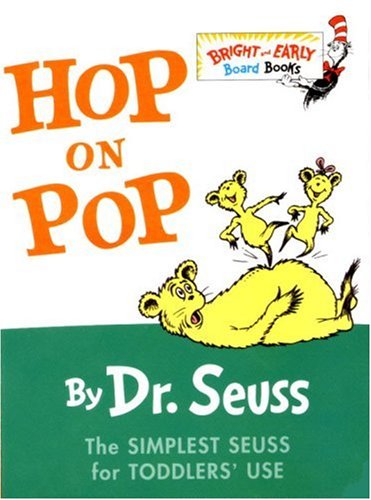
Hop on Pop has been a perennial favorite since it bounced onto the scene in 1963. Dr. Seuss designed it to be a reading primer, combining word recognition and simple phonics in such a way that would be suitable for the very youngest of children just learning to read. True though it is, it all sounds very dry when it's put that way. But Hop on Pop, in typical Seuss fashion, is anything but dry. AS with most of Dr. Seuss's impressive body of work, he takes simple, monosyllabic rhymes and gives them a goose with a good dose of silliness. Who else but Dr. Seuss would think to say, "Three Tree. Three fish in a tree. Fish in a tree? How can that be?" and combine it with an illustration of three fat, self-satisfied fish lounging in the billowy foliage of an orange tree while two yellow puppy-rabbit-Seuss-people look on scratching their heads? But while the silliness, on one hand, is just plain good fun, it serves a second purpose. Just as in Fox in Socks, Green Eggs and Ham and other Seuss classics for slightly older readers, the whimsey and nonsense in Hop on Pop makes reading fun. So while toddlers and preschoolers (and even pre-verbal babies whose loved-ones read the book to them) are being exposed to concepts that help develop and support literacy, they are learning an even more important lesson - that reading is not boring. It is not scary, (at least, it doesn't have to be). In fact, reading, as Dr. Seuss sells it, can be the wildest form of fun, which makes Hop on Pop the perfect "Seuss for Toddler's Use".

April 16, 2012

Hand, Hand, Fingers, Thumb

Hand, Hand, Fingers, Thumb
By Al Perkins; illus. by Eric Gurney
No Author / Illustrator Site
0-4 Preschool Random House 28 pp.
978-0394810768 Hardcover $8.99
Fiction

Though sparse on story, (one monkey and a drum becomes a profusion of drumming, humming, strumming monkeys), Hand, Hand, Fingers, Thumb is full of fun and nonsense, even as it teaches toddlers and preschoolers lessons in anatomy, rhythm, language and numbers. Perkins employs a syncopated beat throughout the text, (Dum ditty Dum ditty Dum dum dum), driving the silliness forward until "millions of fingers!" and "millions of thumbs!" and "millions of monkeys" are "drumming on drums!" Gurney's monkeys are a wiley bunch, hairy and bent on having a noisy good time, a quality that has made them an instant hit with generations of preschoolers. Hand, Hand, Fingers, Thumb is unquestionably well-suited for library and school storytimes being a natural candidate for felt boards and art projects. The book's hallmark is the exuberance with which it introduces educational concepts (everything from numbers to colors make an appearance without cluttering the conceit). Even better, it's a fantastic way to get wiley little monkeys moving, involved and having fun with a book.

What Sadie Sang

What Sadie Sang
By Eve Rice; illus. by author
No Author Site
1-4 Preschool Greenwillow 32 pp.
978-0688021795 Hardcover $9.50
Fiction

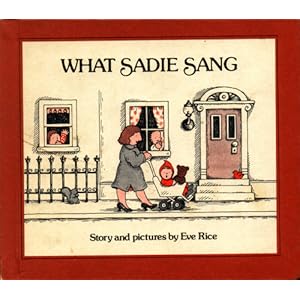
What Sadie Sang is neither visually stunning nor conceptually flashy, which is why it endures so quietly as a lovely, if mostly forgotten, little book. The story is a simple one. Sadie and her mom go for their daily walk with Sadie's teddy bear and her stroller. ("Sadie could walk all by herself. But today, she did not want to walk"). As they go, the stroller wheels go "click, click, click" and Sadie sings "Gheee!" with the exuberance particular to the vocal, yet pre-verbal toddler. Neighbors and storekeepers voice concern that Sadie is crying or in distress because of the noises she's making, but Sadie's mom knows better - her mom knows that she's singing.  Sadie sings her song down the street, past tulips and dogs to the harbor and back again as she and her mom take their walk. She even sings all the way up to bed for naptime. Sadie's song finally ends when she falls asleep.

The story is one of quiet, intimate routine, comforting in its everyday-ness. One gets the sense that Sadie and her mom have done this every day since Sadie was a baby, (walk then nap), a familiar routine for many children. Rice's prose is direct and specific, focusing on particular details in the neighborhood as Sadie might observe them (the "red, red fire hydrant" and the "scratching shaggy dog"). She also employs onomatopoeia judiciously with Sadie's "Ghee, ghee, ghee!" and various neighborhood noises. The illustrations are likewise understated and pleasing with their friendly, round-faced people and select color palette, (the pictures are all black and white ink with shades of orangey-red, gray, pink and brown filling the world in). The result is a safe, warm environment, alive with mundane action and friendly people, one that Sadie and her mom occupy like natives they are. What Sadie Sang may not be glamorous by today's standards, but it's oddly comforting - the picture book version of the teddy bear Sadie carries or the baby song she sings.

April 2, 2012

I Kissed the Baby!

I Kissed the Baby!
By Mary Murphy; illus. by author
No Author Site
0-2 Preschool Candlewick 24 pp.
978-0763621223 Hardcover $12.99
Fiction

"I saw the baby! Did you see the baby?"

With that we enter I Kissed the Baby!, Mary Murphy's enthusiastic rendering of the excitement surrounding a new arrival. The black and white graphic illustrations are big and easy for young eyes to see. The text bounces enthusiastically around each animal as they ask each other if they've seen the baby, or sung to the baby or kissed the baby. Murphy uses color sparingly, with colors like magenta and orange appearing only at one edge of each page until the new arrival appears - a little yellow duckling smiling up at his mama. When asked by the mouse if she's kissed the baby, the mama duck replies that she has kissed the baby, her own "amazing baby" and that she's "going to do it again!", which she does, sending the duckling into a flurry of happy quacking.

Murphy's sing-song text builds rhythmically to the end, mimicking the black and white illustrations that explode suddenly with pinks and yellows when the mama duck kisses her baby, thus revealing the identity of the new arrival. It's a charming story, one that lends itself to lap reads with a new human baby as it provides plenty of rhythm, visual stimulation and opportunities for kisses along the way. I Kissed the Baby! is also a nice way to engender enthusiasm in a reluctant older sibling or include an already enthusiastic new big brother or sister in the celebratory mood. A good read for an important time, I Kissed the Baby! is a rollicking way to celebrate any new baby, duckling or otherwise.

Hello, Peter!

Hello, Peter!
By Beatrix Potter; illus by author
http://www.peterrabbit.com/en
0-2 Puffin 12 pp.
978-0723267171 Board Book $5.99
Fiction

Though authorial credit is rightfully given to Beatrix Potter, the original creator of Peter Rabbit, Jemima Puddleduck and the Flopsy Bunnies among many others, Hello Peter! is not, strictly speaking, one of her original stories. Rather, the editors at Puffin have taken a handful of Potter's original illustrations for The Tale of Peter Rabbit and paired them with a highly simplified, rhyming text ("Peter hops and hops. Peter hides in a flowerpot. Peter loves to jump and play. Peter's had a busy day..."). The result is a surprisingly charming board book that introduces babies and very young toddlers to Peter Rabbit and his propensity for mischief.

Beatrix Potter's The Tale of Peter Rabbit is universally recognized as a classic in children's literature. However, it contains elements that render it better for slightly older children. The prose, though hardly archaic, is denser than that commonly used in picture books for pre-readers. In addition, some occurrences (Peter's father getting baked in a pie; Farmer MacGregor chasing Peter with a rake) could frighten little ones. Hello, Peter! by-passes these elements by focusing on Peter's romp through the vegetable patch, ending with him "safe at home, warm and snug" in his mother's arms without having experienced the chase that required chamomile tea to mend. Because of this, Hello, Peter! is not a fraction of the story that Potter's original is. That said, it's an admirable introduction to the original. Babies and toddlers familiar with Peter Rabbit from this very short board book will likely enjoy The Tale of Peter Rabbit even more when they are older, having already become attached to the story's famous protagonist.

With its puffy, board book cover, over-sized illustrations and simple, rhyming text, Hello, Peter! is, in every way, designed for babies and toddlers. While purists will likely find the results heretical, parents and care-givers will find much good to be had from this baby-friendly appropriation. Beatrix Potter wanted her books to be little, so as to fit in little hands. Given this, and given her sympathy for the very young, it may be safe to assume that the venerable author herself would not object to her creation being adapted for the very youngest of them all.

In My Nest

In My Nest
By Sara Gillingham
http://saragillingham.com/
Illustrated by Lorena Siminovich
http://www.lorenasiminovich.com/
0-3 Chronicle Books 12 pp.
978-0811865555 Board Book $8.99
Fiction / Concept Book

With In My Nest, Sara Gillingham takes a classic conceit - the finger puppet book - and renders it surprisingly fresh. The simple story begins on the cover, with the finger puppet blue bird nestled inside it's multilayered, die-cut nest. Upon opening the cover, we see that there are layers of sticks and "curly twigs" in the nest, which the little bird tells us in the first-person text. The next page turn brings us closer to the bird, now sitting in a layer of "soft, warm feathers," while on the next page shows the little bird sitting amid a layer of green leaves and mud "to help stick things together". With all the layers thus examined, the focus widens. On the next page we see the whole nest tucked into the branches of a tree with the little bird inside ("and there is me! I am cozy in my nest...") Finally, we turn the page and see the little bird snuggled into his nest with his family.

Siminovich's illustrations give the book a naive, collage effect, one that emphasizes the organic feeling of the die-cut openings that the little bird passes through with each page turn. Leaves, caterpillars, twigs and feathers occupy each page in softly gradated shades of brown and green so that the little blue puppet integrates with each picture even as it naturally stands out. The puppet itself has a quilted, folk art quality that adds to the book's coziness, while the entire thing - puppet included - is constructed with little ones in mind. The heavy cardboard pages are obviously meant to stand up to a great deal of chewing, gumming and thumping, while no amount of pulling can dislodge the little bird from its nest.

In My Nest is a lovely little book that will fascinate babies and toddlers and even appeal to very young preschoolers who can read the words and manipulate the puppet themselves. Themes of home, family and nature overlay the simple story, while straightforward facts about what literally goes into making a nest give the little bird its charming, informational context. A great edition to Gillingham's series, which includes In My Pond and In My Tree, In My Nest balances aesthetics, story-telling and information-giving with visual elegance and a spare text, making it a pleasure both for kids, and the parents that will read it to them.

March 26, 2012

Olivia Counts

Olivia Counts
By Ian Falconer; illus. by author
http://www.oliviathepiglet.com/
1-4 Preschool Atheneum 12 pp.
978-0689850875 Board Book $6.99
Non-Fiction

Olivia, Ian Falconer's precocious, porcine heroine, returns, this time in Olivia Counts, an appropriately charming foray into the world of 1-10. Unfortunately, Falconer's trademark Olivia palette, with its blacks, whites and grays punctuated by tomatoey red, makes the counted items difficult to individuate, and therefore hard to count.

The book starts off well, with 1 beach ball dominating the page and a nearly overwhelmed Olivia peeking out from behind it. 2 big red bows at the tips Olivia's ears are similarly easy to see and account for. But the 3 pots of paint (one red, one black and one gray) are small and almost incidental with Olivia and her brush occupying the majority of the white background. Similarly, Olivia's 4 aunts, rendered in smudgy gray and white are oddly hard to differentiate and therefore hard to count. The rest of the items pass in a similar style, with 5 books stacked narrowly atop each other, 7 accessories scattered haphazardly across the page and 10 highly active Olivia's detracting from each other with their kinetic exuberance.

Fans of Olivia already familiar with Falconer's style will love Olivia Counts. While the slight muddiness of the visuals would not necessarily be a problem for a preschooler who already knows her numbers, it could prove distracting or even discouraging for a toddler just learning to count. For this reason, I would say that Olivia Counts is a solid choice for existing fans, but for those who have yet to meet Olivia or develop some familiarity with numbers, there are stronger introductions to counting and other Olivia adventures to explore first.

March 23, 2012

Baby! Baby!

Baby! Baby!
By Vicky Ceelen; photos by author
No Author Site
0-2 Random House 24 pp.
978-0-375-84207-8 Board Book $6.99
Non-Fiction

It's often said that babies love to look at other at babies. Put any 8 month old in front of a mirror and the giggling, waving smile-fest that results will prove this saying true. Because of this, publishers have put out a lot of baby-picture board books - so many, in fact, that there is probably one for every parent's and every baby's preference. The sheer glut can make it difficult for an individual title to stand out, which is why Baby! Baby! is such a lovely contribution to a crowded field.

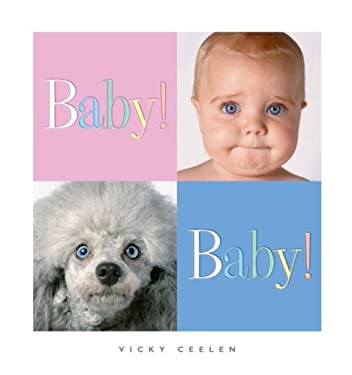
Though the title is slightly misleading, Vicky Ceelen's book features well-chosen animal / baby pairings, some of which are fairly uncanny (the baby / lion cub pairing and the baby / rabbit pairing especially stand out). There are no words and no labels. The pictures stand on their own, with the baby occupying one page and the animal occupying the page opposite. While it's tempting to wish that the animals were labeled or identified, (there's a nameless marsupial that I'm particularly curious about), the wordless quality of the book works in it's favor. The pictures stand out boldly on bright, single-color backgrounds without words competing for the focus of young, baby eyes. As they grow, toddlers can then enjoy flipping through the familiar pages to name the animals on their own.

Unlike a lot of "baby" books, Baby! Baby! grows with a child. It might start out as a simple way for a baby to engage other baby faces, but it becomes a great introduction to animals, colors, shapes and similarities. Though not all of the animals pictured are babies, the concept holds together strongly enough that it doesn't really matter. An altogether good little book that attends to multiple areas of early development while appealing to little ones from baby to toddler-hood.

March 19, 2012

Moo, Baa, La La La!

Moo, Baa, La, La, La!
By Sandra Boynton; illus. by author
www.sandraboynton.com
0-4 Little Simon 14 pp.
978-0671449018 Board Book $5.99
Non-Fiction

Beneath the exuberant silliness of Moo, Baa, La, La!, ("A cow says MOO. A sheep says BAA. Three singing pigs say LA LA LA!"), there are important lessons at work.

Boynton, whose board books have combined concept introduction and good, plain fun for decades, has a light hand and an expert's sense of her audience. She sets up her concept - in this case the sounds that animals make - in facts that are straightforward and known. A cow does say "moo", a sheep does say "baa". Then she hits the reader with a goofy zinger, in this case, the "three singing pigs" and their "la, la, la", all the while employing natural, super-pleasing rhythm that appeals to a child's sense of play. But it doesn't end there. Boynton credits her young reader with the knowledge to recognize that what she's told them is wrong, ("No, no, you say. That isn't right. The pigs say OINK all day and night"). Then, with her young audience fully invested and sitting up in their moms' laps, she writes about rhinos "snuffing" and little dogs "ruffing" and other quirky choices set to an impeccably timed rhythm that rolls along to the end where she again addresses her audience with "It's quiet now. What do you say?" thereby inviting the reader to go ahead and make his own noises too.

Moo, Baa, La La La!, with its classic Boynton animals looking bored and mischievous by turns, is masterful in it's simplicity. Over the course of 14 easy pages, Boynton introduces animals sounds, real versus make-believe, vocabulary and rhyme while effortlessly drawing her reading into the silliness and fun. It's the kind of book that is a pleasure to read and to hear, the kind that works educational magic under the radar, one that might even contribute to a family's lexicon of inside jokes. Incredible - seriously silly fun.

March 8, 2012

More, More, More Said the Baby

More, More, More Said the Baby: Three Love Stories
By Vera B. Williams; illus. by author
No Author Site
0-4 Preschool Greenwillow 32 pp.
978-0688091736 Hardcover $17.99
Fiction

More, More, More Said the Baby is as joyful a book as the title suggests, and the subtitle, 3 Love Stories, couldn't be more accurate. Williams, who won the Caldecott Honor for her effort, offers babies (and toddlers) and their grown-ups an exuberant celebration of love, play and happiness. More, More, More Said the Baby is effortlessly multigenerational and multicultural. The first "baby", Little Guy, and his daddy are white, the second "baby", Little Pumpkin, is African-American while her grandma is white, and the third "baby", Little Bird, and her mom are Asian-American. Williams makes no effort to point out the differences or similarities in each pair. She simply presents each short narrative in warm, colloquial language ("But Little Guy's Daddy catches that baby up all right") and expertly rhythmic prose ("Just look at you with your ten little toes right on the ends, right on the ends, right on the ends of your two little feet, good enough to eat"), underscoring the universality of the love expressed by each couple. The language can only be described as bubbly, almost leaping off the page in rainbow colors. It's not only fun to read, but it's wonderful hear read aloud. Little ones will be especially taken in by the effortless repetition of sounds, words and patterns in each narrative. Williams illustrations, though expertly rendered, have a spontaneous, active quality to them with wide brush-strokes and bold colors, that further supports the playfulness of the text. While this would be a good book for toddler storytimes, the real strength of More, More, More Said the Baby is the affection and love it unlocks between a baby and her grown-up, making it an especially great read for intimate storytimes at home. I can already hear the giggles of parents and babies playing and snuggling, inspired by the down-to-earth sweetness of Williams' work.

March 7, 2012

Eric Carle Animal Flash Cards

Eric Carle Animal Flash Cards
By Eric Carle; illus. by author
http://www.eric-carle.com/home.html
0-3 Chronicle 26 cards
978-0811852562 Flash Cards $14.95
Non-Fiction


These flash cards are designed to teach toddlers their ABC’s. Though they could be used by children as young as one for shape and color recognition, they are really meant for older toddlers and young pre-schoolers about 2-3 years in age. The cards are incredibly sturdy – thicker than a board book’s pages – making them perfectly able to stand up to less than gentle handling. They are also quite large, 5.5 x 7 inches, which is huge by flash card standards. This makes the colors, letters and illustrations very easy to see while giving the cards more of the feel of a game than a learning tool. With a bright letter on one side and one of Carle’s animals on the other (a hippo, a monkey and a very familiar caterpillar to name a few), there is a lot for toddlers to see and absorb without overwhelming the senses. The cards even help support motor skill development as kids learn to take them out of their sturdy box and put them back in. An all-around excellent learning tool that makes it fun and easy for parents to introduce their little ones to the alphabet while sharing a good time.