The Princess and the Pea
By Hans Christian Anderson
Illustrated by Dorothee Duntze
No Author Site
No Illustrator Site
3-4 Preschool North-South Books 22 pp.
1-55858-034-4 Hardcover $16.99
Fiction
Though authorial credit is given to Hans Christian Anderson, who wrote his version of this tale in 1835, this picture book edition is clearly meant to showcase Dorothee Duntze's stylized, evocative illustrations. It is unclear how much of the text originates with Anderson or to whom the translation should be attributed, nor are there notes in any form contextualizing the tale. This is a shame given the fact of it's uncertain origins and enduring popularity as a fairy tale.
That said, the illustrations are gorgeous and full of intriguing detail (the double page spreads of servants searching the garden for a pea, and the triumphant garden wedding, replete with parrots and medieval pageantry, especially stand-out). The prose, though slightly awkward at times (certain phrases, such as "real princess" and "old queen" are repeated several times in a single sentence) is casual and brief. The story moves briskly along, with ample illustrations to keep the eyes of older toddlers and preschoolers happily engaged. There are even touches of absurd humor as Duntze depicts the princess getting a boost from a servant and then climbing a ladder the rest of the way up the top of the bed, which is twenty mattresses high. The casual tone, established by the conversational narrative voice ("The pea was put in a glass case and is there still unless someone has carried it off. So you see, this is a true story!"), is naturally engaging while the brevity of the story itself won't tax the attention span of young readers and listeners.
All in all, the text is so accessible and Duntze's illustrations such a pleasure to look at, that this edition of The Princess and the Pea is a lovely introduction to both this story and to fairy tales in general. A good choice for small group story times, it would be even better enjoyed at home, where the softly detailed images can be more easily seen and engaged.
March 16, 2012
March 14, 2012
The Queen of France
The Queen of France
By Tim Wadham
No Author Site
Illus. by Kady MacDonald Denton http://www.kadymacdonalddenton.ca
3-4 Preschool Primary Candlewick 32 pp.
978-0763641023 Hardcover $16.99
Fiction
One morning Rose wakes up feeling royal, so she opens the make-believe basket and becomes the Queen of France. What follows is a series of interactions between Rose / The Queen of France and Rose's mother and father, neither of whom question their daughter's self-proclaimed "royal" identity while still asserting their love for her.
Wadham's story is patterned without being trite, (Rose changes into the Queen of France twice, not the traditional set of three, while her transformations are bisected by Rose deciding, on her own, to tidy up her room), and purposeful without being ham-fisted (Rose wears her new identity as long as it pleases her, and stops when she wants to stop). Unlike many picture books, The Queen of France, contains no central conflict and the lesson, if it can be called that, is the reinforcement of the pre-existing closeness between Rose and her parents. In fact, what makes The Queen of France so good is its straightforward lack of drama. Rose never doubts that her mother and father love her. That fact is made reassuringly clear throughout. She is a remarkably self-possessed protagonist, playing make-believe with fantastic flair (she goes in search of the Royal Physician when, as the Queen of France, she scratches her finger) while staying remarkably grounded (when the Royal Physician proves elusive, she takes off her Queen clothes and put two band-aids on herself). When Rose's Mother tells the Queen that she would miss Rose if they were to change places, it comes not as a revelation to Rose, but as a reassuring given that nevertheless has Rose abandoning her royal identity in order to have dinner with her parents.
Kady MacDonald Denton, best known for illustrating Bonny Becker's Bear and Mouse stories, supports Wadham's warm, straightforward text, with warm straightforward illustrations. The watercolor images reflect the same blend of fancy and practicality that Rose herself has. The Queen of France is a charming read, with text and pictures working in subtle conjunction. Best of all, it has enough depth to be read in a number of ways, and enough respect for its young reader to let her choose.
By Tim Wadham
No Author Site
Illus. by Kady MacDonald Denton http://www.kadymacdonalddenton.ca
3-4 Preschool Primary Candlewick 32 pp.
978-0763641023 Hardcover $16.99
Fiction
One morning Rose wakes up feeling royal, so she opens the make-believe basket and becomes the Queen of France. What follows is a series of interactions between Rose / The Queen of France and Rose's mother and father, neither of whom question their daughter's self-proclaimed "royal" identity while still asserting their love for her.
Wadham's story is patterned without being trite, (Rose changes into the Queen of France twice, not the traditional set of three, while her transformations are bisected by Rose deciding, on her own, to tidy up her room), and purposeful without being ham-fisted (Rose wears her new identity as long as it pleases her, and stops when she wants to stop). Unlike many picture books, The Queen of France, contains no central conflict and the lesson, if it can be called that, is the reinforcement of the pre-existing closeness between Rose and her parents. In fact, what makes The Queen of France so good is its straightforward lack of drama. Rose never doubts that her mother and father love her. That fact is made reassuringly clear throughout. She is a remarkably self-possessed protagonist, playing make-believe with fantastic flair (she goes in search of the Royal Physician when, as the Queen of France, she scratches her finger) while staying remarkably grounded (when the Royal Physician proves elusive, she takes off her Queen clothes and put two band-aids on herself). When Rose's Mother tells the Queen that she would miss Rose if they were to change places, it comes not as a revelation to Rose, but as a reassuring given that nevertheless has Rose abandoning her royal identity in order to have dinner with her parents.
Kady MacDonald Denton, best known for illustrating Bonny Becker's Bear and Mouse stories, supports Wadham's warm, straightforward text, with warm straightforward illustrations. The watercolor images reflect the same blend of fancy and practicality that Rose herself has. The Queen of France is a charming read, with text and pictures working in subtle conjunction. Best of all, it has enough depth to be read in a number of ways, and enough respect for its young reader to let her choose.
March 9, 2012
Jackhammer Sam
Jackhammer Sam
By Peter Mandel
http://www.author-illustr-source.com/petermandel.html
Illus. by David Catrow
www.catrow.com
3-4 Preschool Primary Roaring Brook 40 pp.
978-1596430341 Hardcover $16.99
Fiction
ATTA-RATTA-TATTA-BAM. D'ya know who I am?
With that, we are introduced to Jackhammer Sam, the larger than life, noisier than New York, protagonist of Peter Mandel's sixth picture book. Jackhammer Sam is a rowdy, chaotic book, with a casual rhyming text ("Th' name's Jackhammer Sam. Yeah, that's the man I am") and illustrations that offer an almost uncanny portal into the rattle and din of a New York City construction site. Mandel employs onomatopoeia with vigorous enthusiasm ("SLIP-SLAP-SLOP...RRRIP-DRIP-DROp...KREEK-KER-PLOP") making this a terrific read-a-loud for preschoolers, and though he sometimes loses track of his rhythm, it can be forgiven as he sweeps the reader along on this rackety ride.
The first half of Jackhammer Sam is quite a strong as Sam takes the reader through Manhattan, blasting away at sidewalks and leaning on his jackhammer with his magnificent belly. Mandel loses some control over his material in the second half as Sam takes the reader out to sea and even to space jackhammering until he "drains the Milky Way," but then it's back to earth where Sam takes a bow at the end of his "song".
The text and illustrations are dynamic and fun and will no doubt be a hit with preschool age boys (and potentially less princess-oriented girls), but the book would be stronger overall if it were slightly shorter. Still, Jackhammer Sam is fun and dynamic. It's a good book for introducing onomatopoeia and sound-play, and a great way to coax reluctant readers (especially boys) into engaging a written text.
By Peter Mandel
http://www.author-illustr-source.com/petermandel.html
Illus. by David Catrow
www.catrow.com
3-4 Preschool Primary Roaring Brook 40 pp.
978-1596430341 Hardcover $16.99
Fiction
ATTA-RATTA-TATTA-BAM. D'ya know who I am?
With that, we are introduced to Jackhammer Sam, the larger than life, noisier than New York, protagonist of Peter Mandel's sixth picture book. Jackhammer Sam is a rowdy, chaotic book, with a casual rhyming text ("Th' name's Jackhammer Sam. Yeah, that's the man I am") and illustrations that offer an almost uncanny portal into the rattle and din of a New York City construction site. Mandel employs onomatopoeia with vigorous enthusiasm ("SLIP-SLAP-SLOP...RRRIP-DRIP-DROp...KREEK-KER-PLOP") making this a terrific read-a-loud for preschoolers, and though he sometimes loses track of his rhythm, it can be forgiven as he sweeps the reader along on this rackety ride.
The first half of Jackhammer Sam is quite a strong as Sam takes the reader through Manhattan, blasting away at sidewalks and leaning on his jackhammer with his magnificent belly. Mandel loses some control over his material in the second half as Sam takes the reader out to sea and even to space jackhammering until he "drains the Milky Way," but then it's back to earth where Sam takes a bow at the end of his "song".
The text and illustrations are dynamic and fun and will no doubt be a hit with preschool age boys (and potentially less princess-oriented girls), but the book would be stronger overall if it were slightly shorter. Still, Jackhammer Sam is fun and dynamic. It's a good book for introducing onomatopoeia and sound-play, and a great way to coax reluctant readers (especially boys) into engaging a written text.
March 8, 2012
More, More, More Said the Baby
More, More, More Said the Baby: Three Love Stories
By Vera B. Williams; illus. by author
No Author Site
0-4 Preschool Greenwillow 32 pp.
978-0688091736 Hardcover $17.99
Fiction
More, More, More Said the Baby is as joyful a book as the title suggests, and the subtitle, 3 Love Stories, couldn't be more accurate. Williams, who won the Caldecott Honor for her effort, offers babies (and toddlers) and their grown-ups an exuberant celebration of love, play and happiness. More, More, More Said the Baby is effortlessly multigenerational and multicultural. The first "baby", Little Guy, and his daddy are white, the second "baby", Little Pumpkin, is African-American while her grandma is white, and the third "baby", Little Bird, and her mom are Asian-American. Williams makes no effort to point out the differences or similarities in each pair. She simply presents each short narrative in warm, colloquial language ("But Little Guy's Daddy catches that baby up all right") and expertly rhythmic prose ("Just look at you with your ten little toes right on the ends, right on the ends, right on the ends of your two little feet, good enough to eat"), underscoring the universality of the love expressed by each couple. The language can only be described as bubbly, almost leaping off the page in rainbow colors. It's not only fun to read, but it's wonderful hear read aloud. Little ones will be especially taken in by the effortless repetition of sounds, words and patterns in each narrative. Williams illustrations, though expertly rendered, have a spontaneous, active quality to them with wide brush-strokes and bold colors, that further supports the playfulness of the text. While this would be a good book for toddler storytimes, the real strength of More, More, More Said the Baby is the affection and love it unlocks between a baby and her grown-up, making it an especially great read for intimate storytimes at home. I can already hear the giggles of parents and babies playing and snuggling, inspired by the down-to-earth sweetness of Williams' work.
By Vera B. Williams; illus. by author
No Author Site
0-4 Preschool Greenwillow 32 pp.
978-0688091736 Hardcover $17.99
Fiction
More, More, More Said the Baby is as joyful a book as the title suggests, and the subtitle, 3 Love Stories, couldn't be more accurate. Williams, who won the Caldecott Honor for her effort, offers babies (and toddlers) and their grown-ups an exuberant celebration of love, play and happiness. More, More, More Said the Baby is effortlessly multigenerational and multicultural. The first "baby", Little Guy, and his daddy are white, the second "baby", Little Pumpkin, is African-American while her grandma is white, and the third "baby", Little Bird, and her mom are Asian-American. Williams makes no effort to point out the differences or similarities in each pair. She simply presents each short narrative in warm, colloquial language ("But Little Guy's Daddy catches that baby up all right") and expertly rhythmic prose ("Just look at you with your ten little toes right on the ends, right on the ends, right on the ends of your two little feet, good enough to eat"), underscoring the universality of the love expressed by each couple. The language can only be described as bubbly, almost leaping off the page in rainbow colors. It's not only fun to read, but it's wonderful hear read aloud. Little ones will be especially taken in by the effortless repetition of sounds, words and patterns in each narrative. Williams illustrations, though expertly rendered, have a spontaneous, active quality to them with wide brush-strokes and bold colors, that further supports the playfulness of the text. While this would be a good book for toddler storytimes, the real strength of More, More, More Said the Baby is the affection and love it unlocks between a baby and her grown-up, making it an especially great read for intimate storytimes at home. I can already hear the giggles of parents and babies playing and snuggling, inspired by the down-to-earth sweetness of Williams' work.
March 7, 2012
Resources & Recommendations: Early Literacy
Assignment 3
Storytime Standouts: Great Books and Resources for Childhood Literacy (http://www.storytimestandouts.com/)
This website, developed by educator Carolyn Hart, is dedicated to “raising children that love to read”. The site’s primary goal is to introduce children to a wide variety of books for every reading level while exploring the role books play in supporting early literacy. It has an impressive database of recommendations for books at all reading levels. The database can be browsed by theme, title, author etc. while the recommendations (from board books to chapter books) are made with early literacy in mind. Topics include everything from alphabet recognition to phonics, while themes include social issues such as bullying, multiculturalism and the environment. In addition to recommendations, the site also provides tips for caregivers and parents, as well as free “printables” on nursery rhymes, the alphabet and phonics, making it is a truly comprehensive source for parents and educators concerned with emergent literacy.
Zero to Three is a website run by the National Center for Infants, Toddlers and Families. Among the site’s copious tools and articles on everything from “Public Policy” to “Care and Education”, is a tab devoted to “Behavior and Development”. All parents have to do is click on the section entitled “Early Literacy and Language - Tips and Tools” under this tab to access a wealth of information on early literacy. Zero to Three provides free access to downloadable booklets and articles on getting a child ready to read, tips for choosing books for toddlers and infants, information on why reading to infants is critical for language acquisition and other related topics. Perhaps even more importantly, the site also provides parents with activities and links to even more resources. The site is geared primarily for parents at all levels of education and is both thorough and accessible. Though not as specialized a site as Storytime Standouts, Zero to Three makes the case for the importance of early literacy and provides parents and caregivers with basic tools to start their child on the path to reading.
The official Sesame Street website has so many resources, games and videos for kids and their parents that it almost makes it a one stop shop. Games, such as “In the Nick of Rhyme” with Super Grover, Murray Monster’s “Word on the Street” and Abby’s “Fairy Treasure Hunt” make letter recognition, vocabulary acquisition and word matching / site words fun and stress-free, while a nice collection of printable activity sheets make it possible for kids to practice their reading skills off-line as well as on. There is also a link for parents and teachers embedded in the PBS Kids site that takes adults to a site full of parent resources, tips and learning activities to do with their child or in the classroom. The Sesame Street website is not specialized – it covers everything from science and math to reading and everyday concerns, like starting pre-school or going to the doctor – but even though it does not focus on early literacy to the exclusion of other skills, the array of reading readiness tools provided in the comforting context of the show and it’s characters makes it a truly valuable resource for kids and their parents.
Storytime Standouts: Great Books and Resources for Childhood Literacy (http://www.storytimestandouts.com/)
This website, developed by educator Carolyn Hart, is dedicated to “raising children that love to read”. The site’s primary goal is to introduce children to a wide variety of books for every reading level while exploring the role books play in supporting early literacy. It has an impressive database of recommendations for books at all reading levels. The database can be browsed by theme, title, author etc. while the recommendations (from board books to chapter books) are made with early literacy in mind. Topics include everything from alphabet recognition to phonics, while themes include social issues such as bullying, multiculturalism and the environment. In addition to recommendations, the site also provides tips for caregivers and parents, as well as free “printables” on nursery rhymes, the alphabet and phonics, making it is a truly comprehensive source for parents and educators concerned with emergent literacy.
Zero To Three: Early Experiences Matter
(http://www.zerotothree.org/child-development/early-language-literacy/tips-tools-early-lit-and-lang.html)
Zero to Three is a website run by the National Center for Infants, Toddlers and Families. Among the site’s copious tools and articles on everything from “Public Policy” to “Care and Education”, is a tab devoted to “Behavior and Development”. All parents have to do is click on the section entitled “Early Literacy and Language - Tips and Tools” under this tab to access a wealth of information on early literacy. Zero to Three provides free access to downloadable booklets and articles on getting a child ready to read, tips for choosing books for toddlers and infants, information on why reading to infants is critical for language acquisition and other related topics. Perhaps even more importantly, the site also provides parents with activities and links to even more resources. The site is geared primarily for parents at all levels of education and is both thorough and accessible. Though not as specialized a site as Storytime Standouts, Zero to Three makes the case for the importance of early literacy and provides parents and caregivers with basic tools to start their child on the path to reading.
The Sesame Street Website
The official Sesame Street website has so many resources, games and videos for kids and their parents that it almost makes it a one stop shop. Games, such as “In the Nick of Rhyme” with Super Grover, Murray Monster’s “Word on the Street” and Abby’s “Fairy Treasure Hunt” make letter recognition, vocabulary acquisition and word matching / site words fun and stress-free, while a nice collection of printable activity sheets make it possible for kids to practice their reading skills off-line as well as on. There is also a link for parents and teachers embedded in the PBS Kids site that takes adults to a site full of parent resources, tips and learning activities to do with their child or in the classroom. The Sesame Street website is not specialized – it covers everything from science and math to reading and everyday concerns, like starting pre-school or going to the doctor – but even though it does not focus on early literacy to the exclusion of other skills, the array of reading readiness tools provided in the comforting context of the show and it’s characters makes it a truly valuable resource for kids and their parents.
Classic Nursery Rhymes sung by Susie Tallman and Friends
See Review dated March 1, 2012. Tag: assignment 3
Eric Carl Animal Flash Cards
See Review Dated March 7, 2012. Tag: assignment 3
Eric Carle Animal Flash Cards
By Eric Carle; illus. by author
http://www.eric-carle.com/home.html
0-3 Chronicle 26 cards
978-0811852562 Flash Cards $14.95
Non-Fiction
By Eric Carle; illus. by author
http://www.eric-carle.com/home.html
0-3 Chronicle 26 cards
978-0811852562 Flash Cards $14.95
Non-Fiction
These flash cards are designed to teach toddlers their ABC’s. Though they could be used by children as young as one for shape and color recognition, they are really meant for older toddlers and young pre-schoolers about 2-3 years in age. The cards are incredibly sturdy – thicker than a board book’s pages – making them perfectly able to stand up to less than gentle handling. They are also quite large, 5.5 x 7 inches, which is huge by flash card standards. This makes the colors, letters and illustrations very easy to see while giving the cards more of the feel of a game than a learning tool. With a bright letter on one side and one of Carle’s animals on the other (a hippo, a monkey and a very familiar caterpillar to name a few), there is a lot for toddlers to see and absorb without overwhelming the senses. The cards even help support motor skill development as kids learn to take them out of their sturdy box and put them back in. An all-around excellent learning tool that makes it fun and easy for parents to introduce their little ones to the alphabet while sharing a good time.
Labels:
assignment 3,
assignment 6,
infant/toddler,
non-book media
March 6, 2012
My First Taggies Book: I Love You
By Kaori Wantanabe; illus. by author
No Author Site
0-1 Cartwheel 6 pp.
978-0439649476 Ragbook $12.99
Non-Fiction
The text of this felted flannel ragbook is reassuring and warm - "I love Mommy / Mommy loves me / I love Daddy / Daddy loves me / I love you / You love me." The textured, stitched illustrations show a baby bear being cuddled and hugged by its mama and papa bear respectively. Everything about I Love You is tactile - the book is made out of the same soft, snuggly, (machine washable), material as baby blankets and pajamas, while Wantanabe's furry, satiny, cottony illustrations populate the flannel background with a homey inevitabilty, giving a baby lots to touch and feel. The great marketing feature of the Taggies books is the set of satin tags that line the outside edges, ostensibly giving the baby something to chew, though my daughter prefers the manufacturer's tag much more than it's charming counterparts. Still, I Love You is the friendliest of books, literally designed to cuddle, gum and hold, while providing parents with a simple, easy to memorize text that can be easily embellished to suit. While it might be boring to a child over one, it is a perfectly designed friend for infants and pre-walkers. As a first introduction to books, I Love You gives babies a chance to explore different textures and colors while learning to "turn" the fat cloth pages and browse the contents, all while hearing the most comforting words - that "Mommy (and Daddy) loves me".
By Kaori Wantanabe; illus. by author
No Author Site
0-1 Cartwheel 6 pp.
978-0439649476 Ragbook $12.99
Non-Fiction
The text of this felted flannel ragbook is reassuring and warm - "I love Mommy / Mommy loves me / I love Daddy / Daddy loves me / I love you / You love me." The textured, stitched illustrations show a baby bear being cuddled and hugged by its mama and papa bear respectively. Everything about I Love You is tactile - the book is made out of the same soft, snuggly, (machine washable), material as baby blankets and pajamas, while Wantanabe's furry, satiny, cottony illustrations populate the flannel background with a homey inevitabilty, giving a baby lots to touch and feel. The great marketing feature of the Taggies books is the set of satin tags that line the outside edges, ostensibly giving the baby something to chew, though my daughter prefers the manufacturer's tag much more than it's charming counterparts. Still, I Love You is the friendliest of books, literally designed to cuddle, gum and hold, while providing parents with a simple, easy to memorize text that can be easily embellished to suit. While it might be boring to a child over one, it is a perfectly designed friend for infants and pre-walkers. As a first introduction to books, I Love You gives babies a chance to explore different textures and colors while learning to "turn" the fat cloth pages and browse the contents, all while hearing the most comforting words - that "Mommy (and Daddy) loves me".
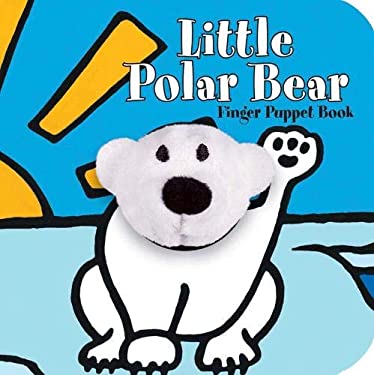
Little Polar Bear: Finger Puppet Book
By Image Books Factory; illus. by Klaartje van der Put
http://www.imagebooks.nl/
No Illustrator Site
0-2 Chronicle Books 12 pp.
978-0811869744 Board $6.99
Fiction
There is an impressive amount of content in this small, simply illustrated package. The authors combine an interactive story, complete with narrative arc, (a baby polar bear can't find the other bears until he realizes something important), with a handful of polar bear facts. The result not only works, it is completely engaging. Even the polar bear's protruding puppet head doesn't distract from the illustrations or the text. In fact, it gives young readers (like, in the interest of full disclosure, my seven month old daughter) something to chew on while the pages turn and the story is read.
Everything about Little Polar Bear is designed for the exceptionally young. The pages are fat and sturdy, even by board book standards, while the book itself is small - roughly four inches square - making it easy for babies to manipulate the pages. Van der Put's illustrations keep the action clear without extraneous detail, while making it seem natural that the Little Polar Bear sits in same spot for the whole book (he has too - his puppet head is affixed to the back so he can't wander about). The rhyming text is engaging ("Polar Bear sees lots of snow. Where did the other polar bears go?") and simple enough to recognize after just a few reads, making the story easy to anticipate and follow phonetically, even for the pre-verbal. The ending is playful and satisfying, with another polar bear tossing a snowball to Little Polar bear, as if to say "Silly bear, don't you know? Polar bears are white as snow!" The end result is a board book with a pleasing rhyming text and illustrations that combines polar bear facts with narrative progression and makes my daughter smile the second I pull it out.
(The Little Polar Bear is part of a finger puppet series that also includes The Little Mouse, The Little Lion, The Little Dino, and The Little Bat among others).
By Image Books Factory; illus. by Klaartje van der Put
http://www.imagebooks.nl/
No Illustrator Site
0-2 Chronicle Books 12 pp.
978-0811869744 Board $6.99
Fiction
There is an impressive amount of content in this small, simply illustrated package. The authors combine an interactive story, complete with narrative arc, (a baby polar bear can't find the other bears until he realizes something important), with a handful of polar bear facts. The result not only works, it is completely engaging. Even the polar bear's protruding puppet head doesn't distract from the illustrations or the text. In fact, it gives young readers (like, in the interest of full disclosure, my seven month old daughter) something to chew on while the pages turn and the story is read.
Everything about Little Polar Bear is designed for the exceptionally young. The pages are fat and sturdy, even by board book standards, while the book itself is small - roughly four inches square - making it easy for babies to manipulate the pages. Van der Put's illustrations keep the action clear without extraneous detail, while making it seem natural that the Little Polar Bear sits in same spot for the whole book (he has too - his puppet head is affixed to the back so he can't wander about). The rhyming text is engaging ("Polar Bear sees lots of snow. Where did the other polar bears go?") and simple enough to recognize after just a few reads, making the story easy to anticipate and follow phonetically, even for the pre-verbal. The ending is playful and satisfying, with another polar bear tossing a snowball to Little Polar bear, as if to say "Silly bear, don't you know? Polar bears are white as snow!" The end result is a board book with a pleasing rhyming text and illustrations that combines polar bear facts with narrative progression and makes my daughter smile the second I pull it out.
(The Little Polar Bear is part of a finger puppet series that also includes The Little Mouse, The Little Lion, The Little Dino, and The Little Bat among others).
March 2, 2012
Old Bear
Old Bear
By Kevin Henkes; illus. by author
http://www.kevinhenkes.com/
0-4 Preschool Primary Greenwillow 26 pp.
978-0-06-155205-2 Hardcover $17.99
Fiction
Old Bear begins on the cover, with the shaggy, sweet-faced protagonist walking though falling autumn leaves and the first sprinklings of snow. Right away, we know that winter must be coming, and we can guess where this bear is heading. He continues his walk on the copyright page and then on to the dedication page so that by the time we reach the first official page of the story, Old Bear is asleep in his den for the winter, and it is snowing hard. The effect is subtle and dynamic without sacrificing the coziness of Old Bear's hibernation. Soon, Henkes writes, "he was dreaming" and this gentle introduction to the seasons starts full swing. Old Bear dreams of spring and of himself as a cub, curled up asleep in a giant crocus (one of my favorite images in the entire book). The text and illustrations (even Bear's outline) in the spring spread are awash in pinks and greens and purples communicating the freshness and light of the season. He dreams of a summer where the sun is a giant daisy and a blueberry rain sprinkles the lush, green world. The autumn spread is red and we see a slightly older cub clinging to a tree next to a river full of orange and yellow fish. Winter returns in the next spread, icy blue and cold, but with a sky full of blazing stars and a light, lemony moon. The text mirrors the cyclical nature of the seasons ("Old Bear slept and dreamed, dreamed and slept"), saying just enough to support the illustrations. When Old Bear wakes up, it's spring again, (this time for real) and he walks out into with a lightness in his step.
Old Bear, which was named an ALA Notable Children's Book and a "Best Book" by School Library Journal among others works magic on several levels. For the youngest readers, it's a lovely introduction to seasons and colors, especially in the intimate setting of a parent-child storytime at home. For older kids, Old Bear provides a great opportunity to discuss cycles in nature and hibernation, while the text is simple enough for early sight readers to work through aided by Henkes's lucid illustrations. This would be an especially great book for preschool storytime, as Old Bear literally walks the reader into an exploration of the seasons. Lovely to look at and soothing to read, Old Bear has something for every cub and depth enough for the adults who read it with them.
By Kevin Henkes; illus. by author
http://www.kevinhenkes.com/
0-4 Preschool Primary Greenwillow 26 pp.
978-0-06-155205-2 Hardcover $17.99
Fiction
Old Bear begins on the cover, with the shaggy, sweet-faced protagonist walking though falling autumn leaves and the first sprinklings of snow. Right away, we know that winter must be coming, and we can guess where this bear is heading. He continues his walk on the copyright page and then on to the dedication page so that by the time we reach the first official page of the story, Old Bear is asleep in his den for the winter, and it is snowing hard. The effect is subtle and dynamic without sacrificing the coziness of Old Bear's hibernation. Soon, Henkes writes, "he was dreaming" and this gentle introduction to the seasons starts full swing. Old Bear dreams of spring and of himself as a cub, curled up asleep in a giant crocus (one of my favorite images in the entire book). The text and illustrations (even Bear's outline) in the spring spread are awash in pinks and greens and purples communicating the freshness and light of the season. He dreams of a summer where the sun is a giant daisy and a blueberry rain sprinkles the lush, green world. The autumn spread is red and we see a slightly older cub clinging to a tree next to a river full of orange and yellow fish. Winter returns in the next spread, icy blue and cold, but with a sky full of blazing stars and a light, lemony moon. The text mirrors the cyclical nature of the seasons ("Old Bear slept and dreamed, dreamed and slept"), saying just enough to support the illustrations. When Old Bear wakes up, it's spring again, (this time for real) and he walks out into with a lightness in his step.
Old Bear, which was named an ALA Notable Children's Book and a "Best Book" by School Library Journal among others works magic on several levels. For the youngest readers, it's a lovely introduction to seasons and colors, especially in the intimate setting of a parent-child storytime at home. For older kids, Old Bear provides a great opportunity to discuss cycles in nature and hibernation, while the text is simple enough for early sight readers to work through aided by Henkes's lucid illustrations. This would be an especially great book for preschool storytime, as Old Bear literally walks the reader into an exploration of the seasons. Lovely to look at and soothing to read, Old Bear has something for every cub and depth enough for the adults who read it with them.
March 1, 2012
Classic Nursery Rhymes
Sung by Susie Tallman and Friends
http://www.susietallman.com/
0-4, Preschool, Early Primary
Rock Me Baby Records $11.95
Audio CD
With Classic Nursery Rhymes (winner of the Oppenheim Toy Portfolio Platinum Award), Susie Tallman once again shows her dedication to making music for children that is dynamic, educational and joyfully fun. Each of the thirty seven tracks on the album is a different nursery rhyme. Some are old favorites imbued with new life as in the rap version of "Hickory Dickory Dock" or "The Itsy Bitsy Spider" done in a surprisingly authentic jazz-style. Other, lesser-known nursery rhymes, such as "Going to St. Ives" and "Lavender's Blue" are introduced with simple arrangements, a sensitive choice that allows Tallman's lovely vocals to stand on their own. Studies have shown that songs and nursery rhymes have a marked impact on a child's phonological awareness and, consequently, on her reading readiness and academic performance later in life. While listening to a CD cannot replace reading with a parent or loved one, Tallman's Classic Nursery Rhymes is a wonderful supplement. With content that is stylish enough to appeal to parents and silly enough to reel kids in, this is an incredibly well-balanced offering that cannot help but make nursery rhymes appeal to even the most distracted preschooler.
Sung by Susie Tallman and Friends
http://www.susietallman.com/
0-4, Preschool, Early Primary
Rock Me Baby Records $11.95
Audio CD
With Classic Nursery Rhymes (winner of the Oppenheim Toy Portfolio Platinum Award), Susie Tallman once again shows her dedication to making music for children that is dynamic, educational and joyfully fun. Each of the thirty seven tracks on the album is a different nursery rhyme. Some are old favorites imbued with new life as in the rap version of "Hickory Dickory Dock" or "The Itsy Bitsy Spider" done in a surprisingly authentic jazz-style. Other, lesser-known nursery rhymes, such as "Going to St. Ives" and "Lavender's Blue" are introduced with simple arrangements, a sensitive choice that allows Tallman's lovely vocals to stand on their own. Studies have shown that songs and nursery rhymes have a marked impact on a child's phonological awareness and, consequently, on her reading readiness and academic performance later in life. While listening to a CD cannot replace reading with a parent or loved one, Tallman's Classic Nursery Rhymes is a wonderful supplement. With content that is stylish enough to appeal to parents and silly enough to reel kids in, this is an incredibly well-balanced offering that cannot help but make nursery rhymes appeal to even the most distracted preschooler.
Labels:
assignment 3,
assignment 6,
award winner,
non-book media,
storytime
Subscribe to:
Posts (Atom)