Wynken, Blynken and Nod
By Eugene W. Field; illus. by David McPhail
No Author Site; No Illustrator Site
0-4 Preschool Scholastic 18 pp.
978-0439921442 Board Book $6.99
Poetry
Possibly one of the most reproduced children's poems of the 20th century, Eugene Field's lullaby poem, "Wynken, Blynken and Nod" has been animated, put to music and illustrated countless times since its publication in 1889. Why then the need for another edition, this time illustrated by children's book author and illustrator David McPhail? For the simple reason that the poem endures as a childhood favorite, passed down from parent to child through countless multigenerational bedtimes. McPhail's edition for Scholastic is simply a fresh version for the newest generation.
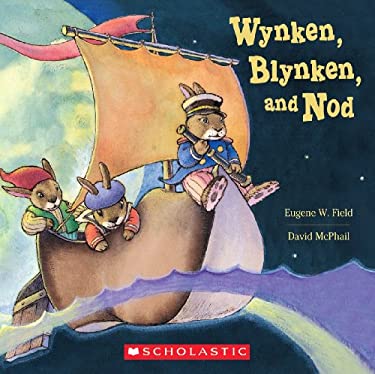
Wynken, Blynken and Nod tells the story of three fishermen who sail the night sky in a wooden shoe. In McPhail's illustrations, the fisherman are three bunnies dressed in sailor-clothes, an appropriately whimsical choice for this drowsy lullaby poem. On their journey, the fishermen meet the moon, who sings a song as they toss their nets into the sea of dew. Then it's back home to a modern little girl's bedroom, where it is revealed that "Wynken and Blyken are two little eyes, and Nod is a little head, and the wooden shoe that sailed the skies is a wee one's trundle bed." Then the fishermen upend a barrel of stars onto the girl's blanket, whereupon she promptly falls asleep with three pairs of rabbit ears peeking out from beneath her covers as the shoe sails back out the window to rendezvous with the moon.
McPhail's palette is dark and soothing, with lots of rich, deep blues and warm candle-lit yellows setting a drowsy visual tone. He makes the transition from the fanciful bunny fisherman to the modern girl's bedroom smoothly, making it seem plausible that the entire book had perhaps been the girl's dream - or perhaps not. This sweet ambiguity comes from McPhail's juxtaposition of images that are by turns timeless (the wooden shoe, the costumed bunnies) and modern (a little girl with short hair climbing into bed in her own room), a balance he strikes seamlessly and to good effect.
Despite McPhail's lovely work, Field's poem is still the heart of the book. He uses rhythm and rhyme to expertly mimic the feeling of drifting to sleep. Wisely, McPhail does not try to compete with this familiar and beloved text. Rather, he supports it with pictures that are consistent (the bunnies and shoe are in every page) without getting stale (he keeps things fresh by shifting visual perspectives and POV). The result is a lovely, understated edition of a poem that has been a favorite of generations. That this edition makes it possible to introduce a new generation to the poem (and in some cases, to poetry in general) feels like a dream - a very, very good one.
March 23, 2012
Baby! Baby!
Baby! Baby!
By Vicky Ceelen; photos by author
No Author Site
0-2 Random House 24 pp.
978-0-375-84207-8 Board Book $6.99
Non-Fiction
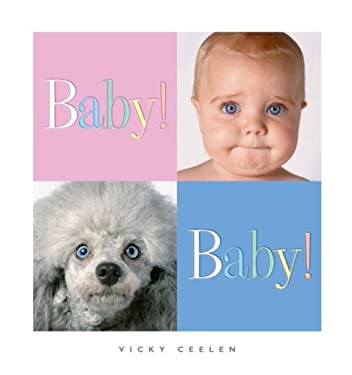
It's often said that babies love to look at other at babies. Put any 8 month old in front of a mirror and the giggling, waving smile-fest that results will prove this saying true. Because of this, publishers have put out a lot of baby-picture board books - so many, in fact, that there is probably one for every parent's and every baby's preference. The sheer glut can make it difficult for an individual title to stand out, which is why Baby! Baby! is such a lovely contribution to a crowded field.
Though the title is slightly misleading, Vicky Ceelen's book features well-chosen animal / baby pairings, some of which are fairly uncanny (the baby / lion cub pairing and the baby / rabbit pairing especially stand out). There are no words and no labels. The pictures stand on their own, with the baby occupying one page and the animal occupying the page opposite. While it's tempting to wish that the animals were labeled or identified, (there's a nameless marsupial that I'm particularly curious about), the wordless quality of the book works in it's favor. The pictures stand out boldly on bright, single-color backgrounds without words competing for the focus of young, baby eyes. As they grow, toddlers can then enjoy flipping through the familiar pages to name the animals on their own.
Unlike a lot of "baby" books, Baby! Baby! grows with a child. It might start out as a simple way for a baby to engage other baby faces, but it becomes a great introduction to animals, colors, shapes and similarities. Though not all of the animals pictured are babies, the concept holds together strongly enough that it doesn't really matter. An altogether good little book that attends to multiple areas of early development while appealing to little ones from baby to toddler-hood.
By Vicky Ceelen; photos by author
No Author Site
0-2 Random House 24 pp.
978-0-375-84207-8 Board Book $6.99
Non-Fiction
It's often said that babies love to look at other at babies. Put any 8 month old in front of a mirror and the giggling, waving smile-fest that results will prove this saying true. Because of this, publishers have put out a lot of baby-picture board books - so many, in fact, that there is probably one for every parent's and every baby's preference. The sheer glut can make it difficult for an individual title to stand out, which is why Baby! Baby! is such a lovely contribution to a crowded field.
Though the title is slightly misleading, Vicky Ceelen's book features well-chosen animal / baby pairings, some of which are fairly uncanny (the baby / lion cub pairing and the baby / rabbit pairing especially stand out). There are no words and no labels. The pictures stand on their own, with the baby occupying one page and the animal occupying the page opposite. While it's tempting to wish that the animals were labeled or identified, (there's a nameless marsupial that I'm particularly curious about), the wordless quality of the book works in it's favor. The pictures stand out boldly on bright, single-color backgrounds without words competing for the focus of young, baby eyes. As they grow, toddlers can then enjoy flipping through the familiar pages to name the animals on their own.
Unlike a lot of "baby" books, Baby! Baby! grows with a child. It might start out as a simple way for a baby to engage other baby faces, but it becomes a great introduction to animals, colors, shapes and similarities. Though not all of the animals pictured are babies, the concept holds together strongly enough that it doesn't really matter. An altogether good little book that attends to multiple areas of early development while appealing to little ones from baby to toddler-hood.
March 22, 2012
Grandfather and I
Grandfather and I
By Helen E. Buckley; illus. by Jan Ormerod
No Author Site; No Illustrator Site
3-4 Preschool Harper Collins 24 pp.
978-0688125349 Hardcover $16.99
Fiction
Originally published in 1959 with illustrations by Paul Galdone, this 2000 reissue of Buckley's classic with updated illustrations by Jan Ormerod is, quite simply, lovely. Having seen only the cover of the original, I will refrain from making comparisons except to say that the reissue is different in at least one respect - Galdone's pictures were of a caucasian grandfather and grandson, while Ormerod's take is of a decidedly cozier looking African-American pair. That said, the race of the protagonists is beside the point. Grandfather and I's quiet celebration of this close, inter-generational bond is in no way altered by the change - a testament to the universality of the theme.
At its heart, Grandfather and I is a meditation on the special relationship between the oldest and youngest members of a modern family. The narrator informs the reader that he and his Grandfather are going for a slow walk, a prospect the boy enjoys. Even Buckley's prose and punctuation reflect his relish as he and his Grandfather take their time. ("We walk along and walk along and stop... and look... just as long as we like"). This time-taking is at the heart of their bond. Everyone else in his busy family rushes - his mother pulls him past a friendly cat, his dad hugs him before he goes to work and his siblings leave him behind, a fact effectively mirrored in Ormerod's illustrations (a family of ducks paddles past the disconsolate looking boy as the smallest duckling scrambles to keep up).
While the family is in no way neglectful or mean, the prose and illustrations on "hurry" pages have a rushed quality, one that is missing from the "Grandfather" pages, which are peaceful and expansive. This boy is relaxed around his Grandfather, a smiling, supportive figure who encourages the boy's curiosity. Together they walk through watercolored natural world, full of pines cones to pick up and heather to inspect. The white background lends to the expansive, relaxed quality while Buckley's prose, which is both loose and deliberate by turns, reflecting the boy's state of mind, verges on poetic. Her repetition of the chorus, "just as long as we like" beautifully communicates the peace this boy finds in his Grandfather's company, as well as the partnership the two have formed.
Grandfather and I is a gentle, quiet book, one best suited for one-on-one reading at home. For younger readers, it's full of opportunities to engage the text (questions like what are they doing? and do you like to rush or take your time? seem like natural extensions of the story), while older children can read Grandfather and I on their own with the help of an adult. Grandfather and I is lovely, old-fashioned, un-flashy book. While it may not stand up to the glamor of bus-driving pigeons and mice with purple plastic purses, it's more than worth finding and sharing with a cuddle, preferably with a beloved grandparent.
By Helen E. Buckley; illus. by Jan Ormerod
No Author Site; No Illustrator Site
3-4 Preschool Harper Collins 24 pp.
978-0688125349 Hardcover $16.99
Fiction
Originally published in 1959 with illustrations by Paul Galdone, this 2000 reissue of Buckley's classic with updated illustrations by Jan Ormerod is, quite simply, lovely. Having seen only the cover of the original, I will refrain from making comparisons except to say that the reissue is different in at least one respect - Galdone's pictures were of a caucasian grandfather and grandson, while Ormerod's take is of a decidedly cozier looking African-American pair. That said, the race of the protagonists is beside the point. Grandfather and I's quiet celebration of this close, inter-generational bond is in no way altered by the change - a testament to the universality of the theme.
At its heart, Grandfather and I is a meditation on the special relationship between the oldest and youngest members of a modern family. The narrator informs the reader that he and his Grandfather are going for a slow walk, a prospect the boy enjoys. Even Buckley's prose and punctuation reflect his relish as he and his Grandfather take their time. ("We walk along and walk along and stop... and look... just as long as we like"). This time-taking is at the heart of their bond. Everyone else in his busy family rushes - his mother pulls him past a friendly cat, his dad hugs him before he goes to work and his siblings leave him behind, a fact effectively mirrored in Ormerod's illustrations (a family of ducks paddles past the disconsolate looking boy as the smallest duckling scrambles to keep up).
While the family is in no way neglectful or mean, the prose and illustrations on "hurry" pages have a rushed quality, one that is missing from the "Grandfather" pages, which are peaceful and expansive. This boy is relaxed around his Grandfather, a smiling, supportive figure who encourages the boy's curiosity. Together they walk through watercolored natural world, full of pines cones to pick up and heather to inspect. The white background lends to the expansive, relaxed quality while Buckley's prose, which is both loose and deliberate by turns, reflecting the boy's state of mind, verges on poetic. Her repetition of the chorus, "just as long as we like" beautifully communicates the peace this boy finds in his Grandfather's company, as well as the partnership the two have formed.
Grandfather and I is a gentle, quiet book, one best suited for one-on-one reading at home. For younger readers, it's full of opportunities to engage the text (questions like what are they doing? and do you like to rush or take your time? seem like natural extensions of the story), while older children can read Grandfather and I on their own with the help of an adult. Grandfather and I is lovely, old-fashioned, un-flashy book. While it may not stand up to the glamor of bus-driving pigeons and mice with purple plastic purses, it's more than worth finding and sharing with a cuddle, preferably with a beloved grandparent.
March 21, 2012
Handy Manny
Handy Manny
Series created by Roger Bollen, Marilyn Sadler and Rick Gitelson
Disney Junior TV Series / DVD
http://disney.go.com
2-4 Preschool Primary
Fiction
With the rise of cultural awareness and immersion programs in schools, there is a need in children's programming that has never existed before. It is no longer enough that a series teach a love of language or the joys of science. We now need shows that support bilingual education and Spanish / English bilingualism. Handy Manny, which airs on Disney Junior, does just that, while modeling kindness, acceptance and the art of being a good neighbor and friend.
Each 30 minute episode of Handy Manny features two stories revolving around the need to fix a broken item. Enter Handy Manny, a bilingual handyman and his anthropomorphic tools. The tools, which range in character from Pat, the well-meaning hammer, to the sarcastic, insecure screwdriver, Turner, fill decidedly child-like roles, each with their strengths and quirks. Though the tools and Manny speak to each other primarily in English, they are all bilingual, as evidenced in the frequent manner in which Spanish phrases are interleaved with English. For example, someone will ask a question like "where are you going?" and the response will come in both Spanish and English - "vamos a la tienda - we're going to the store". This happens repeatedly throughout each episode, reinforcing vocabulary development and language acquisition in both Spanish and English. Given that the target audience is young enough to absorb languages holistically, the approach is an effective introduction to Spanish, and a great support to Spanish language immersion programs.
As a protagonist, Manny is a kind and patient role model willing to go out of his way to help his neighbors without compromising his integrity. The overall effect is one of acceptance and diversity. Paired with the show's bilingualism and the language acquisition it supports, the social aspects of this preschoolers' show model behaviors that support cultural diversity and acceptance in its young viewers, all while laying the foundation for the linguistic skills its audience will need to apply these lessons in real life.
Series created by Roger Bollen, Marilyn Sadler and Rick Gitelson
Disney Junior TV Series / DVD
http://disney.go.com
2-4 Preschool Primary
Fiction
With the rise of cultural awareness and immersion programs in schools, there is a need in children's programming that has never existed before. It is no longer enough that a series teach a love of language or the joys of science. We now need shows that support bilingual education and Spanish / English bilingualism. Handy Manny, which airs on Disney Junior, does just that, while modeling kindness, acceptance and the art of being a good neighbor and friend.
Each 30 minute episode of Handy Manny features two stories revolving around the need to fix a broken item. Enter Handy Manny, a bilingual handyman and his anthropomorphic tools. The tools, which range in character from Pat, the well-meaning hammer, to the sarcastic, insecure screwdriver, Turner, fill decidedly child-like roles, each with their strengths and quirks. Though the tools and Manny speak to each other primarily in English, they are all bilingual, as evidenced in the frequent manner in which Spanish phrases are interleaved with English. For example, someone will ask a question like "where are you going?" and the response will come in both Spanish and English - "vamos a la tienda - we're going to the store". This happens repeatedly throughout each episode, reinforcing vocabulary development and language acquisition in both Spanish and English. Given that the target audience is young enough to absorb languages holistically, the approach is an effective introduction to Spanish, and a great support to Spanish language immersion programs.
As a protagonist, Manny is a kind and patient role model willing to go out of his way to help his neighbors without compromising his integrity. The overall effect is one of acceptance and diversity. Paired with the show's bilingualism and the language acquisition it supports, the social aspects of this preschoolers' show model behaviors that support cultural diversity and acceptance in its young viewers, all while laying the foundation for the linguistic skills its audience will need to apply these lessons in real life.
Labels:
assignment 4,
assignment 6,
multiculturalism,
non-book media
March 20, 2012
Green Eggs and Ham and Other Servings of Dr. Seuss
Written by Dr. Seuss
http://www.seussville.com
Narrated by Jason Alexander, Michael McKean, David Hyde Pierce
No Narrator Sites
1-4 Preschool Primary
Learning Library CD $19.99
Fiction
Few actors can fully embody the exasperation, the exhaustion and the sheer hysteria of Sam I Am's victim in the Dr. Seuss classic, Green Eggs and Ham. Fortunately for those listening to the story on this CD, Jason Alexander is one of them. Alexander takes the listener through the familiar text with pathos-laden gusto, ratcheting up the tension until, finally, the green eggs and ham are tried and, of course, enjoyed. Though Green Eggs and Ham is a classic read-along with only fifty words (mostly sight vocabulary) repeated in increasingly creative combinations, the classic Seussian rhythms are a pleasure to listen to - especially when voiced by an actor with such a strong sense of comedic drama and timing. The effort is an excellent introduction to the rest of the CD.
Green Eggs and Ham and Other Servings of Dr. Seuss follows the Learning Library's first Dr. Seuss offering, The Cat in the Hat and Other Dr. Seuss Favorites. While the first CD featured some of Seuss's more advanced / longer works, Other Servings contains 9 unabridged texts, all of which are classic Seuss beginning readers. On it, David Hyde Pieced expertly tackles Fox in Sox's famous tongue twisters, making them sound as easy to say as his rendition of Hop on Pop, a Seuss title fit for even the youngest readers. Alexander re-appears for a spirited rendition of Dr. Seuss's ABC while Michael McKean introduces treats listeners performances of Oh, Say Can You Say? and I Can Read With My Eyes Shut that are both earnest and ironic. (Vocally, he nails that particular form of Seussian tongue-in-cheek).
Dr. Seuss books are always a pleasure to listen to - his stories tap into the same primal love of word play, rhythm and rhyme that have made Mother Goose so enduringly popular for centuries. It's the biggest reason moms and dads routinely lose their voices reading One Fish, Two Fish, Red Fish, Blue Fish (also read here by Hyde Pierce) for the eleventy-hundreth time. Now, when laryngitis sets in, there's a strong alternative. Even better, Green Eggs and Ham and Other Servings of Dr. Seuss offers parents and children the pleasure of listening to Seuss's work together, allowing for yet another way to share and experience his particularly playful brand of poetry.
Written by Dr. Seuss
http://www.seussville.com
Narrated by Jason Alexander, Michael McKean, David Hyde Pierce
No Narrator Sites
1-4 Preschool Primary
Learning Library CD $19.99
Fiction
Few actors can fully embody the exasperation, the exhaustion and the sheer hysteria of Sam I Am's victim in the Dr. Seuss classic, Green Eggs and Ham. Fortunately for those listening to the story on this CD, Jason Alexander is one of them. Alexander takes the listener through the familiar text with pathos-laden gusto, ratcheting up the tension until, finally, the green eggs and ham are tried and, of course, enjoyed. Though Green Eggs and Ham is a classic read-along with only fifty words (mostly sight vocabulary) repeated in increasingly creative combinations, the classic Seussian rhythms are a pleasure to listen to - especially when voiced by an actor with such a strong sense of comedic drama and timing. The effort is an excellent introduction to the rest of the CD.
Green Eggs and Ham and Other Servings of Dr. Seuss follows the Learning Library's first Dr. Seuss offering, The Cat in the Hat and Other Dr. Seuss Favorites. While the first CD featured some of Seuss's more advanced / longer works, Other Servings contains 9 unabridged texts, all of which are classic Seuss beginning readers. On it, David Hyde Pieced expertly tackles Fox in Sox's famous tongue twisters, making them sound as easy to say as his rendition of Hop on Pop, a Seuss title fit for even the youngest readers. Alexander re-appears for a spirited rendition of Dr. Seuss's ABC while Michael McKean introduces treats listeners performances of Oh, Say Can You Say? and I Can Read With My Eyes Shut that are both earnest and ironic. (Vocally, he nails that particular form of Seussian tongue-in-cheek).
Dr. Seuss books are always a pleasure to listen to - his stories tap into the same primal love of word play, rhythm and rhyme that have made Mother Goose so enduringly popular for centuries. It's the biggest reason moms and dads routinely lose their voices reading One Fish, Two Fish, Red Fish, Blue Fish (also read here by Hyde Pierce) for the eleventy-hundreth time. Now, when laryngitis sets in, there's a strong alternative. Even better, Green Eggs and Ham and Other Servings of Dr. Seuss offers parents and children the pleasure of listening to Seuss's work together, allowing for yet another way to share and experience his particularly playful brand of poetry.
Little Einsteins
Little Einsteins
Series created by Douglas Wood
http://disney.go.com
3-6 Preschool Disney Junior
TV Series / DVD
Fiction / Art / Music
Little Einsteins is one of those shows for children that, in concept, shouldn't actually appeal to children - it features classical music and art (mostly paintings but tapestry, mosaic, pottery and sculpture have all received episodes) and spans geographic locations from ancient Greece to Denmark. Yet, children love it. Though it sounds, conceptually, like a show designed for parents, full of classical art, music and "big words", the execution is aimed entirely at preschoolers.
The four heroes range in age from 4 to 6, and each has a particular skill, though none are pigeon-holed by their aptitudes, (the dancing girl loves astronomy, for example). This makes them fairly well-rounded and relatable to kids in that age bracket. What's even more impressive, is that these young heroes engage in age-appropriate dialogue that is both authentic and challenging (scary woods are "daunting" and their missions are often "quests"). The show provides plenty of context to help the young audience figure out potentially difficult words, making it an excellent form of vocabulary acquisition.
At the beginning of each episode, the characters introduce the mission's art and music. The pairings range well beyond basics like the Mona Lisa and Swan Lake (recent episodes have featured Gustav Klimt with Dvorak, and Kandinsky with Mendellsohn) and are clearly aimed at introducing preschoolers to unfamiliar pieces while keeping the experience accessible and fun. To that end, words like "crescendo" and "staccato" are illustrated by bumpy rides down snowy hills and zooming trips through space. The characters address the audience directly and appeal to them for help, drawing them into each episode through physical activity (the team's rocket is powered by "pats") and terminology (tempera paints, turpentine) that they otherwise would not encounter until they were much older.
The skill with which all of this is accomplished is impressive, and though the pace may be slow for adults, it's perfect for kids, allowing them time to digest information without being ponderous. Even better, the quests contain familiar fable and fairy tale motifs, adding yet another layer to the already rich mix. The result is an adventurous cartoon that introduces preschoolers to art, music, literature and vocabulary. While I wouldn't just plop a child down in front of the TV, it's a great series to watch together with lots to explore and discuss.
Series created by Douglas Wood
http://disney.go.com
3-6 Preschool Disney Junior
TV Series / DVD
Fiction / Art / Music
Little Einsteins is one of those shows for children that, in concept, shouldn't actually appeal to children - it features classical music and art (mostly paintings but tapestry, mosaic, pottery and sculpture have all received episodes) and spans geographic locations from ancient Greece to Denmark. Yet, children love it. Though it sounds, conceptually, like a show designed for parents, full of classical art, music and "big words", the execution is aimed entirely at preschoolers.
The four heroes range in age from 4 to 6, and each has a particular skill, though none are pigeon-holed by their aptitudes, (the dancing girl loves astronomy, for example). This makes them fairly well-rounded and relatable to kids in that age bracket. What's even more impressive, is that these young heroes engage in age-appropriate dialogue that is both authentic and challenging (scary woods are "daunting" and their missions are often "quests"). The show provides plenty of context to help the young audience figure out potentially difficult words, making it an excellent form of vocabulary acquisition.
At the beginning of each episode, the characters introduce the mission's art and music. The pairings range well beyond basics like the Mona Lisa and Swan Lake (recent episodes have featured Gustav Klimt with Dvorak, and Kandinsky with Mendellsohn) and are clearly aimed at introducing preschoolers to unfamiliar pieces while keeping the experience accessible and fun. To that end, words like "crescendo" and "staccato" are illustrated by bumpy rides down snowy hills and zooming trips through space. The characters address the audience directly and appeal to them for help, drawing them into each episode through physical activity (the team's rocket is powered by "pats") and terminology (tempera paints, turpentine) that they otherwise would not encounter until they were much older.
The skill with which all of this is accomplished is impressive, and though the pace may be slow for adults, it's perfect for kids, allowing them time to digest information without being ponderous. Even better, the quests contain familiar fable and fairy tale motifs, adding yet another layer to the already rich mix. The result is an adventurous cartoon that introduces preschoolers to art, music, literature and vocabulary. While I wouldn't just plop a child down in front of the TV, it's a great series to watch together with lots to explore and discuss.
March 19, 2012
Classical Baby (I'm Grown Up Now): The Poetry Show
Classical Baby (I'm Grown Up Now):The Poetry Show
Directed / Produced By Amy Schatz
http://www.hbofamily.com
3-4 Preschool Primary HBOFamily
DVD $9.97
Poetry
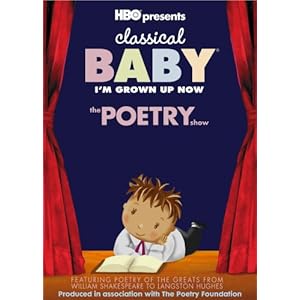
Classical Baby (I'm All Grown Up Now): The Poetry Show is the sequal to the HBO Family series, Classical Baby. In it, the young protagonist from the original series has grown from a music loving baby to a preschool poetry enthusiast. The 30 minute episode is expertly designed to appeal both visually and aurally to young ones, as each poem is accompanied by a brief, animated "frame story" while the poem itself is set to gentle music and an understated kaleidoscopic display - just enough to keep young attention spans from wandering.
The poems (and songs) range in style from "How Do I Love Thee" (read beautifully by Gwyneth Paltrow as a love poem from mother to child) to Robert Frost's "Stopping By the Woods on a Snowy Evening" and were selected to appeal emotionally to their young audience. Preschool and primary school age children may not understand every aspect of the poems, but the words and images will resonate at an emotional level as they alternate between soothing reassurance (John Keats) to good old-fashioned fun (Woody Guthrie).
Each poem is presented by the young protagonist by theme - "roses", "love", "birds" and more are all represented. This is the only place where I feel that the production falls flat. The animation is a bit stilted and the voice-over work for the boy is, quite frankly, creepy (it's a strangely synthesized child-voice, which stands out even more compared to the warm, very human narration of the poems). Still, it's a small complaint in an otherwise excellent production. The show keeps a constantly moving pace that nevertheless manages to feel both meditative and calm, while presenting a wide range of poetry to children in a fashion that is naturally engaging. While poetry is still best experienced at home, with a loved reading to a child, The Poetry Show is an excellent compromise.
Directed / Produced By Amy Schatz
http://www.hbofamily.com
3-4 Preschool Primary HBOFamily
DVD $9.97
Poetry
Classical Baby (I'm All Grown Up Now): The Poetry Show is the sequal to the HBO Family series, Classical Baby. In it, the young protagonist from the original series has grown from a music loving baby to a preschool poetry enthusiast. The 30 minute episode is expertly designed to appeal both visually and aurally to young ones, as each poem is accompanied by a brief, animated "frame story" while the poem itself is set to gentle music and an understated kaleidoscopic display - just enough to keep young attention spans from wandering.
The poems (and songs) range in style from "How Do I Love Thee" (read beautifully by Gwyneth Paltrow as a love poem from mother to child) to Robert Frost's "Stopping By the Woods on a Snowy Evening" and were selected to appeal emotionally to their young audience. Preschool and primary school age children may not understand every aspect of the poems, but the words and images will resonate at an emotional level as they alternate between soothing reassurance (John Keats) to good old-fashioned fun (Woody Guthrie).
Each poem is presented by the young protagonist by theme - "roses", "love", "birds" and more are all represented. This is the only place where I feel that the production falls flat. The animation is a bit stilted and the voice-over work for the boy is, quite frankly, creepy (it's a strangely synthesized child-voice, which stands out even more compared to the warm, very human narration of the poems). Still, it's a small complaint in an otherwise excellent production. The show keeps a constantly moving pace that nevertheless manages to feel both meditative and calm, while presenting a wide range of poetry to children in a fashion that is naturally engaging. While poetry is still best experienced at home, with a loved reading to a child, The Poetry Show is an excellent compromise.
Kids Yoga with Phonics
Little Sensei Studio
http://www.littlesensei.com/
2-4 Preschool Smooth Rivers Productions
DVD $24
Non-Fiction
There are quite a lot of DVD's and programs purporting to teach children yoga, tai chi and even pilates, but Kids Yoga with Phonics is unique in that it combines traditional yogic poses in their simplest forms with an educational component, in this case, the alphabet.
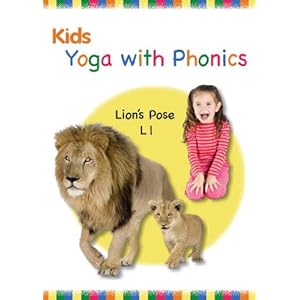
Each of the 26 poses in this 33 minute video corresponds with a letter of the alphabet (C is for Cat's Pose, D is for Dog's Pose / Downward Dog etc.) so that the information is presented and experienced visually, aurally and physically. This does two things. Firstly, it appeals to all three learning styles - visual, aural and haptic - reinforcing the information through multiple mental processes and tying it to the muscle memory associated with each pose. This creates an associative link that is much stronger than a link made by trying to learn the alphabet by rote. Secondly, it's really fun. The music is very kid-centric, as is the pace, which moves along at a measured but energetic clip. Rather than practice in meditative solemnity, the viewer is encouraged to enjoy each pose, fully inhabiting the L for Lion's Pose and the A for Airplane pose with imaginative verve. All of this is done with a sense of authenticity that comes from the fact that the video's instructors are not adults. They are other children in the preschool - primary age group. Despite their youth, however, siblings Juliette and John Rasmussen demonstrate correct form and flow, ensuring that their audience emulates each posture safely and correctly.
While the concept may seem gimmicky to some, it is obvious that a great deal of thought, not to mention research, went into the design and execution of Kids Yoga with Phonics. Appropriate for toddlers as young as 2 and physically fun for kids as old as 8, it manages to teach the alphabet and an ancient meditative practice without making it seem like anything but a really great time. The result is a DVD that kids would very likely choose to make a regular part of their day, adding letter repetition / recognition and the establishment of an active yoga practice to it's impressive list of benefits.
Little Sensei Studio
http://www.littlesensei.com/
2-4 Preschool Smooth Rivers Productions
DVD $24
Non-Fiction
There are quite a lot of DVD's and programs purporting to teach children yoga, tai chi and even pilates, but Kids Yoga with Phonics is unique in that it combines traditional yogic poses in their simplest forms with an educational component, in this case, the alphabet.
Each of the 26 poses in this 33 minute video corresponds with a letter of the alphabet (C is for Cat's Pose, D is for Dog's Pose / Downward Dog etc.) so that the information is presented and experienced visually, aurally and physically. This does two things. Firstly, it appeals to all three learning styles - visual, aural and haptic - reinforcing the information through multiple mental processes and tying it to the muscle memory associated with each pose. This creates an associative link that is much stronger than a link made by trying to learn the alphabet by rote. Secondly, it's really fun. The music is very kid-centric, as is the pace, which moves along at a measured but energetic clip. Rather than practice in meditative solemnity, the viewer is encouraged to enjoy each pose, fully inhabiting the L for Lion's Pose and the A for Airplane pose with imaginative verve. All of this is done with a sense of authenticity that comes from the fact that the video's instructors are not adults. They are other children in the preschool - primary age group. Despite their youth, however, siblings Juliette and John Rasmussen demonstrate correct form and flow, ensuring that their audience emulates each posture safely and correctly.
While the concept may seem gimmicky to some, it is obvious that a great deal of thought, not to mention research, went into the design and execution of Kids Yoga with Phonics. Appropriate for toddlers as young as 2 and physically fun for kids as old as 8, it manages to teach the alphabet and an ancient meditative practice without making it seem like anything but a really great time. The result is a DVD that kids would very likely choose to make a regular part of their day, adding letter repetition / recognition and the establishment of an active yoga practice to it's impressive list of benefits.
Moo, Baa, La La La!
Moo, Baa, La, La, La!
By Sandra Boynton; illus. by author
www.sandraboynton.com
0-4 Little Simon 14 pp.
978-0671449018 Board Book $5.99
Non-Fiction
Beneath the exuberant silliness of Moo, Baa, La, La!, ("A cow says MOO. A sheep says BAA. Three singing pigs say LA LA LA!"), there are important lessons at work.
Boynton, whose board books have combined concept introduction and good, plain fun for decades, has a light hand and an expert's sense of her audience. She sets up her concept - in this case the sounds that animals make - in facts that are straightforward and known. A cow does say "moo", a sheep does say "baa". Then she hits the reader with a goofy zinger, in this case, the "three singing pigs" and their "la, la, la", all the while employing natural, super-pleasing rhythm that appeals to a child's sense of play. But it doesn't end there. Boynton credits her young reader with the knowledge to recognize that what she's told them is wrong, ("No, no, you say. That isn't right. The pigs say OINK all day and night"). Then, with her young audience fully invested and sitting up in their moms' laps, she writes about rhinos "snuffing" and little dogs "ruffing" and other quirky choices set to an impeccably timed rhythm that rolls along to the end where she again addresses her audience with "It's quiet now. What do you say?" thereby inviting the reader to go ahead and make his own noises too.
Moo, Baa, La La La!, with its classic Boynton animals looking bored and mischievous by turns, is masterful in it's simplicity. Over the course of 14 easy pages, Boynton introduces animals sounds, real versus make-believe, vocabulary and rhyme while effortlessly drawing her reading into the silliness and fun. It's the kind of book that is a pleasure to read and to hear, the kind that works educational magic under the radar, one that might even contribute to a family's lexicon of inside jokes. Incredible - seriously silly fun.
By Sandra Boynton; illus. by author
www.sandraboynton.com
0-4 Little Simon 14 pp.
978-0671449018 Board Book $5.99
Non-Fiction
Beneath the exuberant silliness of Moo, Baa, La, La!, ("A cow says MOO. A sheep says BAA. Three singing pigs say LA LA LA!"), there are important lessons at work.
Boynton, whose board books have combined concept introduction and good, plain fun for decades, has a light hand and an expert's sense of her audience. She sets up her concept - in this case the sounds that animals make - in facts that are straightforward and known. A cow does say "moo", a sheep does say "baa". Then she hits the reader with a goofy zinger, in this case, the "three singing pigs" and their "la, la, la", all the while employing natural, super-pleasing rhythm that appeals to a child's sense of play. But it doesn't end there. Boynton credits her young reader with the knowledge to recognize that what she's told them is wrong, ("No, no, you say. That isn't right. The pigs say OINK all day and night"). Then, with her young audience fully invested and sitting up in their moms' laps, she writes about rhinos "snuffing" and little dogs "ruffing" and other quirky choices set to an impeccably timed rhythm that rolls along to the end where she again addresses her audience with "It's quiet now. What do you say?" thereby inviting the reader to go ahead and make his own noises too.
Moo, Baa, La La La!, with its classic Boynton animals looking bored and mischievous by turns, is masterful in it's simplicity. Over the course of 14 easy pages, Boynton introduces animals sounds, real versus make-believe, vocabulary and rhyme while effortlessly drawing her reading into the silliness and fun. It's the kind of book that is a pleasure to read and to hear, the kind that works educational magic under the radar, one that might even contribute to a family's lexicon of inside jokes. Incredible - seriously silly fun.
My Friend Rabbit
My Friend Rabbit
By Eric Rohmann; illus. by author
http://www.ericrohmann.com/
2-4 Preschool Roaring Brook Press 32 pp.
978-1596436633 Hardcover $15.95
Fiction
Have you ever had a friend who, no matter how well he meant, caused trouble without even trying? Mouse's friend, Rabbit, is exactly that type of friend. When Rabbit accidentally launches Mouse's biplane into a tree, he embarks on a daring solution that does indeed end in well-meaning disaster.
Mouse, with his sharp eyes and expressive paws, is clearly the more practical of the two. He's an easy figure to relate to (there are short, bold lines darting from his head expressing worry or exasperation in many of the scenes). You get the sense that he knows it's going to end badly, but that he'll see it through because Rabbit is his friend. Rabbit, for his part, is and energetic soul, dashing gamely off in pursuit of the solution - "Not to worry, Mouse. I've got an idea!" (this mantra is repeated several times, always before more trouble). Rabbit returns over the course of 10 wordless pages pulling an elephant, shoving a rhino, and finally carrying a succession of animals from hippo to duck in order to make a living ladder high enough to reach Mouse's plane. Mouse looks on curiously and then pitches in, gamely joining his friend until all of the animals are stacked and the plane is just out of reach, a sight that stretches over two pages, comically presaging disaster. But when the disaster comes, and Rabbit is alone in a pile of very annoyed animals, Mouse (whose plane got knocked loose in the tumble) flies loyally to his rescue, picking him up just in time, even as the promise of more trouble zooms after them.
Rohmann's text is minimal, but it manages a pleasing, smooth rhythm, with repetition and sight words used to good effect. The story is a simple one of friendship and loyalty - it's the illustrations that make My Friend Rabbit special. The bold black outlines around each figure pop them off the delicious blue background of the sky. Though drawn in a cartoon style, Rabbit and Mouse come alive with fully realized personalities thanks to Rohmann's well-chosen, uncluttered details. The pictures elevate My Friend Rabbit as it romps comically through an impending train-wreck and out the other side, teaching patience, acceptance and the value of friendship along the way.
By Eric Rohmann; illus. by author
http://www.ericrohmann.com/
2-4 Preschool Roaring Brook Press 32 pp.
978-1596436633 Hardcover $15.95
Fiction
Have you ever had a friend who, no matter how well he meant, caused trouble without even trying? Mouse's friend, Rabbit, is exactly that type of friend. When Rabbit accidentally launches Mouse's biplane into a tree, he embarks on a daring solution that does indeed end in well-meaning disaster.
Mouse, with his sharp eyes and expressive paws, is clearly the more practical of the two. He's an easy figure to relate to (there are short, bold lines darting from his head expressing worry or exasperation in many of the scenes). You get the sense that he knows it's going to end badly, but that he'll see it through because Rabbit is his friend. Rabbit, for his part, is and energetic soul, dashing gamely off in pursuit of the solution - "Not to worry, Mouse. I've got an idea!" (this mantra is repeated several times, always before more trouble). Rabbit returns over the course of 10 wordless pages pulling an elephant, shoving a rhino, and finally carrying a succession of animals from hippo to duck in order to make a living ladder high enough to reach Mouse's plane. Mouse looks on curiously and then pitches in, gamely joining his friend until all of the animals are stacked and the plane is just out of reach, a sight that stretches over two pages, comically presaging disaster. But when the disaster comes, and Rabbit is alone in a pile of very annoyed animals, Mouse (whose plane got knocked loose in the tumble) flies loyally to his rescue, picking him up just in time, even as the promise of more trouble zooms after them.
Rohmann's text is minimal, but it manages a pleasing, smooth rhythm, with repetition and sight words used to good effect. The story is a simple one of friendship and loyalty - it's the illustrations that make My Friend Rabbit special. The bold black outlines around each figure pop them off the delicious blue background of the sky. Though drawn in a cartoon style, Rabbit and Mouse come alive with fully realized personalities thanks to Rohmann's well-chosen, uncluttered details. The pictures elevate My Friend Rabbit as it romps comically through an impending train-wreck and out the other side, teaching patience, acceptance and the value of friendship along the way.
Subscribe to:
Posts (Atom)