June 13, 2012

Death Cloud


Death Cloud by Andrew Lane (Farrar Straus Giroux, 2010)
Historical / Action / Mystery

The first in Lane’s new series, Sherlock Holmes: The Legend Begins, Death Cloud follows a fourteen-year-old Sherlock as he embarks on his first investigation – one that begins with two grotesquely swollen corpses and ends with a plot to topple the British Empire. Lane’s command of the material is impressive as he weaves in multiple threads and details that hint at the man the boy will become. The fast-paced, energetic plot is both fun and informative (semaphores and the Crimean War are deftly explained) as Lane pushes the young Holmes through teenage alienation, a first-crush and multiple attempts on his life, at break-neck speed.
Death Cloud is a solid book and will no doubt appeal to boys between the ages of 10-14. Lane’s Sherlock is a compellingly flawed protagonist (just as Doyle’s original is). My only complaint is that some of the action felt superfluous – a bit more deduction and bit less scrapping would have given the remaining action more punch. The climactic swordfight also verged on the preposterous with Sherlock battling an evil Baron whose movements are controlled by a series of ropes and pulleys. However, these complaints are small, and the elements in question will no doubt fail to offend Lane’s intended readership. A good introduction to a classic character, as well as to the concept of deduction and the Victorian era, Death Cloud would be a strong edition to a classroom list of elective titles or a unit on Victorian history.

Ella Enchanted


Ella Enchanted by Gail Carson Levine (Harper Collins, 1997)
Fantasy / Fairy Tales / Romance

When Ella of Frell is born, the fairy Lucinda bestows a gift upon her – the gift of obedience – which turns out to be a terrible curse. As a result, Ella must find ways to assert herself despite the constant threat of obedience (if someone told her to cut off her head, she would have to). Ella’s naturally independent nature grows stronger with every challenge, despite, or perhaps because of, the curse. A clever, genuinely funny adaptation on the Cinderella tale, Ella Enchanted is the story of a cursed girl who becomes a woman capable of saving herself.
This is a wonderful book for reluctant YA and tween readers – especially girls. The story is just recognizable enough to feel familiar to anyone who has heard of Cinderella, but it deviates substantially from the classic girl-as-victim plot, giving the reader a spunky, empowering heroine she can relate to. The humor, romantic elements, and first-person narrative make it a truly accessible, charming read.

June 4, 2012

A Wrinkle in Time

A Wrinkle in Time by Madeleine L'Engle (Random House, re-issue 2005)
Fiction


Winner of the Newberry in 1963, A Wrinkle in Time is the rare sort of book that manages multiple threads on multiple levels seamlessly while following a perfectly linear arc. The book opens on a “dark and stormy night” with misfit Meg Murry having hot chocolate with her mother and brother, Charles Wallace, an uncanny four-year-old savant. When a stranger comes in from the storm, the stage is set for what becomes an extraordinary journey through time and space to save Meg and Charles Wallace’s missing astrophysicist father. On one level, A Wrinkle in Time is a beautifully executed, if unsettling, adventure featuring a disturbing set of antagonists, including a repulsive, disembodied brain with the power of mind control. On another level, it is the story of Meg’s coming of age as she realizes that her beloved father is not omnipotent, and that she herself is more capable than she realizes. It is a sophisticated masterpiece with science, mathematics, philosophy and religion sprinkled throughout. L’Engle expects much from her readers and more than rewards the effort. The first in L'Engle's celebrated Time Quintet, A Wrinkle in Time is celebrating it's 50th Anniversary this year. It deserves quite a party, I think. 

A Visit to William Blake's Inn

A Visit to William Blake's Inn:
Poems for Innocent and Experienced 
Travelers
By Nancy Willard
Illustrated by Alice and Martin Provensen
Harcourt Brace, 1981
Poetry

A Visit to William Blake’s Inn has the rare honor of being the recipient of both the Newbery Medal and a Caldecott Honor, and for good reason. The fifteen poems and epilogue tell the tale of a child’s stay at William Blake’s inn, where dragons bake the bread and angels make the beds. While there, he meets Blake’s famous Tiger, as well as the King of Cats, the Marmalade Man and Blake himself, among many others. Willard’s poems owe themselves to Blake in structure and style, but the whimsical imagery and gentle, absurd humor are original and entirely beguiling. These are not simple, nursery rhymes but real poems with pleasingly complex meters. Yet, what could be a frustrating challenge to young readers is rendered playful fun as Blake takes his guests on a tour of the Milky Way and the Wise Cow eats a cloud on buttered bread. There is just enough non-sense sprinkled throughout (hints of Edward Lear and T.S. Eliot) to keep any child entertained. Even more importantly, it is a wonderful and playful introduction to a more sophisticated poetic form for older readers. Alice and Martin Provensen's odd and delicate gauche illustrations are the perfect counterpoint to Willard's poems, encouraging the reader to fully engage and believe in William Blake's magical inn and very much want to visit themselves.

May 17, 2012

Mirror, Mirror
By Marilyn Singer
Illustrated by Josee Masse
Primary Dutton 32 pp.
978-0525479017 Hardcover $16.99
Fiction / Poetry

Marilyn Singer plays with an interesting concept in Mirror, Mirror. The poems are all distillations of familiar fairy tales - very nice so far - but the verse is "reversible", which is where things begin to get dicey. The concept of reversible verse is a good one. The poems are meant to have different meanings, depending on whether or not one is reading them front to back or back to front. To aid in this exercise, Singer presents the two versions of each poem side by side as mirror images of the other. Some of these reversals are quite successful, (Rapunzel and Cinderella particularly stand out), but others, (like the Red Riding Hood poem among quite a few others), work well enough in one direction but become forced and nonsensical in the other. Given that the reversibility of the verse is the book's foundation, this flaw in execution undermines the whole. That said, Josee Masse's illustrations are lovely, with lush colors and pleasingly rounded, clean lines. Each story receives an illustration and each illustration captures the essence of both the original tale and Singer's poem with charming efficiency. As distillations of well-known stories, the poems are easy to enjoy. Overall, Mirror, Mirror is worth reading and selections would make a nice addition to storytimes for older children, so long as you cherry-pick a handful rather than through the whole.

May 4, 2012

And Then It's Spring

And Then It's Spring
By Julie Fogliano
Illustrated by Erin E. Stead
3-4 Preschool Primary
Roaring Brook 32 pp.
978-1596436244 Hardcover $16.99
Fiction

 And Then It's Spring very quietly took me by surprise. After a long winter, a boy and his dog are tired of brown, ("First you have brown, all around you have brown), so they decide to plant a garden. They plant seeds in the brown dirt and watch the garden for signs of growth through sunshine and rain, always keeping an eye out for a little green. Slowly, the brown becomes a more "hopeful shade of brown" until the garden blooms under their nurturing care.

On the face of it, And Then It's Spring is a straight-forward story about anticipation rewarded. It's the prosaic and visual journey Fogliano and Stead take us on to get to the blooming garden that makes it special. Fogliano's prose is poetic and rhythmic and whimsical without ever losing its grounding in the story, so that when the boy, concerned that the seeds are not growing puts up a sign that says, "please do not stomp here - there are seeds and they are trying," (it's aimed at bears and other stomping creatures), the reader is charmed by his quirky earnestness while never losing sight of his very serious goal. Stead, who won the Caldecott last year for A Sick Day for Amos McGee, gives And Then It's Spring the same meticulous treatment, gradually altering the tone of the browns so that they become lighter and more "hopeful" the closer they get to spring.

There is so much I could say about And Then It's Spring, so many reasons why it's such an excellent book, but interest of brevity, I will simply say that it is a book that rewards slow readings and careful eyes, (look for details like a turtle wearing a red hat that matches the boy's). It is a book that takes a reader by quietly by surprise - like the first, tiny glimpse of green after months and months of brown.


The Red Book

The Red Book
By Barbara Lehman; illus. by author
http://www.barbaralehmanbooks.com
3-4 Preschool Primary Houghton Mifflin 32 pp.
978-0618428588 Hardcover $14.99
Fiction

Barbara Lehman won a Caldecott Honor for The Red Book, a wordless picture book that weaves elements of magical realism and post-modernism successfully into a simple story that simply works. A girl picks up a mysterious red book as she walks down her snowy urban street. When she opens it, the book narrows in on a picture of an island on which there is a boy. The page turn reveals the boy discovering his own red book in the sand. The two watch each other over the course of the day through their respective red books. When school gets out, the girl buys two huge bunches of balloons and floats away to meet the boy on the island. In the process, she drops the red book, ensuring that someone else will find it and continue the story.

Lehman's graphic illustrations are straight-forward and modern. There is little embellishment beyond shading, and even that has a sort of practical, no-nonsense quality to it. You would expect these pictures to illustrate an equally straight-forward story, which is why they communicate the fantastical elements of Lehman's story so well. Of course a red book can show you a different place! Of course a bunch of balloons can take you to an island! It's a wonderful juxtaposition of realism and magical realism and it makes both elements work in the service of the story. The Red Book is a delightful read. While toddlers might have a hard time grasping the self-referentiality of the illustrations, preschoolers are just old enough to buy in and enjoy on their own or with their parents.

Stella's Dancing Days

Stella's Dancing Days
By Sander Asher
http://usawrites4kids.drury.edu/authors/asher/
Illustrated by Katheryn Brown
No Illustrator Website
1-4 Preschool Primary Harcourt 32 pp.
978-0152016135 Hardcover $16.00
Fiction

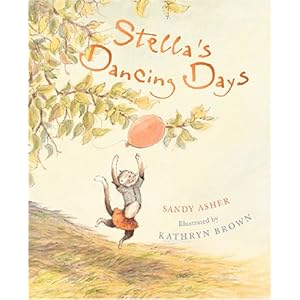
Stella's Dancing Days is a quiet book suited to cozy chairs and a parent's voice. It's the story of Stella, a kitten who loves to dance. She delights the Tall One (a boy who wears a cowboy hat) with her grands jetes, so he brings her home, where she charms the Tall One's younger sister, the Gentle One with pirouettes, and when the Littlest One (the baby of the family) won't stop crying, she makes him laugh by waltzing with her ball. But as Stella grows up and finds bugs to stalk and window sills to sit in, she dances less and less. While the children (also pictured as older) miss her dancing days, Stella does not - she's preoccupied with the important business of preparing for her own kittens, three boys and three girls, all of whom love to dance.

Brown's watercolors have a soft, nostalgic feel, as if we're peering back in time with a slightly hazy lens. The children, the magnificent oak tree and Stella herself occupy their world with a natural, soothing ease, one that suits Asher's story to a tea. Though Stella's kittenish antics are described in dance terms, she is pictured as very much the realistic cat, so while it looks like she's performing grand balletic moves, we know she's just being a kitten, (the one exception to this realism is when the children dress her in a skirt and blouse as seen on the cover, but it's for a tea party and so explained). The story progresses gently to its natural conclusion, a conclusion that is comforting and perfect in its predictability. In the process, Stella's acceptance of each new stage of her life is a wonderful introduction to the idea that things change, and that, while you can miss the past (Stella's dancing), the present and the future have promise too, (Stella's kittens). It's an important message, one embedded deeply in a lovely, gentle story. Highly recommended. My bet is that Stella will charm you too.

May 2, 2012

Red Sled

Red Sled
By Lita Judge
http://www.litajudge.com/
1-4 Preschool Primary Atheneum 40 pp.
978-1442420076 Hardcover $16.99
Fiction

Lita Judge's Red Sled is both simple and unexpected - simple because of the nearly wordless story (a bear "borrows" the red sled of the title from the child in the red hat) and unexpected because the few words that do appear, (Gadung, Gadung, Gadung and fluoomp...ft are my favorites), are marvelous and onomatopoetic and crazy in their accuracy. Anyone who has sledded down a bumpy, snowy hill knows exactly what Gadung, Gadung Gadung feels like. Even better, Gadung, Gadung, Gadung gives those who haven't had the pleasure of sledding down a bumpy hill a terrifically accurate sense of what it feels like to do so. Nowhere in this book does Judge fall back on old standards like "bonk" or "whoosh". She makes up words that capture, with uncanny accuracy, the very real sound of feet crunching through snow, (scrinch, scrunch), not to mention the made-up sound of a bear, a rabbit, a moose, a mouse, two raccoons, a porcupine and an opossum landing at at the bottom of the hill after their sled ride. For those unfamiliar with this sound, it's the fluoomp..ft, I mentioned above. 

Judge's illustrations match, tone for tone, the old-fashioned magic of her minimalist text. The child in the red hat is cherubic and pudgy in her big winter coat as she scrinch, scrunches back to the tiny cabin toting her red sled. This is a visual world in which bears would surely borrow that sled and take it for a spin with his woodland friends. Even better, it's a world in which the red-hatted child would wonder at the animals prints leading to her sled, and then join the bear and friends the next night. Red Sled is a simply lovely book - a real example of the magic a few well chosen words and thoughtfully rendered pictures can work.

How Do Dinosaurs Get Well Soon?

How Do Dinosaurs Get Well Soon?
By Jane Yolen
http://janeyolen.com/
Illustrated by Mark Teague
No Illustrator Website
3-4 Preschool Primary Blue Sky 40 pp.
978-0439241007 Hardcover $16.99
Fiction

Second in the popular How Do Dinosaurs... series by Jane Yolen and Mark Teague, How Do Dinosaurs Get Well Soon? follows the same format that worked so well in the original, How Do Dinosaurs Say Goodnight? And indeed, the question / answer pattern does draw the reader in. What does a dinosaur do when he catches the flu? Does he behave badly, whining as he tosses tissue and medicine all over his room? The answer is no. A dinosaur drinks his juice and gets rest and takes his medicine - just like a human kid should when he's not feeling good. It's a nice guide to behaving well while sick without reverting too heavily towards didacticism.

The dinosaurs are clearly child stand-ins, and they do the job with personality and comedic pizzazz, thanks to Teague's illustrations. Massive next to their human parents, the dinosaurs convey an air of child-like crankiness that resonates emotionally while still being funny. Especially cute is the Shakespearean drama with which they blow their noses, (especially nice is the Styracosaurus who gets forcibly dragged to the doctor by his mom). A nice touch, as always, is the variety of dinosaurs Teague uses. You'll find old, familiar stand-bys like Brachiosaurus in addition to a nice selection of lesser known dinos, like Gallimimus and Carnotaurus. The featured dinos also make a cast appearance on the endpapers with names clearly labeled beneath them. Yolen's rhyming text is fun and accessible, though a bit awkward at times, especially towards the end. Still, it doesn't detract from the overall success of the book, which will surely appeal to preschoolers, both sick and well, at story times and at home. As an added bonus, How Do Dinosaurs Get Well Soon? will likely appeal to parents who recognize their own children in the book's cranky protagonists.