April 1, 2012

Wemberly's Ice Cream Star

Wemberly's Ice Cream Star
By Kevin Henkes; illus by author
http://www.kevinhenkes.com/
1-4 Preschool Greenwillow 22 pp.
978-0060504052 Board Book $6.99
Fiction

Wemberly and her stuffed rabbit, Petal, are back, this time in Wemberly's Ice Cream Star, a board book unrelated but thematically linked to their first picture book, Wemberly Worried. With Wemberly, Henkes has created a portrait, uncanny in its accuracy, of the worried child -  the one who looks before she leaps and whose attachments are devoted and profound (evidenced in her relationship to Petal, whom she treats with the utmost care and consideration). In Wemberly's Ice Cream Star, Wemberly's propensity for concern, already established in Wemberly Worried, and her touching ability to overcome it have been expertly distilled into a deceptively straight-forward board book. Whereas the nuances in Wemberly Worried would go over a toddler's head, Wemberly's Ice Cream Star features a situation simple enough to appeal to the preschool set.

It's a hot day, and as a special treat, Wemberly is given an ice cream star. Though happy to have the star, Wemberly worries that she will drip on her dress. Even more, she worries that there is no ice cream for Petal so she sets about solving the problem. She gets two bowls, two spoons and two napkins and waits, slowly dripping the star into each bowl as it melts over the course of three pages. Then she and Petal enjoy "ice cream soup" with their napkins tied firmly around their necks. The final page features Wemberly offering a droopy Petal help finishing.

Henkes draws Wemberly, with her trademark "worried" eyebrows, hunkering down and looking ever more determined on each page, a progression that makes Wemberly both realistic and loveable. And that's really Henkes' triumph with Wemberly - she is, quite literally, love-able. At the end, when she sits with her bunny proudly eating the fruits of her labor, you feel proud of her too because she solved her problem - she found a way to share her ice cream, and she did so without ruining her dress. Wemberly might worry, but she doesn't let it cripple her. She's a problem-solver and, because of that, a good role model, especially for sensitive kids.

There's a surprising amount of value in Wemberly's Ice Cream Star, the strongest of the five books in Henkes' mouse-board book series (the series also includes Lilly's Chocolate Heart, Owen's Marshmallow Chick, Sheila Rae's Peppermint Stick and Julius's Candy Corn). The sentences are short and declarative ("Wemberly worried that she might drip on her new dress) and the story couldn't be more straight-forward. Yet for all its simplicity, skills like sharing and problem-solving drive the narrative while sight words and rhythm make the text accessible to even the most rudimentary readers. It's a lovely little read with a surprising amount of depth. Combine that with Wemberly herself, the sweetest of Henkes's mice, and Wemberly's Ice Cream Star is a real treat.

March 26, 2012

Olivia Counts

Olivia Counts
By Ian Falconer; illus. by author
http://www.oliviathepiglet.com/
1-4 Preschool Atheneum 12 pp.
978-0689850875 Board Book $6.99
Non-Fiction

Olivia, Ian Falconer's precocious, porcine heroine, returns, this time in Olivia Counts, an appropriately charming foray into the world of 1-10. Unfortunately, Falconer's trademark Olivia palette, with its blacks, whites and grays punctuated by tomatoey red, makes the counted items difficult to individuate, and therefore hard to count.

The book starts off well, with 1 beach ball dominating the page and a nearly overwhelmed Olivia peeking out from behind it. 2 big red bows at the tips Olivia's ears are similarly easy to see and account for. But the 3 pots of paint (one red, one black and one gray) are small and almost incidental with Olivia and her brush occupying the majority of the white background. Similarly, Olivia's 4 aunts, rendered in smudgy gray and white are oddly hard to differentiate and therefore hard to count. The rest of the items pass in a similar style, with 5 books stacked narrowly atop each other, 7 accessories scattered haphazardly across the page and 10 highly active Olivia's detracting from each other with their kinetic exuberance.

Fans of Olivia already familiar with Falconer's style will love Olivia Counts. While the slight muddiness of the visuals would not necessarily be a problem for a preschooler who already knows her numbers, it could prove distracting or even discouraging for a toddler just learning to count. For this reason, I would say that Olivia Counts is a solid choice for existing fans, but for those who have yet to meet Olivia or develop some familiarity with numbers, there are stronger introductions to counting and other Olivia adventures to explore first.

Pocketful of Posies: A Treasury of Nursery Rhymes

Pocketful of Posies: A Treasury of Nursery Rhymes
By Salley Mavor
http://www.weefolkstudio.com/
2-4 Preschool Primary Houghton Mifflin 62 pp.
978-0618737406 Hardcover $21.99
Poetry

Nursery rhymes, though individually short and often non-sensical, are, collectively speaking, a world unto themselves, where lambs follow little girls and eggs fall off walls to disastrous effect. Yet few collections give life to the Mother Goose world, focusing instead on the individual rhymes rather than the links that make them a whole. Pocketful of Posies, Salley Mavor's inventive new collection, beautifully fills the gap.

The strength of Mavor's collection rests in two ares - her rhyme selection and her felted illustrations. Pocketful of Posies, though by no means exhaustive, contains a wide variety of nursery rhymes, with old favorites like "Jack and Jill" nestled together with lesser-known rhymes such as "Elsie Marley" and "Daffy-Down-Dilly". Rather than being tossed in at random, the rhymes are loosely linked through content or theme (last lines of one poem often lead to the first lines of the next). Even more interestingly, poems that, based on their texts alone have nothing in common, share large, double-page spreads (the children tumbling out of the Old Woman's shoe-house bounce straight through the "Roses are red" garden, which appears to be in the Old Woman's back yard). In this way, through careful rhyme selection and placement, Mavor creates the perfect foundation for her incredible cloth illustrations.

It took Mavor ten years of experimentation to perfect the fabric relief technique that gives her illustrations their tactile, three-dimensional quality. With no white space, the pages are completely filled with cottony blue skies and fleecy green hills and embroidered trees and flowers and plants of nearly Faberge-like detail. Into these rich little environments are dropped curly crotched sheep and children with smooth, round faces and tiny, perfectly rendered fingers clutching horns (Little Boy Blue) and shepherd's crooks (Little Bo-Peep) and other found items like feathers, acorns and beads. Even the individual bits of straw in a black hen's nest are individually rendered with incredible care. The overall effect is, quite literally, magical as the reader is visually compelled into each page and welcomed to stay there as long as she might wish.

Pocketful of Posies is an honest work of art, one that is not only accessible to, but designed specifically for, children. My only regret is that its pages aren't indestructible, otherwise I would be recommending it for children of all ages (not just older toddlers and up) - even those whose concept of reading primarily involves gumming a book's pages. Study upon study has been done on Mother Goose and language acquisition. Thanks to Mavor, a collection of nursery rhymes now exists that is as much a feast for the eyes and imagination as the rhymes are for mind.

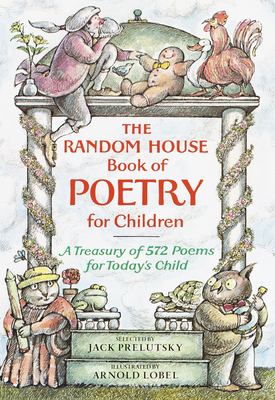
The Random House Book of Poetry for Children

The Random House Book of Poetry for Children
Selected by Jack Prelutsky
http://www.jackprelutsky.com/
Illustrated by Arnold Lobel
No Illustrator Site
Preschool Primary Random House 247 pp.
978-0394850108 Hardcover $22.99
Poetry

First published in 1983, The Random House Book of Poetry for Children has become a modern classic - possibly the most beloved anthology of poetry for children since Robert Lewis Stevenson's collection, A Child's Garden of Verse first appeared in 1885. Expertly selected by the children's poet and author, Jack Prelutsky, and illustrated by the Caldecott winning artist, Arnold Lobel, The Random House Book of Poetry offers up an absolute buffet of poetic possibilities from the silly, absurd and humorous (Lewis Carroll and Shel Silverstein, et al), to classics by Robert Frost, Emily Dickinson and Robert Burns among many others.

Prelutsky's organizational principal is both organic and intuitive as poems are grouped logically according to unifying themes. The book begins with a section entitled, "Nature Is..." (all sections begin with an introductory poem by Prelutsky). From "Nature Is...", we move smoothly to poems on "The Four Seasons", "Dogs, Cats, Bears and Bats", "The Way of Living Things" and "City, Oh City!". From there, the reader is treated to sections on other children, "Me, I Am!" and home before moving on to nonsense, concepts such as the alphabet and numbers and scary poems, ending finally with a catch-all section called "The Land of Potpourri".  Each section leads seamlessly to the next through subtle thematic overlaps, which move the anthology forward without jarring. The structure of the collection also makes it very easy to just jump to a page or section at random or seek out a specific type of poem by theme or topic. Separate indexes for title, poet and first line also contribute to the anthology's search-ability.

This search-ability is important because, regardless of the anthology's excellence, one caveat applies to parents of younger children and preschoolers. In his introduction, Prelutsky states that he specifically focused the collection on elementary-school aged children, and while there are plenty of poems in the anthology that will appeal to preschoolers (and even pre-verbal infants for their rhyme and rhythm), parents of younger children should make sure to use discretion as to which sections they read to their child. As Prelutsky states, "a poem that might be deliciously scary to an eight-year-old might be terrifying to a four-year-old".

That said, there is such a wonderful wealth of age-appropriate material in The Random House Book of Poetry for Children, it would be a shame to forbid it to older toddlers and preschoolers. Given that poetry is perfect shared reading for a child and her loved-one, parental oversight is easy to apply with entire sections on nature, family and feelings appropriate for even the littlest enthusiasts. The Random House Book of Poetry for Children truly is a standard by which other anthologies can be measured - an outstanding resource and a pleasure to read.

March 23, 2012

Wynken, Blynken and Nod

Wynken, Blynken and Nod
By Eugene W. Field; illus. by David McPhail
No Author Site; No Illustrator Site
0-4 Preschool Scholastic 18 pp.
978-0439921442 Board Book $6.99
Poetry

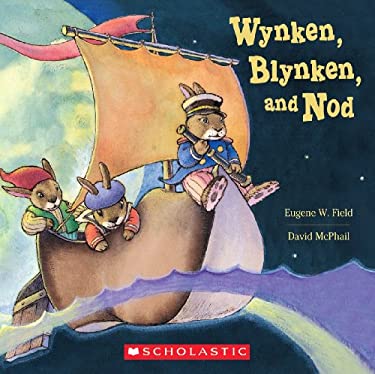
Possibly one of the most reproduced children's poems of the 20th century, Eugene Field's lullaby poem, "Wynken, Blynken and Nod" has been animated, put to music and illustrated countless times since its publication in 1889. Why then the need for another edition, this time illustrated by children's book author and illustrator David McPhail? For the simple reason that the poem endures as a childhood favorite, passed down from parent to child through countless multigenerational bedtimes. McPhail's edition for Scholastic is simply a fresh version for the newest generation.

Wynken, Blynken and Nod tells the story of three fishermen who sail the night sky in a wooden shoe. In McPhail's illustrations, the fisherman are three bunnies dressed in sailor-clothes, an appropriately whimsical choice for this drowsy lullaby poem. On their journey, the fishermen meet the moon, who sings a song as they toss their nets into the sea of dew. Then it's back home to a modern little girl's bedroom, where it is revealed that "Wynken and Blyken are two little eyes, and Nod is a little head, and the wooden shoe that sailed the skies is a wee one's trundle bed." Then the fishermen upend a barrel of stars onto the girl's blanket, whereupon she promptly falls asleep with three pairs of rabbit ears peeking out from beneath her covers as the shoe sails back out the window to rendezvous with the moon.

McPhail's palette is dark and soothing, with lots of rich, deep blues and warm candle-lit yellows setting a drowsy visual tone. He makes the transition from the fanciful bunny fisherman to the modern girl's bedroom smoothly, making it seem plausible that the entire book had perhaps been the girl's dream - or perhaps not. This sweet ambiguity comes from McPhail's juxtaposition of images that are by turns timeless (the wooden shoe, the costumed bunnies) and modern (a little girl with short hair climbing into bed in her own room), a balance he strikes seamlessly and to good effect.

Despite McPhail's lovely work, Field's poem is still the heart of the book. He uses rhythm and rhyme to expertly mimic the feeling of drifting to sleep. Wisely, McPhail does not try to compete with this familiar and beloved text. Rather, he supports it with pictures that are consistent (the bunnies and shoe are in every page) without getting stale (he keeps things fresh by shifting visual perspectives and POV). The result is a lovely, understated edition of a poem that has been a favorite of generations. That this edition makes it possible to introduce a new generation to the poem (and in some cases, to poetry in general) feels like a dream - a very, very good one.

Baby! Baby!

Baby! Baby!
By Vicky Ceelen; photos by author
No Author Site
0-2 Random House 24 pp.
978-0-375-84207-8 Board Book $6.99
Non-Fiction

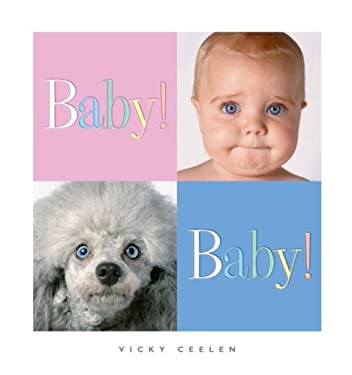
It's often said that babies love to look at other at babies. Put any 8 month old in front of a mirror and the giggling, waving smile-fest that results will prove this saying true. Because of this, publishers have put out a lot of baby-picture board books - so many, in fact, that there is probably one for every parent's and every baby's preference. The sheer glut can make it difficult for an individual title to stand out, which is why Baby! Baby! is such a lovely contribution to a crowded field.

Though the title is slightly misleading, Vicky Ceelen's book features well-chosen animal / baby pairings, some of which are fairly uncanny (the baby / lion cub pairing and the baby / rabbit pairing especially stand out). There are no words and no labels. The pictures stand on their own, with the baby occupying one page and the animal occupying the page opposite. While it's tempting to wish that the animals were labeled or identified, (there's a nameless marsupial that I'm particularly curious about), the wordless quality of the book works in it's favor. The pictures stand out boldly on bright, single-color backgrounds without words competing for the focus of young, baby eyes. As they grow, toddlers can then enjoy flipping through the familiar pages to name the animals on their own.

Unlike a lot of "baby" books, Baby! Baby! grows with a child. It might start out as a simple way for a baby to engage other baby faces, but it becomes a great introduction to animals, colors, shapes and similarities. Though not all of the animals pictured are babies, the concept holds together strongly enough that it doesn't really matter. An altogether good little book that attends to multiple areas of early development while appealing to little ones from baby to toddler-hood.

March 22, 2012

Grandfather and I

Grandfather and I
By Helen E. Buckley; illus. by Jan Ormerod
No Author Site; No Illustrator Site
3-4 Preschool Harper Collins 24 pp.
978-0688125349 Hardcover $16.99
Fiction

Originally published in 1959 with illustrations by Paul Galdone, this 2000 reissue of Buckley's classic with updated illustrations by Jan Ormerod is, quite simply, lovely. Having seen only the cover of the original, I will refrain from making comparisons except to say that the reissue is different in at least one respect - Galdone's pictures were of a caucasian grandfather and grandson, while Ormerod's take is of a decidedly cozier looking African-American pair. That said, the race of the protagonists is beside the point. Grandfather and I's quiet celebration of this close, inter-generational bond is in no way altered by the change - a testament to the universality of the theme.

At its heart, Grandfather and I is a meditation on the special relationship between the oldest and youngest members of a modern family. The narrator informs the reader that he and his Grandfather are going for a slow walk, a prospect the boy enjoys. Even Buckley's prose and punctuation reflect his relish as he and his Grandfather take their time. ("We walk along and walk along and stop... and look... just as long as we like"). This time-taking is at the heart of their bond. Everyone else in his busy family rushes - his mother pulls him past a friendly cat, his dad hugs him before he goes to work and his siblings leave him behind, a fact effectively mirrored in Ormerod's illustrations (a family of ducks paddles past the disconsolate looking boy as the smallest duckling scrambles to keep up).

While the family is in no way neglectful or mean, the prose and illustrations on "hurry" pages have a rushed quality, one that is missing from the "Grandfather" pages, which are peaceful and expansive. This boy is relaxed around his Grandfather, a smiling, supportive figure who encourages the boy's curiosity. Together they walk through watercolored natural world, full of pines cones to pick up and heather to inspect. The white background lends to the expansive, relaxed quality while Buckley's prose, which is both loose and deliberate by turns, reflecting the boy's state of mind, verges on poetic. Her repetition of the chorus, "just as long as we like" beautifully communicates the peace this boy finds in his Grandfather's company, as well as the partnership the two have formed.

Grandfather and I is a gentle, quiet book, one best suited for one-on-one reading at home. For younger readers, it's full of opportunities to engage the text (questions like what are they doing? and do you like to rush or take your time? seem like natural extensions of the story), while older children can read Grandfather and I on their own with the help of an adult. Grandfather and I is lovely, old-fashioned, un-flashy book. While it may not stand up to the glamor of bus-driving pigeons and mice with purple plastic purses, it's more than worth finding and sharing with a cuddle, preferably with a beloved grandparent.

March 21, 2012

Handy Manny

Handy Manny
Series created by Roger Bollen, Marilyn Sadler and Rick Gitelson
Disney Junior TV Series / DVD
http://disney.go.com
2-4 Preschool Primary
Fiction

With the rise of cultural awareness and immersion programs in schools, there is a need in children's programming that has never existed before. It is no longer enough that a series teach a love of language or the joys of science. We now need shows that support bilingual education and Spanish / English bilingualism. Handy Manny, which airs on Disney Junior, does just that, while modeling kindness, acceptance and the art of being a good neighbor and friend.

Each 30 minute episode of Handy Manny features two stories revolving around the need to fix a broken item. Enter Handy Manny, a bilingual handyman and his anthropomorphic tools. The tools, which range in character from Pat, the well-meaning hammer, to the sarcastic, insecure screwdriver, Turner, fill decidedly child-like roles, each with their strengths and quirks. Though the tools and Manny speak to each other primarily in English, they are all bilingual, as evidenced in the frequent manner in which Spanish phrases are interleaved with English. For example, someone will ask a question like "where are you going?" and the response will come in both Spanish and English - "vamos a la tienda - we're going to the store". This happens repeatedly throughout each episode, reinforcing vocabulary development and language acquisition in both Spanish and English. Given that the target audience is young enough to absorb languages holistically, the approach is an effective introduction to Spanish, and a great support to Spanish language immersion programs.

As a protagonist, Manny is a kind and patient role model willing to go out of his way to help his neighbors without compromising his integrity. The overall effect is one of acceptance and diversity. Paired with the show's bilingualism and the language acquisition it supports, the social aspects of this preschoolers' show model behaviors that support cultural diversity and acceptance in its young viewers, all while laying the foundation for the linguistic skills its audience will need to apply these lessons in real life.

March 20, 2012

Green Eggs and Ham and Other Servings of Dr. Seuss

Green Eggs and Ham and Other Servings of Dr. Seuss
Written by Dr. Seuss
http://www.seussville.com
Narrated by Jason Alexander, Michael McKean, David Hyde Pierce
No Narrator Sites
1-4 Preschool Primary
Learning Library CD $19.99
Fiction

Few actors can fully embody the exasperation, the exhaustion and the sheer hysteria of Sam I Am's victim in the Dr. Seuss classic, Green Eggs and Ham. Fortunately for those listening to the story on this CD, Jason Alexander is one of them. Alexander takes the listener through the familiar text with pathos-laden gusto, ratcheting up the tension until, finally, the green eggs and ham are tried and, of course, enjoyed. Though Green Eggs and Ham is a classic read-along with only fifty words (mostly sight vocabulary) repeated in increasingly creative combinations, the classic Seussian rhythms are a pleasure to listen to - especially when voiced by an actor with such a strong sense of comedic drama and timing. The effort is an excellent introduction to the rest of the CD.


Green Eggs and Ham and Other Servings of Dr. Seuss follows the Learning Library's first Dr. Seuss offering, The Cat in the Hat and Other Dr. Seuss Favorites. While the first CD featured some of Seuss's more advanced / longer works, Other Servings contains 9 unabridged texts, all of which are classic Seuss beginning readers. On it, David Hyde Pieced expertly tackles Fox in Sox's famous tongue twisters, making them sound as easy to say as his rendition of Hop on Pop, a Seuss title fit for even the youngest readers. Alexander re-appears for a spirited rendition of Dr. Seuss's ABC while Michael McKean introduces treats listeners performances of Oh, Say Can You Say? and I Can Read With My Eyes Shut that are both earnest and ironic. (Vocally, he nails that particular form of Seussian tongue-in-cheek).

Dr. Seuss books are always a pleasure to listen to - his stories tap into the same primal love of word play, rhythm and rhyme that have made Mother Goose so enduringly popular for centuries. It's the biggest reason moms and dads routinely lose their voices reading One Fish, Two Fish, Red Fish, Blue Fish (also read here by Hyde Pierce) for the eleventy-hundreth time. Now, when laryngitis sets in, there's a strong alternative. Even better, Green Eggs and Ham and Other Servings of Dr. Seuss offers parents and children the pleasure of listening to Seuss's work together, allowing for yet another way to share and experience his particularly playful brand of poetry.

Little Einsteins

Little Einsteins
Series created by Douglas Wood
http://disney.go.com
3-6 Preschool Disney Junior
TV Series / DVD
Fiction / Art / Music

Little Einsteins is one of those shows for children that, in concept, shouldn't actually appeal to children - it features classical music and art (mostly paintings but tapestry, mosaic, pottery and sculpture have all received episodes) and spans geographic locations from ancient Greece to Denmark. Yet, children love it. Though it sounds, conceptually, like a show designed for parents, full of classical art, music and "big words", the execution is aimed entirely at preschoolers.

The four heroes range in age from 4 to 6, and each has a particular skill, though none are pigeon-holed by their aptitudes, (the dancing girl loves astronomy, for example). This makes them fairly well-rounded and relatable to kids in that age bracket. What's even more impressive, is that these young heroes engage in age-appropriate dialogue that is both authentic and challenging (scary woods are "daunting" and their missions are often "quests"). The show provides plenty of context to help the young audience figure out potentially difficult words, making it an excellent form of vocabulary acquisition.

At the beginning of each episode, the characters introduce the mission's art and music. The pairings range well beyond basics like the Mona Lisa and Swan Lake (recent episodes have featured Gustav Klimt with Dvorak, and Kandinsky with Mendellsohn) and are clearly aimed at introducing preschoolers to unfamiliar pieces while keeping the experience accessible and fun. To that end, words like "crescendo" and "staccato" are illustrated by bumpy rides down snowy hills and zooming trips through space. The characters address the audience directly and appeal to them for help, drawing them into each episode through physical activity (the team's rocket is powered by "pats") and terminology (tempera paints, turpentine) that they otherwise would not encounter until they were much older.

The skill with which all of this is accomplished is impressive, and though the pace may be slow for adults, it's perfect for kids, allowing them time to digest information without being ponderous. Even better, the quests contain familiar fable and fairy tale motifs, adding yet another layer to the already rich mix. The result is an adventurous cartoon that introduces preschoolers to art, music, literature and vocabulary. While I wouldn't just plop a child down in front of the TV, it's a great series to watch together with lots to explore and discuss.