October 26, 2012

Ragnarok: The End of the Gods

RAGNAROK: THE END OF THE GODS by A.S. Byatt (Grove Press, 2012)
GENRE: Literary - Mythology

I should state up front that A.S. Byatt is one of my favorite authors. Her short story collections are full of small jewels, perfect little things that leave you questioning or haunted or content. Her novels are odd and thoughtful, woven through with references to other authors and other works - not so much that the references swamp the story, but enough to weave a sort of socio-cultural fabric around the story. Done well, it's shockingly effective. Possession: A Romance, for which Byatt won the Booker Prize, is an excellent example of this. Unfortunately, Byatt's most recent offering, Ragnarok, is not.

Ragnarok refers to the mythical battle that ends the reign of the Norse gods. It's a immensely fertile ground and more than one writer has plumbed its depths - Wagner's Ring Cycle and Tolkein's Fellowship both contain aspects of the myth. What makes these appropriations (adaptation is too strong a word) work, is that Wagner and Tolkein took aspects of the source material and gave them new life in completely separate works, a trick Byatt has pulled off more than once in many of her novels. It is a trick she failed to pull off here. Ragnarok is essentially a straightforward retelling of Ragnarok from Asgard and the Gods. The only nod to a context beyond that of the myth is the fragile frame story about "the thin child" who reads the book, Asgard and the Gods, while her family is evacuated to the countryside during WWII. It's a lovely connection - the fall of the gods set as the backdrop of world war - but Byatt declines to take it further. In fact, she rather declines to take it anywhere at all. The "thin child" reads the book, her father comes home from the war, they all move back to London. Of course, there is more to it than that, but that's what it ultimately comes down to. As a reader, one is left wondering why Byatt bothered with the frame story at all - why not simply publish her own translation of the myth?

In the end, it's a matter of preference. Ragnarok is a beautiful book in that way that all of Byatt's books are beautiful. Her command of language and detail are unparalleled in in their lovely precision, and from that point of view, Ragnarok is a gorgeous success. But I tend to want and expect a chewier narrative from Ms. Byatt and so, unfortunately, Ragnarok left me hungry, not so much for more, but for different. I know many will disagree, but I think that's a fair expectation when something as meaty as a Norse myth is on the menu.

October 4, 2012

Throat-clearing, Or, Finding, Ignoring and Then Using Your Voice(s)

What, exactly, is an author's voice? What does a critic mean when she writes, "Author-with-Potential" has finally found his voice? It seems like an easy question to answer, but it isn't and the prevalence of that statement used to drive me a little nuts. As an writer, it's not something I've ever concerned myself with in a conscious way. My characters sound the way they sound. My narrators narrate and I try to stay out of the way. I've never worried about it and, quite frankly, I tended to think that people who did worry about it could have spent that valuable energy thinking about something else, like plot. Or characterization. Or editing. Or research. Or global warming. Or grocery shopping. Or Whatever. I had found my voice years before, a voice that was fluid, that changed and adapted to suit the material, and I just didn't worry about it. Turns out I was really pretty full of myself and other things...

Take this blog for example. I used to write the "reviews" off-the-cuff, for my own pleasure and amusement (which worked out great because very few people actually read these posts). But then I started to get more formal, because I was using the blog for a class and had an audience whose approval I needed. The reviews became less personal, more professional and perhaps more thorough (read: formulaic), but far less interesting to write or re-read. But I got really nice feed-back from my professors so I kept doing it that way even after the classes ended. Even after that "audience" had checked out, I kept writing for it's approval. I kept ignoring my voice. And there it is. My voice.
In the same way that personalities are not static constructs but rather fluid, adaptable creatures (or maybe that's just me), "voice" is a fluid adaptable thing too. And I had allowed mine to shape itself after the idea of the polished, published review. It sounded authoritative and professional and really fairly hollow, and while it's very legitimately "my voice" it isn't my only voice.

And before you say, "well hold on there missy, my voice is mine and Shakespeare's was Shakespeare's so you can just pipe down", hear me out. You don't speak to your boss the same way you speak to your mother. You have different voices for each situation. I write professional material in one voice, children's material in another, short stories in many voices, and blog posts in what comes closest to my speaking voice - except that I stopped doing that and used the professional voice for what is, ultimately, a blog that I started to please myself (and hopefully the few others who occasionally pop in). Kind of silly. So I started thinking about a writer's voice and I have come to this conclusion:

It is a complicated, oddly personal thing, and not one to be dismissed. It is something to consider, to honor and to pay attention to. And ultimately to leave alone. At least, in the case of my voice(s). Because I have many voices and they're all mine, but they don't all belong in the same place. If one of them invades another's space, context goes out the window and it all loses it's shine. So long live the author's voice - every single one of them.

September 26, 2012

Daughter of Smoke and Bone


Daughter of Smoke and Bone by Laini Taylor, (Little Brown, 2011).
GENRE: Urban Fantasy
AGE: 15 and up

Though a YA novel, Daughter of Smoke and Bone is such an aesthetic pleasure that it has a certain cross-over adult appeal. Though it didn't capture me emtionally to the same degree that Lips Touch Three Times, it is a lovely and formidable title worth of checking out.

Here's the Twisby Review: http://twisbyreviews.blogspot.com/2012/09/daughter-of-smoke-and-bone.html

On a personal note, I'd be envious if Taylor weren't so completely impressive.

September 20, 2012

The Keep

THE KEEP by Jennifer Egan (Anchor, 2007)
GENRE: Literary Realism / Ghost Story (of sorts)

The Keep has been on my to-read list for five years. I'm not entirely sure why it took me so long to read it, but it's left me with a great deal to think about. It's a deceptively simple book, with great and murky depths. And I don't mean "murky" in a pejorative sense. It's simply that there's so very much going on beneath the surface that it seems impossible to sink in deeply enough to touch bottom.

On the surface, it's the story of a man escaping New York to help his cousin renovate an eastern European castle. Danny is an experienced "second" - he's the man who stands beside powerful men and makes things run. Addicted to his cell phone and all other forms of wireless connectivity, he drags a portable satellite dish all the way to the castle, only to lose it to the stygian depths of a ancient pool. It's the first hint of one of Egan's central themes - how much technology is like magic, how very much it makes us like ghosts. About a quarter of the way into Danny's awkward and somewhat fraught reunion with his cousin,  the narrator suddenly introduces himself, exposing the book's second thread, this one concerning the narrator himself, a convict who is penning Danny's story for a prison writing class.

The marriage of these two threads, (Danny's story and the narrator's), should be awkward, but in Egan's hands it works. The narrator is a compelling figure, as compelling, though in a different way, as Danny is. One can't help but feel that the two are viscerally connected. In the climax we learn why and how. The knowledge is both satisfying and inevitable, and strangely touching, given the characters involved -  flawed men living flawed lives, warped and, in Danny's case, occasionally ridiculous. In fact, the book is a symphony of sorts, with various elements playing together in deep harmony - until the denouement.

In the first two sections, the convict narrates Danny's story, inserting asides and moving his own threads forwards as he does. In the final section, his writing teacher takes up the reins, a switch that might have worked were it not so disruptive, so packed with the backstory of a secondary, (though admittedly pivotal), character. I can see why Egan did it - she was able to elucidate certain issues by switching narrators, and it allowed her to tie up loose ends, but overall, it distracted from the final, perfect connection between Danny and the narrator, the thing at the novel's heart. It is The Keep's only real flaw, and one I can forgive, given the structural boldness of the rest. I just can't help but wish for less - less explanation, less backstory, less denouement. With such a well-pitched climax, a brief afterward or epilogue would have functioned to tie the bows. The story stands perfectly without the rest.

September 11, 2012

Knit Your Own Cat

KNIT YOUR OWN CAT by Sally Muir and Joanna Osborne (Black Dog & Leventhal, 2011)
GENRE: Craft - Knitting

This book is adorable. Even if you're just figuring out how to purl, it's adorable. Even if you've been making argyle socks since you were 12, it's adorable. It's just adorable, from concept to execution. Here's why. Knit Your Own Cat does something that many concept-knitting books don't do - it engages the reader emotionally. What does that mean, you might ask. Well, it means that even as your knitty juices get all a-flowing, inspired by the detailed, pristine patterns, the wee yarn cats charm with their cocked heads and wispy whiskers and delicately formed paws. Their little faces have a ton of personality as they look winsomely out at you from their understated photographic boxes, as if they were asking you to bring them home from the pound. The amount of feline body language these patterns capture is impressive, from the gently curled figure of a napping Blue Russian to the languidly raised paw of a Devon Rex. It's a little uncanny and very charming.

One thing to note however, is that these cats are not projects for beginners. The average needle size is a 2 and there is a great deal of shaping done on a very small scale, not to mention changing color-ways and piecing the little critters together. The experienced knitter will find this book to be clear as glass and full of fun challenges, but the beginner is likely to get frustrated. That said, Muir and Osborne include a lot of lovely information about each of the breeds, as well as their reasonings for using certain techniques to achieve the desired effects, so it's a friendly, fascinating, educational book, even for knitters who are still working their way up the skill-ladder. Unassuming and quiet, Knit Your Own Cat is a lovely, specific little book that takes full advantage of the natural compatibility between knitters and cats. I hope it gets the attention it deserves.

September 1, 2012

Lips Touch Three Times

LIPS TOUCH THREE TIMES by Laini Taylor; illustrated by Jim Di Bartolo (Arthur A. Levine, 2009).

Sometimes I read a book and I don't want to talk about it. It's just too... I'm not sure what words to use. It's an impulse I have to be quiet and hold it to my chest because talking would fail to communicate what it was about the book that resonated so deeply with me. It's an impulse to hand it to people without ever discussing it, because I don't want to know what it meant to them any more than I want them to know what it meant to me. It doesn't happen often, but it does happen.

Just recently, it happened with Lips Touch Three Times by Laini Taylor, (which was short listed for the National Book Award), a collection of three novellas rooted deeply in fairy tales and mythology, and... yeah. I can't say much more, other than that it surprised me. So, though it is ostensibly a YA title, the stories are fierce and brutal and delicate too, and should not be overlooked based on marketing alone. So please read it, if you are so inclined. It would please me if you did. Then we could not talk about it together....

August 25, 2012

Clockwork Angel

CLOCKWORK ANGEL: The Infernal Devices Trilogy, Book 1 by Cassandra Clare, (Simon & Schuster, 2010)
GENRE: Paranormal Romance / Historical Fantasy
AGE: 14 and up - though I can see adults gobbling this up too.

Though most definitely a YA title, Cassandra Clare's nod to the Victorian novel, Clockwork Angel, is a slightly flawed though undeniably compelling beach read, particularly if you enjoy foggy beaches on the English coast. It's hard to resist a writer who uses the word "ichor"more than once. Don't believe me? Check out my REVIEW at Twisby Hall....

August 20, 2012

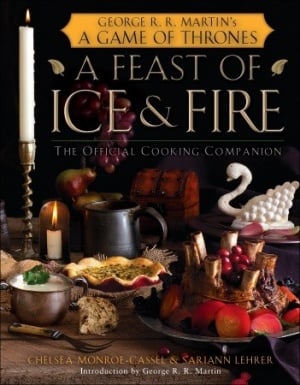
A Feast of Ice and Fire

A FEAST OF ICE AND FIRE: The Official Companion Cookbook by Chelsea Monroe-Cassel and Sariann Lehrer, with George R.R. Martin (Bantam, 2012)
GENRE: Cooking

Allow me to state up front that I'm not a fan of media tie-ins. Wookie Cookies is super cute, but not really my thing and if True Blood came out with a drinks guide, I probably wouldn't crack the spine. That said, A Feast of Fire and Ice, the official companion cookbook to A Game of Thrones is, suffice it to say, an exception.

There is so much about this cookbook that is exceptional, especially for a cooking geek (which I am), or a history geek (MA in medieval lit. here) or a fantasy geek (guilty as charged, though I'm embarrassed to admit that I have yet to read the series that inspired this culinary awesomeness, George R.R. Martin's Game of Fire and Ice). But there's a lot here for those who don't fall into one of these geekdoms too, though a love of food is pretty much required, otherwise what's the point?

Beautifully laid out with photography that begs for roaring fires and malt beer, the book is a visual treat, but it's the recipes that make A Feast and Ice a work of substance, rather than just another pretty face. Thoroughly modern and historically accurate, these dishes are deeply rooted in both the Westeros of Martin's books and the culinary traditions of medieval and Elizabethan Europe. Monroe-Cassel and Lehrer really know their stuff. While I expected the book to be filled with cutesy, Shepherds-pie-shaped nods to faux-Elizabethan cooking, what I found were recipes for everything from pease porridge (part of the "Breakfast on the Wall" menu) to "Dornish Snake with Fiery Sauce".  Every dish in this pristinely researched volume contains two recipes, one a historically accurate version for the cook with the time and resources to roast boar (yes, roast boar), the other a carefully constructed modern update that preserves the spirit of the original while incorporating modern ingredients and techniques. Sample menus are provided, organized by region, and suggestions for viable substitutions are helpfully given, just in case you can't source aurochs in time for your dinner party. An introduction by George R.R. Martin adds a charming touch, as do the quotes that pepper the chapters, which are likewise organized by region, from Winterfell and the Wall in the North to the lands across the Narrow Sea. Most helpfully, perhaps, is the succinct opening chapter on stocking a medieval kitchen and making certain basics, like the pastry dough and sauces that feature in various recipes.

Gorgeous, lush and tempting, A Feast of Ice and Fire really does inspire. It's heads and shoulders the best tie-in anything I've ever read and one of the best cookbooks of the year thus far. My only fear is that it will get overlooked by serious cooks for the same (admittedly snobby) reasons that nearly held me back. All I can do is say, please don't let it. This cookbook stands on it's own and I am officially a fan.

Incidentally, Chelsea Monroe-Cassel and Sariann Lehrer have a fantastic blog devoted to the cooking of Westeros called The Inn at the Crossroads. Check it out here.

August 15, 2012

Wolf Gift

THE WOLF GIFT by Anne Rice, (Knopf, 2012)
GENRE: Literary Horror / Existential Treatise

Anne Rice, the woman who turned the tide of how we perceive monsters with her tortured, sympathetic vampires and her tortured, sympathetic witches, went far afield in recent years, exploring the nature of good and evil in books populated by angels and demons and Jesus Christ. With The Wolf Gift, however, she returns to her old stomping grounds, giving us the existential musings of Ruben, a not-too-tortured but quite sympathetic werewolf.

At the start of the novel, Ruben Golding is a handsome and thoughtful, if somewhat wayward, young man, slouching successfully through the beginnings of a promising career in journalism while the women in his life rev forward in a blaze of professional ambition. But Ruben is destined for greater, stranger things. On a trip up the Mendocino coast to interview the mysterious and lovely Marchent Nideck, Ruben is attacked and bitten by a creature thought to be a wolf. Over the course of the following month, his senses sharpen and he grows physically even more impressive as his metabolism transforms and he becomes, yes, a werewolf. Driven by bloodlust and an instinctual urge to protect and avenge the innocent, Ruben rips through a nice collection of San Francisco's bad guys and, in the process, creates a public sensation in the form of the Man Wolf, a dark, avenging hero. What follows are Ruben's attempts to reconcile the two halves of his nature - the man's and the predator's - while learning about the true nature of lycanthropy, falling in love with a sexy older woman, and trying to uncover the mystery of the previous generation of werewolves before they kill him, all while dodging an Evil Eastern European Doctor (tm) hell bent of eradicating his kind. Needless to say, there's a lot going on.

Sprinkled in and among all of this are plenty of musings on religion, God and the nature of good and evil, (some at such interruptive length that they try the reader's patience). As with Lestat, Rice clearly loves Ruben. She has made him a nearly unbelievable idyll, with an MA at 20, a penchant for existential musings and religious philosophy, and the uncanny ability to quote obscure short stories without a second thought. This is not a bad thing, it's just that one must suspend a great deal of disbelief to buy into Ruben as a character. But, if you let go of the expectation that he could be a real person (lycanthropy or no) and is, rather, simply a construct of Rice's imagination, the entire thing is easier and much more pleasurable to read. Ultimately, The Wolf Gift contains many elements that fans will recognize from the Vampire Chronicles and the Mayfair Witches. For non-fans, the mannered language, tepid climax and mild, cliffhanger ending may fail to work, but for the legion of readers that have been waiting for her to return to her monsters, The Wolf Gift will be a welcome homecoming.


August 13, 2012

On the Abrupt and Sudden Need for Order

Up until now, this blog has pretty much functioned as a reader's catch-all. Most of the posts are informal reflections on whatever it is that I've read with plenty of gaps and non-posting in between. The most recent posts are reviews of picture books that I did as part of a project for a collection development class. The end result is that The Foggy Foot Review is a bit of a mess and the obsessive, organizational maniac in me cannot let this rest. So... I'm splitting things up into two blogs.

This blog will continue to be what it originally was - a mostly informal collection of mostly informal reviews (critical yes, with opinions and analysis aplenty, but with a fair bit of silliness and whatever else thrown in). I also reserve the right to post random stuff related to the written word here too. The other blog, Twisby Hall, (which I'm really pretty excited about), will focus entirely on material for young people, fans of young people and people who love young people and want them to read neat and exciting things. The occasional picture book might, on occasion, show up, but the focus will mostly be on materials for tweens and teens. The reviews are likely to be a little more serious (though scintillating and fascinating and never, ever stuffy), with a more professional focus, mostly because I'm trying to develop it as a professional resource for myself and for other librarians when the time comes.

And now I know return myself to the STACK of work that's gotten ignored in the name of blog clarity. I feel better now.

July 4, 2012

Courtney Crumrin and the Night Things


Courtney Crumrin and the Night Things by Ted Naifeh (Oni Press, 2002)
Graphic Novel / Contemporary / Horror

 Courtney Crumrin and the Night Things is the first volume in the three volume series that chronicles the not-so-normal everyday life of a loner girl who learns magic from her mysterious uncle and uses it to navigate a world of school bullies and bloodthirsty goblins and adolescent peer pressure. Throughout her adventures, Courtney displays ingenuity and intelligence, qualities that see her through some truly strange things (a good-girl doppelganger, goblins stealing a baby she’s sitting, etc). But though she is independent, strong and loyal, Courtney is far from perfect – she’s sarcastic and grumpy too, making her a fantastically real adolescent heroine. The world she inhabits is, by turns, normal to the point of banality, as well as gothic and creepy. Thanks to Neifeh’s clean, expressive illustrations (everyone but Courtney, Uncle Aloysius and select Night Things have vacant, empty eyes – a nice commentary on how Courtney feels about “normal”, suburban life), it’s a world that the reader can’t help but want to enter.

 Courtney Crumrin and the Night Things is excellent on several levels – the stories are fast-paced, engrossing and easy to read, making it a great selection for reluctant readers; and the subject matter veers elegantly between the fantastic (spells gone wrong) to the very real (bullying and isolation). It’s simply too good not to have in a library’s tween collection. Excellent recommendation for reluctant readers or tweens with an alternative vibe, great addition to any graphic novel display, particularly with other, darker / alternative stories like Gloomcookie and any of Neil Gaiman’s work.

Love That Dog: A Novel


. Love That Dog: A Novel by Susan Creech (Scholastic, 2001)
Contemporary / Poetry

On September 13, Jack writes down in his notebook that he does not want to write poetry, because “boy’s don’t write poetry. Girl’s do.” By the end of the book, on June 6th, Jack writes a letter thanking Walter Dean Myers for writing the poem, “Love That Boy” and for coming to talk to his class. Jack’s evolution over the course of the year is moving and inevitable and Creech reveals worlds of emotion through his changing relationship to poetry and his ability to write it. By weaving in snippets of, and references to, canonical poems, (“Stopping By Woods on a Snowy Evening” and “Red Wheelbarrow” among others) Creech hints at a deeper world and poetry’s ability to transcend resistance and grief. That said, the narrative is the opposite of stuffy, and Jack is a compelling but typical kid. His growth over the course of the year is not miraculous. It is natural. But that manner in which he experiences it is true poetry. 

Creech tells the moving story of a boy’s relationship to his dog and his growth over the course of a year with a spare, poetic grace. Structurally, Love That Dog could not be more sound, mixing prose and poetry seamlessly and effectively to communicate story, emotion and the accessibility of poetry with simple, stunning efficiency. I realize that I’m gushing, but I was simply blown away. And the back matter Creech includes at the end only deepens the reader’s appreciation for, and understanding of, the topic. It’s a fantastic discussion book and would do well as a quick book club selection or intro to a unit on poetry. Would also do well in a poetry display with Robert Frost, Walter Dean Myers and William Carlos Williams, among others. 

Matilda

Matilda 
By Roald Dahl; illustrations by Quentin Blake (Puffin Modern Classics, 1988)
Humor / Fantasy

Matilda is an exceptionally gifted five year-old, able to read and do mathematics well above her grade level. She is also the daughter of two exceptionally rotten parents, but despite her less-than-ideal home life, she is sweet, unassuming and surprisingly wise. The book Matilda, though charming in its own right (as most of Dahl’s work is), is in-and-of-itself exceptional, because of it’s exceptional heroine. As Matilda good naturedly sets out to do everything from read the classics to avenging her beloved teacher, Miss Honey, the reader is propelled along by a compulsion to see how Matilda will handle herself. And one is never disappointed.
 Matilda occupies a territory that is difficult to define – it is humorous without being expressly funny and it passes fluidly back and forth between the realistic and fantastic – and yet, Dahl never falters. The story is seamless and his heroine is a delight from start to finish. Though younger adolescents may get more out of reading it with an adult (some of the vocabulary and phrasings may prove challenging), most will gobble the story up as Matilda gets hers over the wretched Wormwoods and the horrific Miss Trunchbull. Matilda would be a great suggestion for a summer reading program. It would also do well in a display of books that celebrate reading (along with the Inkheart series, etc.)

June 25, 2012

The Aviary

The Aviary by Kathleen O'Dell (Knopf 2011)
Historical / Mystery


Eleven year old Clara lives in the once magnificent Glendoveer mansion, (the family home of a great magician) with her mother, the housekeeper, the magician’s aging widow and an aviary full of exotic birds. The birds respond to Clara as they respond to no one else – squawking, shrieking and eventually talking – as they enlist her help in solving the mystery of the five Glendoveer children, who were murdered fifty years before. It is a mystery that Clara is, unknowingly, at the very heart of.

The Aviary is a well paced, if slightly predictable, juvenile take on the Victorian gothic novel. The Glendoveer mansion is a gorgeous crumbling mausoleum, complete with locked rooms and drafty halls, in which Clara is essentially confined due to a “weak heart”. Her connection to Mrs. Glendoveer and the feathered inhabitants of the aviary is both genuine and touching, grounding her in her cloistered world, even as she longs to break free of it. The mystery at the heart of the novel – who killed the five oldest Glendoveer children and kidnapped the youngest – is interesting enough to drive the plot, though it does, at times, verge on the slightly ridiculous as it nears the inevitable climax. Overall, a quick-reading love note to period fiction of the Victorian age with just enough creepiness and mystery to keep young readers on their toes. Pair with other ghost stories in a library book club, or include in a classroom reading list with “Turn of the Screw” or “The Monkey’s Paw”. It’s a fun novel and a good way to introduce tension and mood. 


June 13, 2012

Death Cloud


Death Cloud by Andrew Lane (Farrar Straus Giroux, 2010)
Historical / Action / Mystery

The first in Lane’s new series, Sherlock Holmes: The Legend Begins, Death Cloud follows a fourteen-year-old Sherlock as he embarks on his first investigation – one that begins with two grotesquely swollen corpses and ends with a plot to topple the British Empire. Lane’s command of the material is impressive as he weaves in multiple threads and details that hint at the man the boy will become. The fast-paced, energetic plot is both fun and informative (semaphores and the Crimean War are deftly explained) as Lane pushes the young Holmes through teenage alienation, a first-crush and multiple attempts on his life, at break-neck speed.
Death Cloud is a solid book and will no doubt appeal to boys between the ages of 10-14. Lane’s Sherlock is a compellingly flawed protagonist (just as Doyle’s original is). My only complaint is that some of the action felt superfluous – a bit more deduction and bit less scrapping would have given the remaining action more punch. The climactic swordfight also verged on the preposterous with Sherlock battling an evil Baron whose movements are controlled by a series of ropes and pulleys. However, these complaints are small, and the elements in question will no doubt fail to offend Lane’s intended readership. A good introduction to a classic character, as well as to the concept of deduction and the Victorian era, Death Cloud would be a strong edition to a classroom list of elective titles or a unit on Victorian history.

Ella Enchanted


Ella Enchanted by Gail Carson Levine (Harper Collins, 1997)
Fantasy / Fairy Tales / Romance

When Ella of Frell is born, the fairy Lucinda bestows a gift upon her – the gift of obedience – which turns out to be a terrible curse. As a result, Ella must find ways to assert herself despite the constant threat of obedience (if someone told her to cut off her head, she would have to). Ella’s naturally independent nature grows stronger with every challenge, despite, or perhaps because of, the curse. A clever, genuinely funny adaptation on the Cinderella tale, Ella Enchanted is the story of a cursed girl who becomes a woman capable of saving herself.
This is a wonderful book for reluctant YA and tween readers – especially girls. The story is just recognizable enough to feel familiar to anyone who has heard of Cinderella, but it deviates substantially from the classic girl-as-victim plot, giving the reader a spunky, empowering heroine she can relate to. The humor, romantic elements, and first-person narrative make it a truly accessible, charming read.

June 4, 2012

A Wrinkle in Time

A Wrinkle in Time by Madeleine L'Engle (Random House, re-issue 2005)
Fiction


Winner of the Newberry in 1963, A Wrinkle in Time is the rare sort of book that manages multiple threads on multiple levels seamlessly while following a perfectly linear arc. The book opens on a “dark and stormy night” with misfit Meg Murry having hot chocolate with her mother and brother, Charles Wallace, an uncanny four-year-old savant. When a stranger comes in from the storm, the stage is set for what becomes an extraordinary journey through time and space to save Meg and Charles Wallace’s missing astrophysicist father. On one level, A Wrinkle in Time is a beautifully executed, if unsettling, adventure featuring a disturbing set of antagonists, including a repulsive, disembodied brain with the power of mind control. On another level, it is the story of Meg’s coming of age as she realizes that her beloved father is not omnipotent, and that she herself is more capable than she realizes. It is a sophisticated masterpiece with science, mathematics, philosophy and religion sprinkled throughout. L’Engle expects much from her readers and more than rewards the effort. The first in L'Engle's celebrated Time Quintet, A Wrinkle in Time is celebrating it's 50th Anniversary this year. It deserves quite a party, I think. 

A Visit to William Blake's Inn

A Visit to William Blake's Inn:
Poems for Innocent and Experienced 
Travelers
By Nancy Willard
Illustrated by Alice and Martin Provensen
Harcourt Brace, 1981
Poetry

A Visit to William Blake’s Inn has the rare honor of being the recipient of both the Newbery Medal and a Caldecott Honor, and for good reason. The fifteen poems and epilogue tell the tale of a child’s stay at William Blake’s inn, where dragons bake the bread and angels make the beds. While there, he meets Blake’s famous Tiger, as well as the King of Cats, the Marmalade Man and Blake himself, among many others. Willard’s poems owe themselves to Blake in structure and style, but the whimsical imagery and gentle, absurd humor are original and entirely beguiling. These are not simple, nursery rhymes but real poems with pleasingly complex meters. Yet, what could be a frustrating challenge to young readers is rendered playful fun as Blake takes his guests on a tour of the Milky Way and the Wise Cow eats a cloud on buttered bread. There is just enough non-sense sprinkled throughout (hints of Edward Lear and T.S. Eliot) to keep any child entertained. Even more importantly, it is a wonderful and playful introduction to a more sophisticated poetic form for older readers. Alice and Martin Provensen's odd and delicate gauche illustrations are the perfect counterpoint to Willard's poems, encouraging the reader to fully engage and believe in William Blake's magical inn and very much want to visit themselves.

May 17, 2012

Mirror, Mirror
By Marilyn Singer
Illustrated by Josee Masse
Primary Dutton 32 pp.
978-0525479017 Hardcover $16.99
Fiction / Poetry

Marilyn Singer plays with an interesting concept in Mirror, Mirror. The poems are all distillations of familiar fairy tales - very nice so far - but the verse is "reversible", which is where things begin to get dicey. The concept of reversible verse is a good one. The poems are meant to have different meanings, depending on whether or not one is reading them front to back or back to front. To aid in this exercise, Singer presents the two versions of each poem side by side as mirror images of the other. Some of these reversals are quite successful, (Rapunzel and Cinderella particularly stand out), but others, (like the Red Riding Hood poem among quite a few others), work well enough in one direction but become forced and nonsensical in the other. Given that the reversibility of the verse is the book's foundation, this flaw in execution undermines the whole. That said, Josee Masse's illustrations are lovely, with lush colors and pleasingly rounded, clean lines. Each story receives an illustration and each illustration captures the essence of both the original tale and Singer's poem with charming efficiency. As distillations of well-known stories, the poems are easy to enjoy. Overall, Mirror, Mirror is worth reading and selections would make a nice addition to storytimes for older children, so long as you cherry-pick a handful rather than through the whole.

May 4, 2012

And Then It's Spring

And Then It's Spring
By Julie Fogliano
Illustrated by Erin E. Stead
3-4 Preschool Primary
Roaring Brook 32 pp.
978-1596436244 Hardcover $16.99
Fiction

 And Then It's Spring very quietly took me by surprise. After a long winter, a boy and his dog are tired of brown, ("First you have brown, all around you have brown), so they decide to plant a garden. They plant seeds in the brown dirt and watch the garden for signs of growth through sunshine and rain, always keeping an eye out for a little green. Slowly, the brown becomes a more "hopeful shade of brown" until the garden blooms under their nurturing care.

On the face of it, And Then It's Spring is a straight-forward story about anticipation rewarded. It's the prosaic and visual journey Fogliano and Stead take us on to get to the blooming garden that makes it special. Fogliano's prose is poetic and rhythmic and whimsical without ever losing its grounding in the story, so that when the boy, concerned that the seeds are not growing puts up a sign that says, "please do not stomp here - there are seeds and they are trying," (it's aimed at bears and other stomping creatures), the reader is charmed by his quirky earnestness while never losing sight of his very serious goal. Stead, who won the Caldecott last year for A Sick Day for Amos McGee, gives And Then It's Spring the same meticulous treatment, gradually altering the tone of the browns so that they become lighter and more "hopeful" the closer they get to spring.

There is so much I could say about And Then It's Spring, so many reasons why it's such an excellent book, but interest of brevity, I will simply say that it is a book that rewards slow readings and careful eyes, (look for details like a turtle wearing a red hat that matches the boy's). It is a book that takes a reader by quietly by surprise - like the first, tiny glimpse of green after months and months of brown.