Mirror, Mirror
By Marilyn Singer
Illustrated by Josee Masse
Primary Dutton 32 pp.
978-0525479017 Hardcover $16.99
Fiction / Poetry
Marilyn Singer plays with an interesting concept in Mirror, Mirror. The poems are all distillations of familiar fairy tales - very nice so far - but the verse is "reversible", which is where things begin to get dicey. The concept of reversible verse is a good one. The poems are meant to have different meanings, depending on whether or not one is reading them front to back or back to front. To aid in this exercise, Singer presents the two versions of each poem side by side as mirror images of the other. Some of these reversals are quite successful, (Rapunzel and Cinderella particularly stand out), but others, (like the Red Riding Hood poem among quite a few others), work well enough in one direction but become forced and nonsensical in the other. Given that the reversibility of the verse is the book's foundation, this flaw in execution undermines the whole. That said, Josee Masse's illustrations are lovely, with lush colors and pleasingly rounded, clean lines. Each story receives an illustration and each illustration captures the essence of both the original tale and Singer's poem with charming efficiency. As distillations of well-known stories, the poems are easy to enjoy. Overall, Mirror, Mirror is worth reading and selections would make a nice addition to storytimes for older children, so long as you cherry-pick a handful rather than through the whole.
Showing posts with label storytime. Show all posts
May 17, 2012
May 4, 2012
And Then It's Spring
By Julie Fogliano
Illustrated by Erin E. Stead
3-4 Preschool Primary
Roaring Brook 32 pp.
978-1596436244 Hardcover $16.99
Fiction
And Then It's Spring very quietly took me by surprise. After a long winter, a boy and his dog are tired of brown, ("First you have brown, all around you have brown), so they decide to plant a garden. They plant seeds in the brown dirt and watch the garden for signs of growth through sunshine and rain, always keeping an eye out for a little green. Slowly, the brown becomes a more "hopeful shade of brown" until the garden blooms under their nurturing care.
On the face of it, And Then It's Spring is a straight-forward story about anticipation rewarded. It's the prosaic and visual journey Fogliano and Stead take us on to get to the blooming garden that makes it special. Fogliano's prose is poetic and rhythmic and whimsical without ever losing its grounding in the story, so that when the boy, concerned that the seeds are not growing puts up a sign that says, "please do not stomp here - there are seeds and they are trying," (it's aimed at bears and other stomping creatures), the reader is charmed by his quirky earnestness while never losing sight of his very serious goal. Stead, who won the Caldecott last year for A Sick Day for Amos McGee, gives And Then It's Spring the same meticulous treatment, gradually altering the tone of the browns so that they become lighter and more "hopeful" the closer they get to spring.
There is so much I could say about And Then It's Spring, so many reasons why it's such an excellent book, but interest of brevity, I will simply say that it is a book that rewards slow readings and careful eyes, (look for details like a turtle wearing a red hat that matches the boy's). It is a book that takes a reader by quietly by surprise - like the first, tiny glimpse of green after months and months of brown.
By Julie Fogliano
Illustrated by Erin E. Stead
3-4 Preschool Primary
Roaring Brook 32 pp.
978-1596436244 Hardcover $16.99
Fiction
And Then It's Spring very quietly took me by surprise. After a long winter, a boy and his dog are tired of brown, ("First you have brown, all around you have brown), so they decide to plant a garden. They plant seeds in the brown dirt and watch the garden for signs of growth through sunshine and rain, always keeping an eye out for a little green. Slowly, the brown becomes a more "hopeful shade of brown" until the garden blooms under their nurturing care.
On the face of it, And Then It's Spring is a straight-forward story about anticipation rewarded. It's the prosaic and visual journey Fogliano and Stead take us on to get to the blooming garden that makes it special. Fogliano's prose is poetic and rhythmic and whimsical without ever losing its grounding in the story, so that when the boy, concerned that the seeds are not growing puts up a sign that says, "please do not stomp here - there are seeds and they are trying," (it's aimed at bears and other stomping creatures), the reader is charmed by his quirky earnestness while never losing sight of his very serious goal. Stead, who won the Caldecott last year for A Sick Day for Amos McGee, gives And Then It's Spring the same meticulous treatment, gradually altering the tone of the browns so that they become lighter and more "hopeful" the closer they get to spring.
There is so much I could say about And Then It's Spring, so many reasons why it's such an excellent book, but interest of brevity, I will simply say that it is a book that rewards slow readings and careful eyes, (look for details like a turtle wearing a red hat that matches the boy's). It is a book that takes a reader by quietly by surprise - like the first, tiny glimpse of green after months and months of brown.
May 2, 2012
How Do Dinosaurs Get Well Soon?
By Jane Yolen
http://janeyolen.com/
Illustrated by Mark Teague
No Illustrator Website
3-4 Preschool Primary Blue Sky 40 pp.
978-0439241007 Hardcover $16.99
Fiction
Second in the popular How Do Dinosaurs... series by Jane Yolen and Mark Teague, How Do Dinosaurs Get Well Soon? follows the same format that worked so well in the original, How Do Dinosaurs Say Goodnight? And indeed, the question / answer pattern does draw the reader in. What does a dinosaur do when he catches the flu? Does he behave badly, whining as he tosses tissue and medicine all over his room? The answer is no. A dinosaur drinks his juice and gets rest and takes his medicine - just like a human kid should when he's not feeling good. It's a nice guide to behaving well while sick without reverting too heavily towards didacticism.
The dinosaurs are clearly child stand-ins, and they do the job with personality and comedic pizzazz, thanks to Teague's illustrations. Massive next to their human parents, the dinosaurs convey an air of child-like crankiness that resonates emotionally while still being funny. Especially cute is the Shakespearean drama with which they blow their noses, (especially nice is the Styracosaurus who gets forcibly dragged to the doctor by his mom). A nice touch, as always, is the variety of dinosaurs Teague uses. You'll find old, familiar stand-bys like Brachiosaurus in addition to a nice selection of lesser known dinos, like Gallimimus and Carnotaurus. The featured dinos also make a cast appearance on the endpapers with names clearly labeled beneath them. Yolen's rhyming text is fun and accessible, though a bit awkward at times, especially towards the end. Still, it doesn't detract from the overall success of the book, which will surely appeal to preschoolers, both sick and well, at story times and at home. As an added bonus, How Do Dinosaurs Get Well Soon? will likely appeal to parents who recognize their own children in the book's cranky protagonists.
By Jane Yolen
http://janeyolen.com/
Illustrated by Mark Teague
No Illustrator Website
3-4 Preschool Primary Blue Sky 40 pp.
978-0439241007 Hardcover $16.99
Fiction
Second in the popular How Do Dinosaurs... series by Jane Yolen and Mark Teague, How Do Dinosaurs Get Well Soon? follows the same format that worked so well in the original, How Do Dinosaurs Say Goodnight? And indeed, the question / answer pattern does draw the reader in. What does a dinosaur do when he catches the flu? Does he behave badly, whining as he tosses tissue and medicine all over his room? The answer is no. A dinosaur drinks his juice and gets rest and takes his medicine - just like a human kid should when he's not feeling good. It's a nice guide to behaving well while sick without reverting too heavily towards didacticism.
The dinosaurs are clearly child stand-ins, and they do the job with personality and comedic pizzazz, thanks to Teague's illustrations. Massive next to their human parents, the dinosaurs convey an air of child-like crankiness that resonates emotionally while still being funny. Especially cute is the Shakespearean drama with which they blow their noses, (especially nice is the Styracosaurus who gets forcibly dragged to the doctor by his mom). A nice touch, as always, is the variety of dinosaurs Teague uses. You'll find old, familiar stand-bys like Brachiosaurus in addition to a nice selection of lesser known dinos, like Gallimimus and Carnotaurus. The featured dinos also make a cast appearance on the endpapers with names clearly labeled beneath them. Yolen's rhyming text is fun and accessible, though a bit awkward at times, especially towards the end. Still, it doesn't detract from the overall success of the book, which will surely appeal to preschoolers, both sick and well, at story times and at home. As an added bonus, How Do Dinosaurs Get Well Soon? will likely appeal to parents who recognize their own children in the book's cranky protagonists.
April 30, 2012
Brave Charlotte
Brave Charlotte
By Anu Stohner
Illustrated by Henrike Wilson
No Author / Illustrator Website
2-4 Preschool Primary Bloomsbury 32 pp.
978-1582346908 Hardcover $16.95
Fiction
Winner of NY Times Best Illustrated Book Award, Brave Charlotte is the story of a very un-sheep-like sheep named Charlotte. Charlotte is ready for adventure. She climbs trees, leaps over riverbanks and performs feats of daring-do, all while the other sheep in her flock look on with a mixture of disapproval and disbelief. Still, Charlotte continues to do her own thing, and when the old shepherd falls and breaks his leg, her bravery saves the day as she is the only one able or willing to travel the long distance to the farmer's house to get help.
Brave Charlotte is a well-constructed story with a timeless moral - sometimes the outsider, the one who doesn't follow the flock, is important to the whole precisely because she does not quite fit in. This lesson is underscored by the fact that each thing Charlotte does that garners disapproval, (climbing rocks and trees, jumping rivers and crossing roads) is part of her climactic journey to the farmer's house. Far from moralizing however, Stohner's text is natural and charming, with sweet touches like a trucker picking up Charlotte for the last leg of her journey and the farmer recognizing her as she peers in the farmhouse window. Wilson's illustrations are irresistibly appealing with Charlotte pictured as both intrepid and sweetly vulnerable as she sets out on her own. She is a truly appealing heroine, one that fully engages the reader just by being herself. A lovely story beautifully illustrated, Brave Charlotte won't fail to win the day, whether at storytime or at home.
By Anu Stohner
Illustrated by Henrike Wilson
No Author / Illustrator Website
2-4 Preschool Primary Bloomsbury 32 pp.
978-1582346908 Hardcover $16.95
Fiction
Winner of NY Times Best Illustrated Book Award, Brave Charlotte is the story of a very un-sheep-like sheep named Charlotte. Charlotte is ready for adventure. She climbs trees, leaps over riverbanks and performs feats of daring-do, all while the other sheep in her flock look on with a mixture of disapproval and disbelief. Still, Charlotte continues to do her own thing, and when the old shepherd falls and breaks his leg, her bravery saves the day as she is the only one able or willing to travel the long distance to the farmer's house to get help.
Brave Charlotte is a well-constructed story with a timeless moral - sometimes the outsider, the one who doesn't follow the flock, is important to the whole precisely because she does not quite fit in. This lesson is underscored by the fact that each thing Charlotte does that garners disapproval, (climbing rocks and trees, jumping rivers and crossing roads) is part of her climactic journey to the farmer's house. Far from moralizing however, Stohner's text is natural and charming, with sweet touches like a trucker picking up Charlotte for the last leg of her journey and the farmer recognizing her as she peers in the farmhouse window. Wilson's illustrations are irresistibly appealing with Charlotte pictured as both intrepid and sweetly vulnerable as she sets out on her own. She is a truly appealing heroine, one that fully engages the reader just by being herself. A lovely story beautifully illustrated, Brave Charlotte won't fail to win the day, whether at storytime or at home.
April 27, 2012
From Head to Toe
From Head to Toe
By Eric Carle; illus. by author
http://www.eric-carle.com/home.html
2-4 Preschool Primary Harper Collins 32 pp.
978-0590222020 Hardcover $17.99
Non Fiction
Animals do a lot of things with their bodies, from the simple to the complex. Penguins turn their heads. "Can you do it?" the penguin asks. "I can do it!" the boy on the opposite page replies. And so it goes, with animals performing physical acts and children mimicking their movements. The movements become progressively more challenging with a giraffe turning its head giving way to a cat arching its back and a donkey kicking its legs, but always the response to the question, "can you do it?" comes the answer, "I can do it!" It's an enthusiastic invitation to the reader to jump in and kick, wriggle and stomp with the animals, as well.
From Head to Toe is pure interactive fun, but there is a lot of education occurring within its patterned framework. The reader is introduced not only to a variety of animals, but to specific physical actions and body parts. The interactive text asks that children listen and follow directions, and practice both fine and gross motor skills while imitating the animals. A nice additional touch is the repeated declaration of "I can do it!" as part of the call and response, and as usual, Carle's collage illustrations are exuberant, appealing and hard to resist. A great choice for story times and group settings, From Head to Toe also works at home, being adaptable to siblings in a wide variety of ages.
By Eric Carle; illus. by author
http://www.eric-carle.com/home.html
2-4 Preschool Primary Harper Collins 32 pp.
978-0590222020 Hardcover $17.99
Non Fiction
Animals do a lot of things with their bodies, from the simple to the complex. Penguins turn their heads. "Can you do it?" the penguin asks. "I can do it!" the boy on the opposite page replies. And so it goes, with animals performing physical acts and children mimicking their movements. The movements become progressively more challenging with a giraffe turning its head giving way to a cat arching its back and a donkey kicking its legs, but always the response to the question, "can you do it?" comes the answer, "I can do it!" It's an enthusiastic invitation to the reader to jump in and kick, wriggle and stomp with the animals, as well.
From Head to Toe is pure interactive fun, but there is a lot of education occurring within its patterned framework. The reader is introduced not only to a variety of animals, but to specific physical actions and body parts. The interactive text asks that children listen and follow directions, and practice both fine and gross motor skills while imitating the animals. A nice additional touch is the repeated declaration of "I can do it!" as part of the call and response, and as usual, Carle's collage illustrations are exuberant, appealing and hard to resist. A great choice for story times and group settings, From Head to Toe also works at home, being adaptable to siblings in a wide variety of ages.
April 25, 2012
Dear Zoo
Dear Zoo: A Lift the Flap Book
By Rod Campbell; illus. by author
http://www.rodcampbell.co.uk/
1-4 Preschool Little Simon 18 pp.
978-1416947370 Board $6.99
Fiction
Dear Zoo is 25 years old. In honor of its silver anniversary, Rod Campbell refreshed and updated the original illustrations. Happily, they remain as classically appealing as the originals, (nothing substantial was changed). The patterned text is simple and almost universally appealing to toddlers and preschoolers. An unseen narrator, (presumably a child), tells the reader that he wrote to the zoo to send him a pet. So the very obliging zoo-keepers send him a series of animals, each hiding behind a flap. There are clues on each flap as to which animal is in the box, (the elephant's box is labeled "very heavy", the lion is partially visible between the slats, etc.), while below the illustration is the reason that each particular animal won't do, (the giraffe is too tall, the monkey too naughty, and so on). Finally, the zoo sends the perfect pet - a puppy - which the narrator happily keeps.
Dear Zoo is a classic example of an interactive book for toddlers and preschoolers. Great for storytime at libraries or at home, it provides pre-verbal listeners with the opportunity to manipulate the flaps and reveal the surprise of each animal, while slightly older toddlers and preschoolers can guess at the occupant of each box, read the simple text and practice their animal sounds. A classic for a reason, the reissued board book is sturdy enough to withstand the repeated readings and constant handling it will no doubt (deservedly) receive.
By Rod Campbell; illus. by author
http://www.rodcampbell.co.uk/
1-4 Preschool Little Simon 18 pp.
978-1416947370 Board $6.99
Fiction
Dear Zoo is 25 years old. In honor of its silver anniversary, Rod Campbell refreshed and updated the original illustrations. Happily, they remain as classically appealing as the originals, (nothing substantial was changed). The patterned text is simple and almost universally appealing to toddlers and preschoolers. An unseen narrator, (presumably a child), tells the reader that he wrote to the zoo to send him a pet. So the very obliging zoo-keepers send him a series of animals, each hiding behind a flap. There are clues on each flap as to which animal is in the box, (the elephant's box is labeled "very heavy", the lion is partially visible between the slats, etc.), while below the illustration is the reason that each particular animal won't do, (the giraffe is too tall, the monkey too naughty, and so on). Finally, the zoo sends the perfect pet - a puppy - which the narrator happily keeps.
Dear Zoo is a classic example of an interactive book for toddlers and preschoolers. Great for storytime at libraries or at home, it provides pre-verbal listeners with the opportunity to manipulate the flaps and reveal the surprise of each animal, while slightly older toddlers and preschoolers can guess at the occupant of each box, read the simple text and practice their animal sounds. A classic for a reason, the reissued board book is sturdy enough to withstand the repeated readings and constant handling it will no doubt (deservedly) receive.
Mama Cat Has Three Kittens
By Denise Fleming; illus. by author
http://www.denisefleming.com/
1-4 Preschool Primary Henry Holt 32 pp.
978-0805057454 Hardcover $17.95
Fiction
Mama Cat has three kittens, two of whom - Fluffy and Skinny - follow in her footsteps as she washes her paws and walks the stone wall and engages in a number of other classically feline endeavors. Boris, the third kitten, naps... until Mama Cat, Fluffy and Skinny curl up to nap too. Then Boris comes alive, washing his paws and pouncing, (if only to his next napping stop, this time with his Mama and siblings).
Mama Cat Has Three Kittens is a visually beautiful book. Fleming, an obvious cat lover, captures feline body language and behavior with surprising ease. Her use of deeply saturated colors on handmade paper gives the illustrations a textured look that works especially well on the cats, with their bold colorations and nuanced expressions. As an added bit of charm, Fleming adds trios of other creatures to each spread (bees, ants and beetles, etc.), as well as one intrepid Mama Mouse, (the purpose of whose foraging is revealed at the end). Unfortunately, the text falls flat beside the vibrant pictures. While there is nothing particularly wrong with the narrative, it's pattern feels unfulfilled when, after napping through his family's long series of activities, Boris wakes only to pounce once and nap again. Rather than vindicating the little one who lags behind or marches to his own drum, Boris, though made a central figure throughout by Fleming's repetition of "Boris naps" fails to ever take on a dynamic quality of his own. A small thing, but one that contributes to the slightness of the story. That said, very young readers will appreciate the bold font and simple vocabulary, while pre-readers will respond to the illustrations and love playing "find-the-mouse". A solid book overall, Mama Cat Has Three Kittens fails only in that it could have been more than solid - it could have been great.
By Denise Fleming; illus. by author
http://www.denisefleming.com/
1-4 Preschool Primary Henry Holt 32 pp.
978-0805057454 Hardcover $17.95
Fiction
Mama Cat has three kittens, two of whom - Fluffy and Skinny - follow in her footsteps as she washes her paws and walks the stone wall and engages in a number of other classically feline endeavors. Boris, the third kitten, naps... until Mama Cat, Fluffy and Skinny curl up to nap too. Then Boris comes alive, washing his paws and pouncing, (if only to his next napping stop, this time with his Mama and siblings).
Mama Cat Has Three Kittens is a visually beautiful book. Fleming, an obvious cat lover, captures feline body language and behavior with surprising ease. Her use of deeply saturated colors on handmade paper gives the illustrations a textured look that works especially well on the cats, with their bold colorations and nuanced expressions. As an added bit of charm, Fleming adds trios of other creatures to each spread (bees, ants and beetles, etc.), as well as one intrepid Mama Mouse, (the purpose of whose foraging is revealed at the end). Unfortunately, the text falls flat beside the vibrant pictures. While there is nothing particularly wrong with the narrative, it's pattern feels unfulfilled when, after napping through his family's long series of activities, Boris wakes only to pounce once and nap again. Rather than vindicating the little one who lags behind or marches to his own drum, Boris, though made a central figure throughout by Fleming's repetition of "Boris naps" fails to ever take on a dynamic quality of his own. A small thing, but one that contributes to the slightness of the story. That said, very young readers will appreciate the bold font and simple vocabulary, while pre-readers will respond to the illustrations and love playing "find-the-mouse". A solid book overall, Mama Cat Has Three Kittens fails only in that it could have been more than solid - it could have been great.
Two Homes
Two Homes
By Claire Masurel
No Author Site
Illustrated by Kady MacDonald Denton
http://www.kadymacdonalddenton.ca/
2-4 Preschool Primary Candlewick 40 pp.
978-0763619848 Paperback $6.99
Fiction
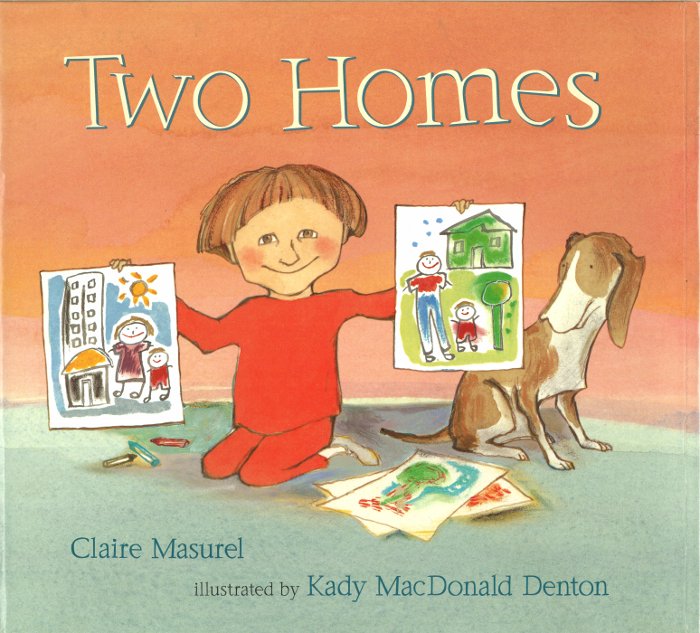
The word that most came to mind as I was reading Claire Masurel's Two Homes was "comforting". Regardless of the circumstances, whether friendly or hostile, divorce is a life altering experience for a child, one that cannot be soothed away with trite, authorial reassurances. Given this, Masurel makes a nice choice in having Alex, the protagonist of Two Homes, address the reader directly as one who's arrived on the other side of divorce and survived with both relationships intact. The narrative's dual structure helps reinforce the strength of his relationships to each parent. Each home balances the other - "I have two rooms. My room at Daddy's. My room at Mommy's." Both are shown as being equally important to Alex, while the illustrations picture Alex being equally happy in both.
The list of things Alex has two of - favorite chairs, toothbrushes, front doors etc. - are comforting in their everyday-ness, making it clear that, though Alex has two homes, both are very stable. Kady MacDonald Denton's illustrations add to that sense of well-being. Both parents are portrayed as warm and engaged, while Alex is never pictured as being upset, confused or missing the parent that isn't there. In fact, he seems like a very well-adjusted kid with artwork of both parents up in both homes. The story is tremendously reassuring. It feels like a kid addressing another kid, until the end when both parents in, one voice, tell Alex that they love him wherever he is. A simple, satisfying message in an honest, lovely book - the best on divorce that I've come across for this age group.
By Claire Masurel
No Author Site
Illustrated by Kady MacDonald Denton
http://www.kadymacdonalddenton.ca/
2-4 Preschool Primary Candlewick 40 pp.
978-0763619848 Paperback $6.99
Fiction
The word that most came to mind as I was reading Claire Masurel's Two Homes was "comforting". Regardless of the circumstances, whether friendly or hostile, divorce is a life altering experience for a child, one that cannot be soothed away with trite, authorial reassurances. Given this, Masurel makes a nice choice in having Alex, the protagonist of Two Homes, address the reader directly as one who's arrived on the other side of divorce and survived with both relationships intact. The narrative's dual structure helps reinforce the strength of his relationships to each parent. Each home balances the other - "I have two rooms. My room at Daddy's. My room at Mommy's." Both are shown as being equally important to Alex, while the illustrations picture Alex being equally happy in both.
The list of things Alex has two of - favorite chairs, toothbrushes, front doors etc. - are comforting in their everyday-ness, making it clear that, though Alex has two homes, both are very stable. Kady MacDonald Denton's illustrations add to that sense of well-being. Both parents are portrayed as warm and engaged, while Alex is never pictured as being upset, confused or missing the parent that isn't there. In fact, he seems like a very well-adjusted kid with artwork of both parents up in both homes. The story is tremendously reassuring. It feels like a kid addressing another kid, until the end when both parents in, one voice, tell Alex that they love him wherever he is. A simple, satisfying message in an honest, lovely book - the best on divorce that I've come across for this age group.
April 24, 2012
The Good-Bye Book
The Good-Bye Book
By Judith Viorst
No Author Site
Illustrated by Kay Chorao
http://www.kaychorao.com/
3-4 Preschool Primary Atheneum 32 pp.
978-0780788572 Hardcover $16.25
Fiction
The Good-Bye Book is not so much a story, as a child's reaction to being left with a sitter while his parents go out to dinner. The boy, illustrated by Kay Chorao with just the right blend of vulnerability and stubbornness, does not want his parents to go to a French restaurant. He begs, wheedles, yells and even offers to go to the restaurant with them rather than be left at home with a dreaded sitter, whom he imagines as an old lady with too much make-up who makes him eat vegetables and watch boring TV. When that doesn't work, he decides that he's sick, ("I mean, maybe I'm dying") and asks for "one more book. Okay, half a book. A poem?" Meanwhile, his parents continue to get dressed, (though the sting of this is softened by their concerned looks and patient expressions). Finally, the boy refuses to say good-bye just as the sitter, (a young man with a stack of picture books) arrives. The boy begins to smile and ends up waving good-bye to his parents, perched on his sitter's shoulders.
The Good-Bye Book is interesting in that it's written entirely in the 2nd person, with the boy addressing the soliloquy to his parents. It makes the situation feel very immediate, mimicking the immediacy of his distress. Viorst allows her young protagonist to run the entire emotional gamut without ever going over the top so that, while funny in places, (the boy imagines being attacked by the celery the sitter might force on him), his distress always rings emotionally true. Just as important is the fact that his turn-around in the face of the real sitter feels organic and unforced. The end result is a book that acknowledges the difficulties of saying good-bye, while allowing the protagonist (and the reader) to naturally conclude that it will be all right. A reassuring message made all the more reassuring by the voice of the boy and the strength of his initial worries at being left at home.
By Judith Viorst
No Author Site
Illustrated by Kay Chorao
http://www.kaychorao.com/
3-4 Preschool Primary Atheneum 32 pp.
978-0780788572 Hardcover $16.25
Fiction
The Good-Bye Book is not so much a story, as a child's reaction to being left with a sitter while his parents go out to dinner. The boy, illustrated by Kay Chorao with just the right blend of vulnerability and stubbornness, does not want his parents to go to a French restaurant. He begs, wheedles, yells and even offers to go to the restaurant with them rather than be left at home with a dreaded sitter, whom he imagines as an old lady with too much make-up who makes him eat vegetables and watch boring TV. When that doesn't work, he decides that he's sick, ("I mean, maybe I'm dying") and asks for "one more book. Okay, half a book. A poem?" Meanwhile, his parents continue to get dressed, (though the sting of this is softened by their concerned looks and patient expressions). Finally, the boy refuses to say good-bye just as the sitter, (a young man with a stack of picture books) arrives. The boy begins to smile and ends up waving good-bye to his parents, perched on his sitter's shoulders.
The Good-Bye Book is interesting in that it's written entirely in the 2nd person, with the boy addressing the soliloquy to his parents. It makes the situation feel very immediate, mimicking the immediacy of his distress. Viorst allows her young protagonist to run the entire emotional gamut without ever going over the top so that, while funny in places, (the boy imagines being attacked by the celery the sitter might force on him), his distress always rings emotionally true. Just as important is the fact that his turn-around in the face of the real sitter feels organic and unforced. The end result is a book that acknowledges the difficulties of saying good-bye, while allowing the protagonist (and the reader) to naturally conclude that it will be all right. A reassuring message made all the more reassuring by the voice of the boy and the strength of his initial worries at being left at home.
April 23, 2012
Charlotte Jane Battles Bedtime
By Myra Wolfe
Illustrated by Maria Monescillo
No Author / Illustrator Sites
3-4 Preschool Primary Harcourt 32 pp.
978-0152061500 Hardcover $16.99
Fiction
Charlotte Jane Battles Bedtime is a fabulous read, with a feisty protagonist and a straightforward but cleverly executed message. Charlotte Jane is born into a family of pirates. Even as a baby her parents could see that she has lots of "oomph," a fact born out by the illustration of her parents (dad has an eyepatch and mom a saucy bandana) smiling over the howling Charlotte. Charlotte Jane grows and so does her oomph. Soon both are sturdy and bold, and bent on getting "all of the juice" out the day. But sleep is not juicy, so she battles bedtime until one night, she doesn't go to sleep at all. The cost of her victory is high - as a result, Charlotte Jane loses her "oomph". Though her parents look everywhere, including the neighbor's recycling bin, her oomph remains missing. But then, while glaring at her bed, Charlotte Jane realizes that sleep might be "for landlubbers" but dreams, particularly piratical dreams, can be "rip-roarers," so Charlotte Jane dreams and wakes up with her formidable oomph in tact.
There are a lot of elements that make Charlotte Jane Battles Bedtime so good. The dialogue sprinkled with pirate-isms is just plain fun (Charlotte Jane refers to her parents as "me buckos" and her father calls her his "little doubloon"), the illustrations are clever, (Charlotte Jane and her parents live in a boat-shaped house in an otherwise regular neighborhood, hinting at the possibility that Charlotte Jane's imagination may be at work on the pirate theme) and the story is well-paced and tight. Especially nice was the fact that Charlotte Jane finds the solution to her problem by herself - she learns that sleep feeds her oomph and that "hearty" dreams are a good excuse to sleep - without authorial moralizing. Charlotte Jane Battles Bedtime is one of the most original bedtimes stories I've recently read. Great for storytime and bedtime and any time in between, this is one story with formidable oomph.
By Myra Wolfe
Illustrated by Maria Monescillo
No Author / Illustrator Sites
3-4 Preschool Primary Harcourt 32 pp.
978-0152061500 Hardcover $16.99
Fiction
Charlotte Jane Battles Bedtime is a fabulous read, with a feisty protagonist and a straightforward but cleverly executed message. Charlotte Jane is born into a family of pirates. Even as a baby her parents could see that she has lots of "oomph," a fact born out by the illustration of her parents (dad has an eyepatch and mom a saucy bandana) smiling over the howling Charlotte. Charlotte Jane grows and so does her oomph. Soon both are sturdy and bold, and bent on getting "all of the juice" out the day. But sleep is not juicy, so she battles bedtime until one night, she doesn't go to sleep at all. The cost of her victory is high - as a result, Charlotte Jane loses her "oomph". Though her parents look everywhere, including the neighbor's recycling bin, her oomph remains missing. But then, while glaring at her bed, Charlotte Jane realizes that sleep might be "for landlubbers" but dreams, particularly piratical dreams, can be "rip-roarers," so Charlotte Jane dreams and wakes up with her formidable oomph in tact.
There are a lot of elements that make Charlotte Jane Battles Bedtime so good. The dialogue sprinkled with pirate-isms is just plain fun (Charlotte Jane refers to her parents as "me buckos" and her father calls her his "little doubloon"), the illustrations are clever, (Charlotte Jane and her parents live in a boat-shaped house in an otherwise regular neighborhood, hinting at the possibility that Charlotte Jane's imagination may be at work on the pirate theme) and the story is well-paced and tight. Especially nice was the fact that Charlotte Jane finds the solution to her problem by herself - she learns that sleep feeds her oomph and that "hearty" dreams are a good excuse to sleep - without authorial moralizing. Charlotte Jane Battles Bedtime is one of the most original bedtimes stories I've recently read. Great for storytime and bedtime and any time in between, this is one story with formidable oomph.
April 22, 2012
But Not the Hippopotamus
By Sandra Boynton; illus. by author
http://www.sandraboynton.com
0-4 Preschool Primary Little Simon 12 pp.
978-0671449049 Board $5.99
Fiction
It's easy to feel out of step with the world, especially when you're a shy hippopotamus. Once again, Sandra Boynton addresses a serious topic - in this case, feeling left out - in terms of such fun and silliness that toddlers will have their emotional horizons gently broadened without even realizing it's happened.
The eponymous hippopotamus looks on alone as different pairs of animals engage in variety of activities. "A hog and a frog to a dance in the bog" and "a moose and a goose together have juice" and on and on. But just when it seems that she is destined to loneliness simply because it's hard to rhyme "hippopotamus", the other animals come back and say, "hey! Come join the lot of us!" And after a moment's hesitation, the hippopotamus does... but "not the armadillo."
The rhyme scheme and illustrations make But Not the Hippopotamus a solid choice, even for pre-verbal babies. Though rhythmically less predictable than some of her other stories, But Not the Hippopotamus scans poetically and is, if anything, more interesting because its rhymes don't fall into the sing-songy pattern of many baby books. Meanwhile, the titular key phrase guides the reader through and provides an element of narrative structure. The way that Boynton ends up rhyming "hippopotamus" with "the lot of us", (thus ensuring her hippo's inclusion), is nothing but terribly clever.
As with many of her books, Boynton uses humor a vehicle for genuine emotion. Her hippopotamus looks lonely and unsure, garnering the sympathies of young readers and engendering a sense of relief when she's finally included - but only if a child is emotionally mature enough to do so. But Not the Hippopotamus works on multiple levels. For younger toddlers, the tale is just funny, which is fine too, and even very little ones will enjoy hearing the rhythms and seeing the pictures. But Not the Hippopotamus is silly and funny and surprisingly deep. A lovely surprise of a book, it has as much to offer a baby as it does a toddler, and will grow with a baby as the baby grows up.
By Sandra Boynton; illus. by author
http://www.sandraboynton.com
0-4 Preschool Primary Little Simon 12 pp.
978-0671449049 Board $5.99
Fiction
It's easy to feel out of step with the world, especially when you're a shy hippopotamus. Once again, Sandra Boynton addresses a serious topic - in this case, feeling left out - in terms of such fun and silliness that toddlers will have their emotional horizons gently broadened without even realizing it's happened.
The eponymous hippopotamus looks on alone as different pairs of animals engage in variety of activities. "A hog and a frog to a dance in the bog" and "a moose and a goose together have juice" and on and on. But just when it seems that she is destined to loneliness simply because it's hard to rhyme "hippopotamus", the other animals come back and say, "hey! Come join the lot of us!" And after a moment's hesitation, the hippopotamus does... but "not the armadillo."
The rhyme scheme and illustrations make But Not the Hippopotamus a solid choice, even for pre-verbal babies. Though rhythmically less predictable than some of her other stories, But Not the Hippopotamus scans poetically and is, if anything, more interesting because its rhymes don't fall into the sing-songy pattern of many baby books. Meanwhile, the titular key phrase guides the reader through and provides an element of narrative structure. The way that Boynton ends up rhyming "hippopotamus" with "the lot of us", (thus ensuring her hippo's inclusion), is nothing but terribly clever.
As with many of her books, Boynton uses humor a vehicle for genuine emotion. Her hippopotamus looks lonely and unsure, garnering the sympathies of young readers and engendering a sense of relief when she's finally included - but only if a child is emotionally mature enough to do so. But Not the Hippopotamus works on multiple levels. For younger toddlers, the tale is just funny, which is fine too, and even very little ones will enjoy hearing the rhythms and seeing the pictures. But Not the Hippopotamus is silly and funny and surprisingly deep. A lovely surprise of a book, it has as much to offer a baby as it does a toddler, and will grow with a baby as the baby grows up.
Duck and Goose: How Are You Feeling?
By Tad Hills; illus. by author
http://tadhills.com/
0-4 Preschool Schwartz & Wade 22 pp.
978-0375846298 Board $6.99
Non Fiction
Duck and Goose: How Are You Feeling? is the third installment of Tad Hills's popular Duck and Goose series. This time, the duo is back in board book form to address the subject of feelings. Unlike the previous two Duck and Goose books (Duck and Goose and Duck, Duck, Goose), How Are You Feeling? does not feature a plot. Rather, each page contains a one-word feeling ("selfish", "angry", "happy") and an illustration modeling that emotion. It's a well-used conceit and one that mostly works here. I say mostly because, though effective with concrete emotions like "scared" (Duck and Goose huddled together in the dark during a thunderstorm), it is less effective with abstract emotions like "hopeful" (Duck and Goose staring at a tiny green plant with their bills open, presumably watching it grow). Toddlers will undoubtedly recognize feelings like "happy", "frustrated" and "sad", all of which Duck and Goose model well, but emotions like "hopeful" and "selfish" may be slightly beyond their conceptual reach. That said, there's no harm in introducing the concepts and using the pictures to talk about them.
Though Duck and Goose, being water fowl, have a limited repertoire of facial expressions, Hills illustrates them in such a way that they manage to communicate a wide variety of feelings. He also uses the trick of making the environment mirror the featured emotion, ("sad" features a cloudy day, "happy" has sunshine and butterflies), providing the reader with even more context - especially helpful for toddlers just learning to recognize and name emotions. It also serves as a nice beginning reader for preschoolers, as sight words, ("sad" and "happy") appear with challenging words, ("loving") and all are paired with illustrations designed to interpret the words. Overall, Duck and Goose: How Are You Feeling? is a friendly introduction to the complicated territory of feelings and one that will likely appeal.
By Tad Hills; illus. by author
http://tadhills.com/
0-4 Preschool Schwartz & Wade 22 pp.
978-0375846298 Board $6.99
Non Fiction
Duck and Goose: How Are You Feeling? is the third installment of Tad Hills's popular Duck and Goose series. This time, the duo is back in board book form to address the subject of feelings. Unlike the previous two Duck and Goose books (Duck and Goose and Duck, Duck, Goose), How Are You Feeling? does not feature a plot. Rather, each page contains a one-word feeling ("selfish", "angry", "happy") and an illustration modeling that emotion. It's a well-used conceit and one that mostly works here. I say mostly because, though effective with concrete emotions like "scared" (Duck and Goose huddled together in the dark during a thunderstorm), it is less effective with abstract emotions like "hopeful" (Duck and Goose staring at a tiny green plant with their bills open, presumably watching it grow). Toddlers will undoubtedly recognize feelings like "happy", "frustrated" and "sad", all of which Duck and Goose model well, but emotions like "hopeful" and "selfish" may be slightly beyond their conceptual reach. That said, there's no harm in introducing the concepts and using the pictures to talk about them.
Though Duck and Goose, being water fowl, have a limited repertoire of facial expressions, Hills illustrates them in such a way that they manage to communicate a wide variety of feelings. He also uses the trick of making the environment mirror the featured emotion, ("sad" features a cloudy day, "happy" has sunshine and butterflies), providing the reader with even more context - especially helpful for toddlers just learning to recognize and name emotions. It also serves as a nice beginning reader for preschoolers, as sight words, ("sad" and "happy") appear with challenging words, ("loving") and all are paired with illustrations designed to interpret the words. Overall, Duck and Goose: How Are You Feeling? is a friendly introduction to the complicated territory of feelings and one that will likely appeal.
Labels:
assignment 6,
concept book,
infant/toddler,
storytime
April 20, 2012
The House in the Night
By Susan Marie Swanson
No Author Site
Illustrated by Beth Krommes
http://bethkrommes.com/
2-4 Preschool Primary Houghton Mifflin 40 pp.
978-0618862443 Hardcover $17.00
Fiction
Here is the key to the house. In the house burns a light. In that light rests a bed. On that bed waits a book. In that book flies a bird.
The heart of The House in the Night is its cumulative narrative structure, one that has been made familiar by nursery rhymes and stories ("The House that Jack Built" and "The Keys to the Kingdom") for generations. It is dangerous territory that Swanson treads with this structure. Done badly, it can render a story sing-songy and trite. But done well - and Swanson does it very well - it leads the reader compulsively on, into the house, to the light and into the book where the bird flies. From there the narrative expands as the girl imagines herself flying on the bird's back into the starry sky past the smiling moon and into the cosmos. Then, with expert control, Krommes contracts the narrative focus, bringing the reader back to earth, back to the house in the night.
Swanson's prose and use of structure place the book in the company of traditional tales, even as she lays the foundation for Krommes's inventive scratchboard illustrations, (for which she won the Caldecott Medal in 2009). The freshness and balance of Krommes's pictures, all black and white save for judicious dollops of gold, place The House in the Night in an aesthetic category all its own while Swanson's seemless narration provides the guiding light. Together, they create a book of enduring resonance that will likely becomes a classic. The House in the Night is a rare thing - a picture book that is both traditional and unexpected. A beautiful bedtime story, it soothes with language that ebbs and flows and illustrations that are, quite honestly, too perfect to be sufficiently described. It is a book that reassures little ones that, while the universe is mysterious and large, there is a place in it for them, in their room, and their bed and their house in the night.
By Susan Marie Swanson
No Author Site
Illustrated by Beth Krommes
http://bethkrommes.com/
2-4 Preschool Primary Houghton Mifflin 40 pp.
978-0618862443 Hardcover $17.00
Fiction
Here is the key to the house. In the house burns a light. In that light rests a bed. On that bed waits a book. In that book flies a bird.
The heart of The House in the Night is its cumulative narrative structure, one that has been made familiar by nursery rhymes and stories ("The House that Jack Built" and "The Keys to the Kingdom") for generations. It is dangerous territory that Swanson treads with this structure. Done badly, it can render a story sing-songy and trite. But done well - and Swanson does it very well - it leads the reader compulsively on, into the house, to the light and into the book where the bird flies. From there the narrative expands as the girl imagines herself flying on the bird's back into the starry sky past the smiling moon and into the cosmos. Then, with expert control, Krommes contracts the narrative focus, bringing the reader back to earth, back to the house in the night.
Swanson's prose and use of structure place the book in the company of traditional tales, even as she lays the foundation for Krommes's inventive scratchboard illustrations, (for which she won the Caldecott Medal in 2009). The freshness and balance of Krommes's pictures, all black and white save for judicious dollops of gold, place The House in the Night in an aesthetic category all its own while Swanson's seemless narration provides the guiding light. Together, they create a book of enduring resonance that will likely becomes a classic. The House in the Night is a rare thing - a picture book that is both traditional and unexpected. A beautiful bedtime story, it soothes with language that ebbs and flows and illustrations that are, quite honestly, too perfect to be sufficiently described. It is a book that reassures little ones that, while the universe is mysterious and large, there is a place in it for them, in their room, and their bed and their house in the night.
Rosie and the Nightmares
By Philip Waechter; illus. by author
No Author Site
3-4 Preschool Primary Chronicle 32 pp.
978-1593541156 Hardcover $15.99
Fiction
Rosie is a bunny beset by horrible dreams. She puts on her red coat and goes to visit a dream specialist who declares that she has a "clear case of fear of monsters." He prescribes a book (Everything You Ever Wanted to Know About Monsters), which the very proactive Rosie goes out and reads. She learns many monster-handling skills, (how to be a "calming influence," how to do an incapacitating throw, and how to run in emergencies), all lovably pictured with Rosie and a fanged paper bag. Finally, Rosie tests herself at the amusement park's Tunnel of Fear. She drives her little red car into the fanged entrance an proceeds to meet the monsters head on, pouncing and attacking and kissing the most gruesome on the nose. Triumphant, Rosie leaves the amusement park and, after treating herself to ice cream and jasmine tea, falls asleep to happy dreams.
Though a book worth reading, there are a few problems with Rosie and the Nightmares. Waechter's prose is tends to be a bit overwritten, and it's not entirely clear that Rosie had to attack the monsters in the Tunnel, (it may have been more effective to simply show her facing her fears and having a great time on the ride rather than acting the aggressor unprovoked). That said, Waechter's illustrations are worth the price of admission. His monsters are more silly than fearsome - theoretically scary but not enough to actually disturb young readers - and Rosie is a take-charge charmer in her little red coat. With a slightly New Yorker quality to them, and well-chosen details paired with plenty of white space, Waechter's pen and ink watercolors are an emotionally vivid treat. As a not-so-subtle metaphor, Rosie and the Nightmares succeeds, modeling a proactive approach to facing ones fears and showing little ones that, even though something scares you, you can help yourself learn how to handle it.
By Philip Waechter; illus. by author
No Author Site
3-4 Preschool Primary Chronicle 32 pp.
978-1593541156 Hardcover $15.99
Fiction
Rosie is a bunny beset by horrible dreams. She puts on her red coat and goes to visit a dream specialist who declares that she has a "clear case of fear of monsters." He prescribes a book (Everything You Ever Wanted to Know About Monsters), which the very proactive Rosie goes out and reads. She learns many monster-handling skills, (how to be a "calming influence," how to do an incapacitating throw, and how to run in emergencies), all lovably pictured with Rosie and a fanged paper bag. Finally, Rosie tests herself at the amusement park's Tunnel of Fear. She drives her little red car into the fanged entrance an proceeds to meet the monsters head on, pouncing and attacking and kissing the most gruesome on the nose. Triumphant, Rosie leaves the amusement park and, after treating herself to ice cream and jasmine tea, falls asleep to happy dreams.
Though a book worth reading, there are a few problems with Rosie and the Nightmares. Waechter's prose is tends to be a bit overwritten, and it's not entirely clear that Rosie had to attack the monsters in the Tunnel, (it may have been more effective to simply show her facing her fears and having a great time on the ride rather than acting the aggressor unprovoked). That said, Waechter's illustrations are worth the price of admission. His monsters are more silly than fearsome - theoretically scary but not enough to actually disturb young readers - and Rosie is a take-charge charmer in her little red coat. With a slightly New Yorker quality to them, and well-chosen details paired with plenty of white space, Waechter's pen and ink watercolors are an emotionally vivid treat. As a not-so-subtle metaphor, Rosie and the Nightmares succeeds, modeling a proactive approach to facing ones fears and showing little ones that, even though something scares you, you can help yourself learn how to handle it.
April 19, 2012
Charming Opal
Charming Opal
By Holly Hobbie; illus. by author
No Author Site
3-4 Preschool Primary Little Brown 32 pp.
0316366331 Hardcover $15.95
Fiction
Charming Opal is the sixth installment of Holly Hobbie's Toot and Puddle series, and a lovely addition it is. Opal, Puddle's little cousin, comes to visit Toot and Puddle in Woodcock Pocket bearing her first loose tooth. Toot offers to help it come out (an offer made while fingering a piece of string he's tied to the kitchen doorknob), but Opal, with admirable self-possession, replies that she would rather it come out "all by itself". The trio goes about having a lovely day together, all under the influence of Opal's calm, good-natured anticipation. In fact, "good-natured" is the perfect way to qualify the heart of Opal's charm. She is simply good natured - as good natured as Toot and Puddle are. When her tooth pops and is lost during a dive into the pond, she doesn't throw a tantrum as many kids would. She accepts the disappointment though her ears droop and a few tears fall, until Toot (wearing snorkel gear) comes to the rescue and retrieves it from the bottom of the pond. Then the wait for the tooth fairy begins, and yet more good natured-ness ensues when Puddle, concerned that the Tooth Fairy won't come, dresses up in a cape and shower cap and decides to do the job. Hobbie trods delicate ground here - does the Tooth Fairy exist and will she come for Opal? It turns out despite Puddle's worries, the Tooth Fairy comes through and leaves Opal a shiny new quarter for her tooth.
Everything about Charming Opal is soothing and quietly ebullient. Opal is the 4 year old everyone wishes they had without being false or saccharine, and Toot and Puddle treat her with gentle respect. It's a wonderful book that covers milestone issues (first teeth, Tooth Fairy existence and even vacations away from home and parents) with a light hand and a reassuring touch. Hobbie's illustrations support the well paced text. Though they are softly pastel with lots of white space, the pictures make Woodcock Pocket feel safe and cozy, while Opal, Toot and Puddle are rendered with so much sensitivity, all three are pigs you would want to know. A great book for older preschoolers, Charming Opal is sure to charm.
By Holly Hobbie; illus. by author
No Author Site
3-4 Preschool Primary Little Brown 32 pp.
0316366331 Hardcover $15.95
Fiction
Charming Opal is the sixth installment of Holly Hobbie's Toot and Puddle series, and a lovely addition it is. Opal, Puddle's little cousin, comes to visit Toot and Puddle in Woodcock Pocket bearing her first loose tooth. Toot offers to help it come out (an offer made while fingering a piece of string he's tied to the kitchen doorknob), but Opal, with admirable self-possession, replies that she would rather it come out "all by itself". The trio goes about having a lovely day together, all under the influence of Opal's calm, good-natured anticipation. In fact, "good-natured" is the perfect way to qualify the heart of Opal's charm. She is simply good natured - as good natured as Toot and Puddle are. When her tooth pops and is lost during a dive into the pond, she doesn't throw a tantrum as many kids would. She accepts the disappointment though her ears droop and a few tears fall, until Toot (wearing snorkel gear) comes to the rescue and retrieves it from the bottom of the pond. Then the wait for the tooth fairy begins, and yet more good natured-ness ensues when Puddle, concerned that the Tooth Fairy won't come, dresses up in a cape and shower cap and decides to do the job. Hobbie trods delicate ground here - does the Tooth Fairy exist and will she come for Opal? It turns out despite Puddle's worries, the Tooth Fairy comes through and leaves Opal a shiny new quarter for her tooth.
Everything about Charming Opal is soothing and quietly ebullient. Opal is the 4 year old everyone wishes they had without being false or saccharine, and Toot and Puddle treat her with gentle respect. It's a wonderful book that covers milestone issues (first teeth, Tooth Fairy existence and even vacations away from home and parents) with a light hand and a reassuring touch. Hobbie's illustrations support the well paced text. Though they are softly pastel with lots of white space, the pictures make Woodcock Pocket feel safe and cozy, while Opal, Toot and Puddle are rendered with so much sensitivity, all three are pigs you would want to know. A great book for older preschoolers, Charming Opal is sure to charm.
April 18, 2012
Toddler Two-Step
Toddler Two-Step
By Kathi Appelt
http://www.kathiappelt.com/
Illustrated by Ward Schumaker
http://warddraw.com/
1-2 Preschool Harper 24 pp.
978-0694012442 Hardcover $9.95
Non-Fiction
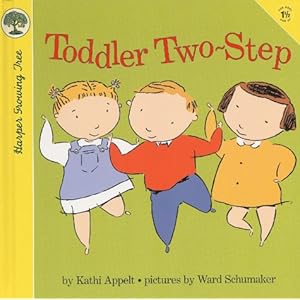
Toddler Two-Step is a counting book designed for 1-2 year olds in every possible way. Appelt's jaunty poem guides young counters from 1-10 and then back down from 10-1 as Schumaker's round, balloon-shaped toddlers (and one very unsure cat) dance and move to the poem's predictable rhythm. The text is simple and straightforward ("Three, four, clippity-clop. Cross the floor, hippity-hop"), providing instructions for a literal toddler two-step, while the illustrations fill in the movements that the text leaves out. The rhythm and action ramp up energetically all the way to 10, which arrives with a conga line and a huge JUMP. But from there, Appelt gradually slows things back down for 10-1, organically bringing the reader back to a (relatively) calm, cool stop. Schumaker mirrors the rise and fall in energy as his toddlers spin, circle, bounce and sway until they return to the same positions they were in when the book began, a clever way to bring the reader full-circle along with the numbers at the center of the action. The reader is left with a kinetic sense of 1-10 and 10-1, both numerically and as a pair of related number series that mirror the rise and fall of dance's energy. It's a clever conceit and one that is very well executed. Great for toddler storytimes as either a story or as an interstitial activity, Toddler Two-Step packs an unexpected punch for a counting book, (and parents will no doubt appreciate the exhaustion that will no doubt follow a really good reading).
By Kathi Appelt
http://www.kathiappelt.com/
Illustrated by Ward Schumaker
http://warddraw.com/
1-2 Preschool Harper 24 pp.
978-0694012442 Hardcover $9.95
Non-Fiction
Toddler Two-Step is a counting book designed for 1-2 year olds in every possible way. Appelt's jaunty poem guides young counters from 1-10 and then back down from 10-1 as Schumaker's round, balloon-shaped toddlers (and one very unsure cat) dance and move to the poem's predictable rhythm. The text is simple and straightforward ("Three, four, clippity-clop. Cross the floor, hippity-hop"), providing instructions for a literal toddler two-step, while the illustrations fill in the movements that the text leaves out. The rhythm and action ramp up energetically all the way to 10, which arrives with a conga line and a huge JUMP. But from there, Appelt gradually slows things back down for 10-1, organically bringing the reader back to a (relatively) calm, cool stop. Schumaker mirrors the rise and fall in energy as his toddlers spin, circle, bounce and sway until they return to the same positions they were in when the book began, a clever way to bring the reader full-circle along with the numbers at the center of the action. The reader is left with a kinetic sense of 1-10 and 10-1, both numerically and as a pair of related number series that mirror the rise and fall of dance's energy. It's a clever conceit and one that is very well executed. Great for toddler storytimes as either a story or as an interstitial activity, Toddler Two-Step packs an unexpected punch for a counting book, (and parents will no doubt appreciate the exhaustion that will no doubt follow a really good reading).
Labels:
assignment 6,
concept book,
infant/toddler,
storytime
April 17, 2012
Morris's Disappearing Bag
By Rosemary Wells; illus. by author
http://www.rosemarywells.com/
0-4 Preschool Primary Puffin 40 pp.
978-0142300046 Paperback $6.99
Fiction
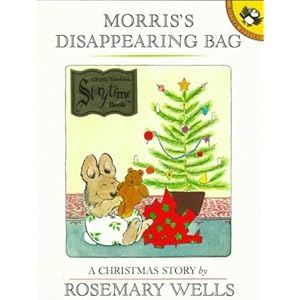
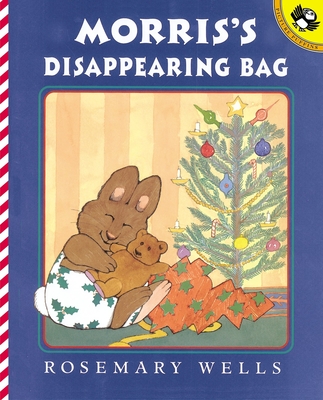
In the interest of fairness, I should state up front that my review for Morris's Disappearing Bag is by no means impartial - this was not only my favorite Christmas books growing up, it was one of my favorites period, (for this reason, I included the original cover of the edition I read-to-death as a girl, as well as Puffin's recent re-issue).
Put simply, Morris's Disappearing Bag is the story of what happens when nobody wants to play with the teddy bear Morris receives on Christmas morning. Morris loves his bear. But his older siblings, all of whom receive older kid presents, (hockey gear, a chemistry set and a beauty kit), take no interest. They don't want to play with Morris's gift, and they say that Morris is too young to try theirs'. This leaves Morris feeling understandably left-out , a fact Well's communicates in her fantastically sensitive illustrations (Morris is seen on a series of pages, to the side or in the background, ears sagging and shoulders slumped. I still remember the waves of childish empathy I felt for Morris because of those ears). But all is not lost. Morris finds an unopened present beneath the Christmas tree. In it lies the eponymous bag. Morris climbs in and, to his delight, promptly disappears! Suddenly, Morris's siblings can't wait to try his present out, and so they do while Morris skates, mixes chemicals and "beautifies". Balance is restored and all is well as Morris's father carries him to bed, happy, exhausted and clutching his new bear.
The magic of Morris's Disappearing Bag is in Wells's masterful pacing and understated prose. Every word counts, every word communicates an emotional reality that, while trivial to an adult or older child, is critical to a little one, especially one inadvertently left out. One of Wells's earlier works, the illustrations in Morris's Disappearing Bag lack the bright, pop-off-the-page quality of her more recent books, but this is not shortcoming. The illustrations are warm and nuanced, lightly inked and filled in with soft watercolors, perfect for a story that is both fun and emotionally resonant. In my opinion, Morris's Disappearing Bag is the strongest book in Wells's admittedly impressive oeuvre. Speaking personally, I look forward to reading it many more times to come.
By Rosemary Wells; illus. by author
http://www.rosemarywells.com/
0-4 Preschool Primary Puffin 40 pp.
978-0142300046 Paperback $6.99
Fiction
In the interest of fairness, I should state up front that my review for Morris's Disappearing Bag is by no means impartial - this was not only my favorite Christmas books growing up, it was one of my favorites period, (for this reason, I included the original cover of the edition I read-to-death as a girl, as well as Puffin's recent re-issue).
The magic of Morris's Disappearing Bag is in Wells's masterful pacing and understated prose. Every word counts, every word communicates an emotional reality that, while trivial to an adult or older child, is critical to a little one, especially one inadvertently left out. One of Wells's earlier works, the illustrations in Morris's Disappearing Bag lack the bright, pop-off-the-page quality of her more recent books, but this is not shortcoming. The illustrations are warm and nuanced, lightly inked and filled in with soft watercolors, perfect for a story that is both fun and emotionally resonant. In my opinion, Morris's Disappearing Bag is the strongest book in Wells's admittedly impressive oeuvre. Speaking personally, I look forward to reading it many more times to come.
April 16, 2012
Hand, Hand, Fingers, Thumb
By Al Perkins; illus. by Eric Gurney
No Author / Illustrator Site
0-4 Preschool Random House 28 pp.
978-0394810768 Hardcover $8.99
Fiction
Though sparse on story, (one monkey and a drum becomes a profusion of drumming, humming, strumming monkeys), Hand, Hand, Fingers, Thumb is full of fun and nonsense, even as it teaches toddlers and preschoolers lessons in anatomy, rhythm, language and numbers. Perkins employs a syncopated beat throughout the text, (Dum ditty Dum ditty Dum dum dum), driving the silliness forward until "millions of fingers!" and "millions of thumbs!" and "millions of monkeys" are "drumming on drums!" Gurney's monkeys are a wiley bunch, hairy and bent on having a noisy good time, a quality that has made them an instant hit with generations of preschoolers. Hand, Hand, Fingers, Thumb is unquestionably well-suited for library and school storytimes being a natural candidate for felt boards and art projects. The book's hallmark is the exuberance with which it introduces educational concepts (everything from numbers to colors make an appearance without cluttering the conceit). Even better, it's a fantastic way to get wiley little monkeys moving, involved and having fun with a book.
Labels:
assignment 6,
concept book,
infant/toddler,
storytime
A Visitor for Bear
A Visitor for Bear
By Bonny Becker
http://www.bonnybecker.com/
Illustrated by Kady MacDonald Denton
http://www.kadymacdonalddenton.ca/
2-4 Preschool Primary Candlewick 56 pp.
978-0763628079 Hardcover $15.99
Fiction
A Visitor for Bear, the first book in Bonny Becker's New York Times Bestselling Bear and Mouse series, recounts the beginning of that now famous, if unlikely, friendship. It is the story of Bear, a reclusive sort who doesn't like visitors (he even has a sign) and the mouse who wears him down.
At the beginning of the book, it is plainly stated that "No one ever came to Bear's house. It had always been that way, and Bear was quite sure that he didn't like visitors." He lives a quiet, if stuffy, existence, one fully embodied by his sniffy annoyance at the "tap, tap, tapping" on his front door. There stands a mouse, "small and gray and bright-eyed," looking oddly determined. Bear sends him away. What follows is a series of comedic interruptions, with Bear trying to make his solitary breakfast while Mouse pops up in drawers and behind bread. Finally, Bear (in tears after having stoppered the chimney and plugged the tub) lets Mouse stay.
Bear's revelation, that having a friend might be nice, comes about with gentle inevitability and good humor, but there is a depth to this story that belies its easy moral. To see the apron-wearing Bear exhausted into providing tea and a crackling fire for the cheeky mouse is one thing, but Becker takes it further by exposing Bear's vulnerabilities. Mouse listens to Bear. He takes an interest and laughs at his jokes - all new experiences for Bear - so that when Mouse says he has to go, Bear's despair is painful and understandable. Happily, Mouse ends up staying and the pair enjoy a second cup of tea by Bear's fire, a comforting ending to a moment of genuine catharsis and change on Bear's part.
Even without Kady MacDonald Denton's fantastic watercolor illustrations (done with characteristic warmth and expressiveness), A Visitor for Bear is a charming story with real emotional depth. The use of repeated phrases (such as "there was the mouse, small and gray and bright-eyed") and an expert sense of pacing make it a pleasure to read. Toddlers and preschoolers will no doubt laugh as Bear's hysteria reaches fever pitch. But those who are a bit more sensitive will also enjoy the story's quieter aspects as Bear makes a friend and alleviates the loneliness he didn't know he had.
By Bonny Becker
http://www.bonnybecker.com/
Illustrated by Kady MacDonald Denton
http://www.kadymacdonalddenton.ca/
2-4 Preschool Primary Candlewick 56 pp.
978-0763628079 Hardcover $15.99
Fiction
A Visitor for Bear, the first book in Bonny Becker's New York Times Bestselling Bear and Mouse series, recounts the beginning of that now famous, if unlikely, friendship. It is the story of Bear, a reclusive sort who doesn't like visitors (he even has a sign) and the mouse who wears him down.
At the beginning of the book, it is plainly stated that "No one ever came to Bear's house. It had always been that way, and Bear was quite sure that he didn't like visitors." He lives a quiet, if stuffy, existence, one fully embodied by his sniffy annoyance at the "tap, tap, tapping" on his front door. There stands a mouse, "small and gray and bright-eyed," looking oddly determined. Bear sends him away. What follows is a series of comedic interruptions, with Bear trying to make his solitary breakfast while Mouse pops up in drawers and behind bread. Finally, Bear (in tears after having stoppered the chimney and plugged the tub) lets Mouse stay.
Bear's revelation, that having a friend might be nice, comes about with gentle inevitability and good humor, but there is a depth to this story that belies its easy moral. To see the apron-wearing Bear exhausted into providing tea and a crackling fire for the cheeky mouse is one thing, but Becker takes it further by exposing Bear's vulnerabilities. Mouse listens to Bear. He takes an interest and laughs at his jokes - all new experiences for Bear - so that when Mouse says he has to go, Bear's despair is painful and understandable. Happily, Mouse ends up staying and the pair enjoy a second cup of tea by Bear's fire, a comforting ending to a moment of genuine catharsis and change on Bear's part.
Even without Kady MacDonald Denton's fantastic watercolor illustrations (done with characteristic warmth and expressiveness), A Visitor for Bear is a charming story with real emotional depth. The use of repeated phrases (such as "there was the mouse, small and gray and bright-eyed") and an expert sense of pacing make it a pleasure to read. Toddlers and preschoolers will no doubt laugh as Bear's hysteria reaches fever pitch. But those who are a bit more sensitive will also enjoy the story's quieter aspects as Bear makes a friend and alleviates the loneliness he didn't know he had.
We All Went on Safari
We All Went on Safair: A Counting Journey Through Tanzania
By Laurie Krebs
http://www.lauriekrebs.com/
Illustrated by Julia Cairns
http://juliacairns.net/
3-4 Preschool Primary Barefoot Books 32 pp.
978-1841484785 Hardcover $16.99
Non Fiction
As far as concept books go, We All Went on Safari: A Counting Journey Through Tanzania, is one of the best I've come across. There is no part of the text or the illustrations that fails to educate the reader in the most entertaining, layered way. Even more, We All Went on Safari does something that not many books - concept or otherwise - manage to do. It gives the reader a tantalizing taste of a completely foreign culture, just enough to plant curiosity and engender a desire to learn more.
The book's primary goal is to introduce the concept of counting from one to ten, which it does under the guise of an adventure through the grasslands of Tanzania. The protagonists are a group of Maasai children and their caretakers. As Arusha, Mosi, Tumpe and their friends walk through the savannah, they discover and count many different kinds of African animals, including lions, giraffes and warthogs, in both English and Swahili. Krebs's smooth rhyming text helps lead the reader on, making it easy for children unfamiliar with the numbers to intuit what comes next ("We all went on safari, When the day had just begun. We spied a lonely leopard. Arusha counted one"). A large, red numeral "1" is placed in the right hand corner of the page with the Swahili word, "moja" next to it in black, making it easy to connect the word "one" with the number "1" and it's corresponding name in Swahili. The rest of the book progresses in the same way, ending with the adventurers, portrayed in traditional Massai costumes, building a campfire and saying goodnight.
The strength of We All Went on Safari lies in two places. The first is that, in addition to the counting aspect and the easy rhythm of the story, Krebs included a map of Tanzania, a collection of facts about the country, notes about each of the animals encountered on the adventure, information about the Maasai, including translations of each name and a pronunciation key for the numbers 1-10 in Swahili. All of this additional material is organized intuitively at the back so, while not cluttering the main text or confusing younger listeners, it offers curious preschoolers more information on what they've just read. The book's other strength is in Cairns's beautiful illustrations, which have a rich, iconic, almost primitive aspect while portraying the animals, Tanzanian grasslands and Maasai people with dignity and certain natural elegance.
We All Went on Safari is a can't miss. Toddlers and pre-readers will enjoy hearing the rhyming text and seeing the gorgeously depicted animals - and as an introduction to counting, it's hard to beat 2 ("mbili") ostriches sprinting through green grass. Preschoolers and kindergardners will likewise love reading the text for themselves while the animals tantalizingly present themselves for counting. Best of all, We All Went on Safari inspires curiosity and gives parents and children a chance to learn about a new culture together.
By Laurie Krebs
http://www.lauriekrebs.com/
Illustrated by Julia Cairns
http://juliacairns.net/
3-4 Preschool Primary Barefoot Books 32 pp.
978-1841484785 Hardcover $16.99
Non Fiction
As far as concept books go, We All Went on Safari: A Counting Journey Through Tanzania, is one of the best I've come across. There is no part of the text or the illustrations that fails to educate the reader in the most entertaining, layered way. Even more, We All Went on Safari does something that not many books - concept or otherwise - manage to do. It gives the reader a tantalizing taste of a completely foreign culture, just enough to plant curiosity and engender a desire to learn more.
The book's primary goal is to introduce the concept of counting from one to ten, which it does under the guise of an adventure through the grasslands of Tanzania. The protagonists are a group of Maasai children and their caretakers. As Arusha, Mosi, Tumpe and their friends walk through the savannah, they discover and count many different kinds of African animals, including lions, giraffes and warthogs, in both English and Swahili. Krebs's smooth rhyming text helps lead the reader on, making it easy for children unfamiliar with the numbers to intuit what comes next ("We all went on safari, When the day had just begun. We spied a lonely leopard. Arusha counted one"). A large, red numeral "1" is placed in the right hand corner of the page with the Swahili word, "moja" next to it in black, making it easy to connect the word "one" with the number "1" and it's corresponding name in Swahili. The rest of the book progresses in the same way, ending with the adventurers, portrayed in traditional Massai costumes, building a campfire and saying goodnight.
The strength of We All Went on Safari lies in two places. The first is that, in addition to the counting aspect and the easy rhythm of the story, Krebs included a map of Tanzania, a collection of facts about the country, notes about each of the animals encountered on the adventure, information about the Maasai, including translations of each name and a pronunciation key for the numbers 1-10 in Swahili. All of this additional material is organized intuitively at the back so, while not cluttering the main text or confusing younger listeners, it offers curious preschoolers more information on what they've just read. The book's other strength is in Cairns's beautiful illustrations, which have a rich, iconic, almost primitive aspect while portraying the animals, Tanzanian grasslands and Maasai people with dignity and certain natural elegance.
We All Went on Safari is a can't miss. Toddlers and pre-readers will enjoy hearing the rhyming text and seeing the gorgeously depicted animals - and as an introduction to counting, it's hard to beat 2 ("mbili") ostriches sprinting through green grass. Preschoolers and kindergardners will likewise love reading the text for themselves while the animals tantalizingly present themselves for counting. Best of all, We All Went on Safari inspires curiosity and gives parents and children a chance to learn about a new culture together.
Labels:
assignment 6,
concept book,
multiculturalism,
storytime
Subscribe to:
Posts (Atom)