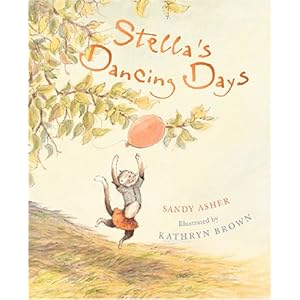
Stella's Dancing Days
By Sander Asher
http://usawrites4kids.drury.edu/authors/asher/
Illustrated by Katheryn Brown
No Illustrator Website
1-4 Preschool Primary Harcourt 32 pp.
978-0152016135 Hardcover $16.00
Fiction
Stella's Dancing Days is a quiet book suited to cozy chairs and a parent's voice. It's the story of Stella, a kitten who loves to dance. She delights the Tall One (a boy who wears a cowboy hat) with her grands jetes, so he brings her home, where she charms the Tall One's younger sister, the Gentle One with pirouettes, and when the Littlest One (the baby of the family) won't stop crying, she makes him laugh by waltzing with her ball. But as Stella grows up and finds bugs to stalk and window sills to sit in, she dances less and less. While the children (also pictured as older) miss her dancing days, Stella does not - she's preoccupied with the important business of preparing for her own kittens, three boys and three girls, all of whom love to dance.
Brown's watercolors have a soft, nostalgic feel, as if we're peering back in time with a slightly hazy lens. The children, the magnificent oak tree and Stella herself occupy their world with a natural, soothing ease, one that suits Asher's story to a tea. Though Stella's kittenish antics are described in dance terms, she is pictured as very much the realistic cat, so while it looks like she's performing grand balletic moves, we know she's just being a kitten, (the one exception to this realism is when the children dress her in a skirt and blouse as seen on the cover, but it's for a tea party and so explained). The story progresses gently to its natural conclusion, a conclusion that is comforting and perfect in its predictability. In the process, Stella's acceptance of each new stage of her life is a wonderful introduction to the idea that things change, and that, while you can miss the past (Stella's dancing), the present and the future have promise too, (Stella's kittens). It's an important message, one embedded deeply in a lovely, gentle story. Highly recommended. My bet is that Stella will charm you too.
Showing posts with label assignment 6. Show all posts
May 4, 2012
May 2, 2012
Red Sled
Red Sled
By Lita Judge
http://www.litajudge.com/
1-4 Preschool Primary Atheneum 40 pp.
978-1442420076 Hardcover $16.99
Fiction
Lita Judge's Red Sled is both simple and unexpected - simple because of the nearly wordless story (a bear "borrows" the red sled of the title from the child in the red hat) and unexpected because the few words that do appear, (Gadung, Gadung, Gadung and fluoomp...ft are my favorites), are marvelous and onomatopoetic and crazy in their accuracy. Anyone who has sledded down a bumpy, snowy hill knows exactly what Gadung, Gadung Gadung feels like. Even better, Gadung, Gadung, Gadung gives those who haven't had the pleasure of sledding down a bumpy hill a terrifically accurate sense of what it feels like to do so. Nowhere in this book does Judge fall back on old standards like "bonk" or "whoosh". She makes up words that capture, with uncanny accuracy, the very real sound of feet crunching through snow, (scrinch, scrunch), not to mention the made-up sound of a bear, a rabbit, a moose, a mouse, two raccoons, a porcupine and an opossum landing at at the bottom of the hill after their sled ride. For those unfamiliar with this sound, it's the fluoomp..ft, I mentioned above.
Judge's illustrations match, tone for tone, the old-fashioned magic of her minimalist text. The child in the red hat is cherubic and pudgy in her big winter coat as she scrinch, scrunches back to the tiny cabin toting her red sled. This is a visual world in which bears would surely borrow that sled and take it for a spin with his woodland friends. Even better, it's a world in which the red-hatted child would wonder at the animals prints leading to her sled, and then join the bear and friends the next night. Red Sled is a simply lovely book - a real example of the magic a few well chosen words and thoughtfully rendered pictures can work.
By Lita Judge
http://www.litajudge.com/
1-4 Preschool Primary Atheneum 40 pp.
978-1442420076 Hardcover $16.99
Fiction
Lita Judge's Red Sled is both simple and unexpected - simple because of the nearly wordless story (a bear "borrows" the red sled of the title from the child in the red hat) and unexpected because the few words that do appear, (Gadung, Gadung, Gadung and fluoomp...ft are my favorites), are marvelous and onomatopoetic and crazy in their accuracy. Anyone who has sledded down a bumpy, snowy hill knows exactly what Gadung, Gadung Gadung feels like. Even better, Gadung, Gadung, Gadung gives those who haven't had the pleasure of sledding down a bumpy hill a terrifically accurate sense of what it feels like to do so. Nowhere in this book does Judge fall back on old standards like "bonk" or "whoosh". She makes up words that capture, with uncanny accuracy, the very real sound of feet crunching through snow, (scrinch, scrunch), not to mention the made-up sound of a bear, a rabbit, a moose, a mouse, two raccoons, a porcupine and an opossum landing at at the bottom of the hill after their sled ride. For those unfamiliar with this sound, it's the fluoomp..ft, I mentioned above.
Judge's illustrations match, tone for tone, the old-fashioned magic of her minimalist text. The child in the red hat is cherubic and pudgy in her big winter coat as she scrinch, scrunches back to the tiny cabin toting her red sled. This is a visual world in which bears would surely borrow that sled and take it for a spin with his woodland friends. Even better, it's a world in which the red-hatted child would wonder at the animals prints leading to her sled, and then join the bear and friends the next night. Red Sled is a simply lovely book - a real example of the magic a few well chosen words and thoughtfully rendered pictures can work.
How Do Dinosaurs Get Well Soon?
By Jane Yolen
http://janeyolen.com/
Illustrated by Mark Teague
No Illustrator Website
3-4 Preschool Primary Blue Sky 40 pp.
978-0439241007 Hardcover $16.99
Fiction
Second in the popular How Do Dinosaurs... series by Jane Yolen and Mark Teague, How Do Dinosaurs Get Well Soon? follows the same format that worked so well in the original, How Do Dinosaurs Say Goodnight? And indeed, the question / answer pattern does draw the reader in. What does a dinosaur do when he catches the flu? Does he behave badly, whining as he tosses tissue and medicine all over his room? The answer is no. A dinosaur drinks his juice and gets rest and takes his medicine - just like a human kid should when he's not feeling good. It's a nice guide to behaving well while sick without reverting too heavily towards didacticism.
The dinosaurs are clearly child stand-ins, and they do the job with personality and comedic pizzazz, thanks to Teague's illustrations. Massive next to their human parents, the dinosaurs convey an air of child-like crankiness that resonates emotionally while still being funny. Especially cute is the Shakespearean drama with which they blow their noses, (especially nice is the Styracosaurus who gets forcibly dragged to the doctor by his mom). A nice touch, as always, is the variety of dinosaurs Teague uses. You'll find old, familiar stand-bys like Brachiosaurus in addition to a nice selection of lesser known dinos, like Gallimimus and Carnotaurus. The featured dinos also make a cast appearance on the endpapers with names clearly labeled beneath them. Yolen's rhyming text is fun and accessible, though a bit awkward at times, especially towards the end. Still, it doesn't detract from the overall success of the book, which will surely appeal to preschoolers, both sick and well, at story times and at home. As an added bonus, How Do Dinosaurs Get Well Soon? will likely appeal to parents who recognize their own children in the book's cranky protagonists.
By Jane Yolen
http://janeyolen.com/
Illustrated by Mark Teague
No Illustrator Website
3-4 Preschool Primary Blue Sky 40 pp.
978-0439241007 Hardcover $16.99
Fiction
Second in the popular How Do Dinosaurs... series by Jane Yolen and Mark Teague, How Do Dinosaurs Get Well Soon? follows the same format that worked so well in the original, How Do Dinosaurs Say Goodnight? And indeed, the question / answer pattern does draw the reader in. What does a dinosaur do when he catches the flu? Does he behave badly, whining as he tosses tissue and medicine all over his room? The answer is no. A dinosaur drinks his juice and gets rest and takes his medicine - just like a human kid should when he's not feeling good. It's a nice guide to behaving well while sick without reverting too heavily towards didacticism.
The dinosaurs are clearly child stand-ins, and they do the job with personality and comedic pizzazz, thanks to Teague's illustrations. Massive next to their human parents, the dinosaurs convey an air of child-like crankiness that resonates emotionally while still being funny. Especially cute is the Shakespearean drama with which they blow their noses, (especially nice is the Styracosaurus who gets forcibly dragged to the doctor by his mom). A nice touch, as always, is the variety of dinosaurs Teague uses. You'll find old, familiar stand-bys like Brachiosaurus in addition to a nice selection of lesser known dinos, like Gallimimus and Carnotaurus. The featured dinos also make a cast appearance on the endpapers with names clearly labeled beneath them. Yolen's rhyming text is fun and accessible, though a bit awkward at times, especially towards the end. Still, it doesn't detract from the overall success of the book, which will surely appeal to preschoolers, both sick and well, at story times and at home. As an added bonus, How Do Dinosaurs Get Well Soon? will likely appeal to parents who recognize their own children in the book's cranky protagonists.
April 30, 2012
Brave Charlotte
Brave Charlotte
By Anu Stohner
Illustrated by Henrike Wilson
No Author / Illustrator Website
2-4 Preschool Primary Bloomsbury 32 pp.
978-1582346908 Hardcover $16.95
Fiction
Winner of NY Times Best Illustrated Book Award, Brave Charlotte is the story of a very un-sheep-like sheep named Charlotte. Charlotte is ready for adventure. She climbs trees, leaps over riverbanks and performs feats of daring-do, all while the other sheep in her flock look on with a mixture of disapproval and disbelief. Still, Charlotte continues to do her own thing, and when the old shepherd falls and breaks his leg, her bravery saves the day as she is the only one able or willing to travel the long distance to the farmer's house to get help.
Brave Charlotte is a well-constructed story with a timeless moral - sometimes the outsider, the one who doesn't follow the flock, is important to the whole precisely because she does not quite fit in. This lesson is underscored by the fact that each thing Charlotte does that garners disapproval, (climbing rocks and trees, jumping rivers and crossing roads) is part of her climactic journey to the farmer's house. Far from moralizing however, Stohner's text is natural and charming, with sweet touches like a trucker picking up Charlotte for the last leg of her journey and the farmer recognizing her as she peers in the farmhouse window. Wilson's illustrations are irresistibly appealing with Charlotte pictured as both intrepid and sweetly vulnerable as she sets out on her own. She is a truly appealing heroine, one that fully engages the reader just by being herself. A lovely story beautifully illustrated, Brave Charlotte won't fail to win the day, whether at storytime or at home.
By Anu Stohner
Illustrated by Henrike Wilson
No Author / Illustrator Website
2-4 Preschool Primary Bloomsbury 32 pp.
978-1582346908 Hardcover $16.95
Fiction
Winner of NY Times Best Illustrated Book Award, Brave Charlotte is the story of a very un-sheep-like sheep named Charlotte. Charlotte is ready for adventure. She climbs trees, leaps over riverbanks and performs feats of daring-do, all while the other sheep in her flock look on with a mixture of disapproval and disbelief. Still, Charlotte continues to do her own thing, and when the old shepherd falls and breaks his leg, her bravery saves the day as she is the only one able or willing to travel the long distance to the farmer's house to get help.
Brave Charlotte is a well-constructed story with a timeless moral - sometimes the outsider, the one who doesn't follow the flock, is important to the whole precisely because she does not quite fit in. This lesson is underscored by the fact that each thing Charlotte does that garners disapproval, (climbing rocks and trees, jumping rivers and crossing roads) is part of her climactic journey to the farmer's house. Far from moralizing however, Stohner's text is natural and charming, with sweet touches like a trucker picking up Charlotte for the last leg of her journey and the farmer recognizing her as she peers in the farmhouse window. Wilson's illustrations are irresistibly appealing with Charlotte pictured as both intrepid and sweetly vulnerable as she sets out on her own. She is a truly appealing heroine, one that fully engages the reader just by being herself. A lovely story beautifully illustrated, Brave Charlotte won't fail to win the day, whether at storytime or at home.
Picture This...
Picture This...
By Alison Jay; illus. by author
http://www.childrensillustrators.com/ajay/
1-4 Preschool Dutton 40 pp.
0525463801 Hardcover $15.99
Non Fiction (that draws on Fiction)
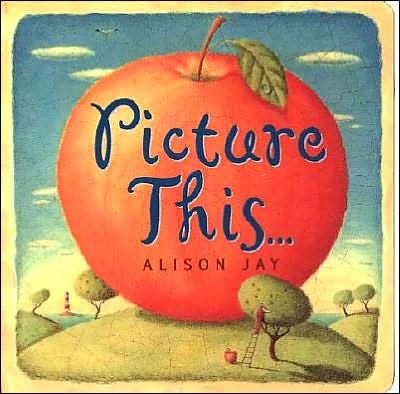
On the face of it, Picture This... is a simple word book with each page featuring a sight word and its illustration, but a second glance shows a surprising amount of depth, with each picture making a visual reference to the seasons, nursery rhymes, fables and / or the pages that either precede or follow it.
Picture This... begins with a "clock", but the clock Jay illustrates is no simple timepiece. Pictured on its face are panels depicting each of the four seasons while a mouse peers over the top in a clear reference to "Hickory Dickory Dock." The next page features the word "dog" with an illustration of a dog jumping after the ball in a spring meadow. The careful reader will notice that this illustration mirrors the spring panel on the clock, and that the mouse is now watching the dog from the stem of a daffodil in the meadow. And so on it goes, with the well that is pictured in the background of "dog" taking center stage on the next page for "hill" and a couple, presumably Jack and Jill, going up the hill with a bucket while a dog runs up ahead of them. The thoroughness with which Jay weaves this collective tapestry from the details in each image is truly impressive. Just as impressive is the manner in which she takes the reader through the seasons shown on the clock without making the progression feel forced or even particularly central to the book's purpose, (to present a word and an associated image).
Picture This... is a festival of detail, but what makes it work for its intended audience is its subtlety. Toddlers can look at the word "cat" and associate it with the very clear picture of the cat without having to worry about the little red airplane that will show up in the next illustration, but for preschoolers, the details make the book an interactive puzzle. With its inventive storytelling hidden within the guise of a traditional concept book, Picture This... rewards multiple readings over several developmental stages, making it a lovely, long-term addition to any collection.
By Alison Jay; illus. by author
http://www.childrensillustrators.com/ajay/
1-4 Preschool Dutton 40 pp.
0525463801 Hardcover $15.99
Non Fiction (that draws on Fiction)
On the face of it, Picture This... is a simple word book with each page featuring a sight word and its illustration, but a second glance shows a surprising amount of depth, with each picture making a visual reference to the seasons, nursery rhymes, fables and / or the pages that either precede or follow it.
Picture This... begins with a "clock", but the clock Jay illustrates is no simple timepiece. Pictured on its face are panels depicting each of the four seasons while a mouse peers over the top in a clear reference to "Hickory Dickory Dock." The next page features the word "dog" with an illustration of a dog jumping after the ball in a spring meadow. The careful reader will notice that this illustration mirrors the spring panel on the clock, and that the mouse is now watching the dog from the stem of a daffodil in the meadow. And so on it goes, with the well that is pictured in the background of "dog" taking center stage on the next page for "hill" and a couple, presumably Jack and Jill, going up the hill with a bucket while a dog runs up ahead of them. The thoroughness with which Jay weaves this collective tapestry from the details in each image is truly impressive. Just as impressive is the manner in which she takes the reader through the seasons shown on the clock without making the progression feel forced or even particularly central to the book's purpose, (to present a word and an associated image).
Picture This... is a festival of detail, but what makes it work for its intended audience is its subtlety. Toddlers can look at the word "cat" and associate it with the very clear picture of the cat without having to worry about the little red airplane that will show up in the next illustration, but for preschoolers, the details make the book an interactive puzzle. With its inventive storytelling hidden within the guise of a traditional concept book, Picture This... rewards multiple readings over several developmental stages, making it a lovely, long-term addition to any collection.
Babybug Magazine
Babybug Magazine
Publishers of Cricket
www.cricketmag.com
0-3 Preschool Cricket 22 pp.
1 year subscription $33.95
Magazine
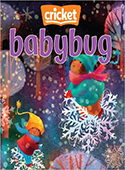
From the publishers of Cricket magazine and Ladybug magazine comes Babybug magazine, a publication especially for for babies and toddlers (ages 6 months -3 years). The recipient of multiple awards, including the 2012 Parents' Choice Silver Honor, Babybug features stories, nursery rhymes, poems and illustrations from some of the world's best children's writers and artists, including its own serial entitled "Kim and Carrots" about a little girl and and stuffed rabbit, Carrots. All of the content is designed to be read aloud by parents and grandparents, while the extra-heavy pages, non-toxic ink, rounded corners, and staple-free binding make Babybug safe for little ones to explore on their own. Babybug does not contain the games and activities featured in many magazines for slightly older toddlers and preschoolers - its content is entirely literary, specifically designed to provide toddlers and their caregivers with a variety of illustrated stories and poems to share. It is literally a baby's first literary magazine and a great introduction to short stories, as well as a source for light, age appropriate material.
Publishers of Cricket
www.cricketmag.com
0-3 Preschool Cricket 22 pp.
1 year subscription $33.95
Magazine
From the publishers of Cricket magazine and Ladybug magazine comes Babybug magazine, a publication especially for for babies and toddlers (ages 6 months -3 years). The recipient of multiple awards, including the 2012 Parents' Choice Silver Honor, Babybug features stories, nursery rhymes, poems and illustrations from some of the world's best children's writers and artists, including its own serial entitled "Kim and Carrots" about a little girl and and stuffed rabbit, Carrots. All of the content is designed to be read aloud by parents and grandparents, while the extra-heavy pages, non-toxic ink, rounded corners, and staple-free binding make Babybug safe for little ones to explore on their own. Babybug does not contain the games and activities featured in many magazines for slightly older toddlers and preschoolers - its content is entirely literary, specifically designed to provide toddlers and their caregivers with a variety of illustrated stories and poems to share. It is literally a baby's first literary magazine and a great introduction to short stories, as well as a source for light, age appropriate material.
April 27, 2012
Press Here
Press Here
By Herve Tullet; illus. by author
http://www.herve-tullet.com/
2-4 Preschool Primary Chronicle 56 pp.
978-0811879545 Hardcover $15.99
Non Fiction
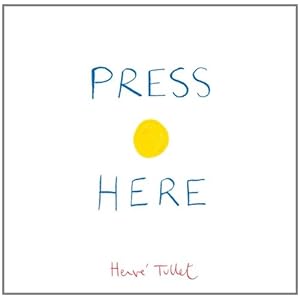
Recipient of more starred reviews than one can count, Herve Tullet's groundbreaking picture book, Press Here, could very well be the most interactive book of 2011 based solely on the tacit agreement between its author and the reader - follow these instructions and things will happen! And they do. Without pull tabs, flaps or batteries, Press Here illustrates the power of cause and effect as one yellow dot becomes two when the narrator instructs the reader to "press here and turn the page". More instructions follow, paired with more dots and a lot of positive reinforcement (the narrator wisely "responds" to the reader's successful pressing, rubbing and shaking with many a well-placed "perfect!" and "excellent"). Dots expand and contract, get blown to the top of the page and shaken down, and all the while the unspoken agreement between author and reader holds firm - do this and the book will respond. Therein lies the magic that belies picture book technologies like iPhone apps and electronic adaptations. Therein lies the magic that brings children back to their favorite books again and again: Do This. Read Me. I Will Respond. It's a wonderful thing to see it done so inventively and with such exuberant force. Press Here is so innovative in its simplicity, so true to what picture books can do, that it's an almost overwhelming read from this adult's perspective. From a child's perspective however, it's a game pure and simple, and that perspective is certainly the most important of all.
By Herve Tullet; illus. by author
http://www.herve-tullet.com/
2-4 Preschool Primary Chronicle 56 pp.
978-0811879545 Hardcover $15.99
Non Fiction
Recipient of more starred reviews than one can count, Herve Tullet's groundbreaking picture book, Press Here, could very well be the most interactive book of 2011 based solely on the tacit agreement between its author and the reader - follow these instructions and things will happen! And they do. Without pull tabs, flaps or batteries, Press Here illustrates the power of cause and effect as one yellow dot becomes two when the narrator instructs the reader to "press here and turn the page". More instructions follow, paired with more dots and a lot of positive reinforcement (the narrator wisely "responds" to the reader's successful pressing, rubbing and shaking with many a well-placed "perfect!" and "excellent"). Dots expand and contract, get blown to the top of the page and shaken down, and all the while the unspoken agreement between author and reader holds firm - do this and the book will respond. Therein lies the magic that belies picture book technologies like iPhone apps and electronic adaptations. Therein lies the magic that brings children back to their favorite books again and again: Do This. Read Me. I Will Respond. It's a wonderful thing to see it done so inventively and with such exuberant force. Press Here is so innovative in its simplicity, so true to what picture books can do, that it's an almost overwhelming read from this adult's perspective. From a child's perspective however, it's a game pure and simple, and that perspective is certainly the most important of all.
My First ABC
The NY Metropolitan Museum of Art
http://www.metmuseum.org/
0-3 Preschool LB Kids 32 pp.
978-0316068178 Board $8.99
Non Fiction
The Metropolitan Museum of Art had great success with Museum ABC, an alphabet book featuring each letter of the alphabet paired with a quartet of famous works containing a word associated with that letter. It's a beautiful book, but one more suitable to older preschoolers and kindergartners already familiar with the alphabet and able to grasp the sometimes abstract concepts pictured in the artwork (light, zigzag etc.). My First ABC is a simplified version of Museum ABC, with artwork specifically chosen to illustrate the letters to children just learning their ABC's. Each letter is shown in both capital and lowercase forms next to the representative word, so that connections between the images and letters are easy to make. Instead of the panel of four paintings for each letter featured in Museum ABC, My First ABC features only one image per letter making it visually easier to see and distinguish each object. But though the format is simplified, My First ABC is not dumbed down - famous works by Cezanne (A for apples) and Matisse (D for dancers) share space with ancient Egyptian paintings (H for hair), exposing even the littlest ones to the artwork and culture on display in the museum. My First ABC is a beautiful book and an excellent adaptation of Museum ABC well suited to the cognitive capabilities of very little ones. Highly recommended, it teaches the ABC's to modern toddlers with style and classical grace.
From Head to Toe
From Head to Toe
By Eric Carle; illus. by author
http://www.eric-carle.com/home.html
2-4 Preschool Primary Harper Collins 32 pp.
978-0590222020 Hardcover $17.99
Non Fiction
Animals do a lot of things with their bodies, from the simple to the complex. Penguins turn their heads. "Can you do it?" the penguin asks. "I can do it!" the boy on the opposite page replies. And so it goes, with animals performing physical acts and children mimicking their movements. The movements become progressively more challenging with a giraffe turning its head giving way to a cat arching its back and a donkey kicking its legs, but always the response to the question, "can you do it?" comes the answer, "I can do it!" It's an enthusiastic invitation to the reader to jump in and kick, wriggle and stomp with the animals, as well.
From Head to Toe is pure interactive fun, but there is a lot of education occurring within its patterned framework. The reader is introduced not only to a variety of animals, but to specific physical actions and body parts. The interactive text asks that children listen and follow directions, and practice both fine and gross motor skills while imitating the animals. A nice additional touch is the repeated declaration of "I can do it!" as part of the call and response, and as usual, Carle's collage illustrations are exuberant, appealing and hard to resist. A great choice for story times and group settings, From Head to Toe also works at home, being adaptable to siblings in a wide variety of ages.
By Eric Carle; illus. by author
http://www.eric-carle.com/home.html
2-4 Preschool Primary Harper Collins 32 pp.
978-0590222020 Hardcover $17.99
Non Fiction
Animals do a lot of things with their bodies, from the simple to the complex. Penguins turn their heads. "Can you do it?" the penguin asks. "I can do it!" the boy on the opposite page replies. And so it goes, with animals performing physical acts and children mimicking their movements. The movements become progressively more challenging with a giraffe turning its head giving way to a cat arching its back and a donkey kicking its legs, but always the response to the question, "can you do it?" comes the answer, "I can do it!" It's an enthusiastic invitation to the reader to jump in and kick, wriggle and stomp with the animals, as well.
From Head to Toe is pure interactive fun, but there is a lot of education occurring within its patterned framework. The reader is introduced not only to a variety of animals, but to specific physical actions and body parts. The interactive text asks that children listen and follow directions, and practice both fine and gross motor skills while imitating the animals. A nice additional touch is the repeated declaration of "I can do it!" as part of the call and response, and as usual, Carle's collage illustrations are exuberant, appealing and hard to resist. A great choice for story times and group settings, From Head to Toe also works at home, being adaptable to siblings in a wide variety of ages.
April 25, 2012
Dear Zoo
Dear Zoo: A Lift the Flap Book
By Rod Campbell; illus. by author
http://www.rodcampbell.co.uk/
1-4 Preschool Little Simon 18 pp.
978-1416947370 Board $6.99
Fiction
Dear Zoo is 25 years old. In honor of its silver anniversary, Rod Campbell refreshed and updated the original illustrations. Happily, they remain as classically appealing as the originals, (nothing substantial was changed). The patterned text is simple and almost universally appealing to toddlers and preschoolers. An unseen narrator, (presumably a child), tells the reader that he wrote to the zoo to send him a pet. So the very obliging zoo-keepers send him a series of animals, each hiding behind a flap. There are clues on each flap as to which animal is in the box, (the elephant's box is labeled "very heavy", the lion is partially visible between the slats, etc.), while below the illustration is the reason that each particular animal won't do, (the giraffe is too tall, the monkey too naughty, and so on). Finally, the zoo sends the perfect pet - a puppy - which the narrator happily keeps.
Dear Zoo is a classic example of an interactive book for toddlers and preschoolers. Great for storytime at libraries or at home, it provides pre-verbal listeners with the opportunity to manipulate the flaps and reveal the surprise of each animal, while slightly older toddlers and preschoolers can guess at the occupant of each box, read the simple text and practice their animal sounds. A classic for a reason, the reissued board book is sturdy enough to withstand the repeated readings and constant handling it will no doubt (deservedly) receive.
By Rod Campbell; illus. by author
http://www.rodcampbell.co.uk/
1-4 Preschool Little Simon 18 pp.
978-1416947370 Board $6.99
Fiction
Dear Zoo is 25 years old. In honor of its silver anniversary, Rod Campbell refreshed and updated the original illustrations. Happily, they remain as classically appealing as the originals, (nothing substantial was changed). The patterned text is simple and almost universally appealing to toddlers and preschoolers. An unseen narrator, (presumably a child), tells the reader that he wrote to the zoo to send him a pet. So the very obliging zoo-keepers send him a series of animals, each hiding behind a flap. There are clues on each flap as to which animal is in the box, (the elephant's box is labeled "very heavy", the lion is partially visible between the slats, etc.), while below the illustration is the reason that each particular animal won't do, (the giraffe is too tall, the monkey too naughty, and so on). Finally, the zoo sends the perfect pet - a puppy - which the narrator happily keeps.
Dear Zoo is a classic example of an interactive book for toddlers and preschoolers. Great for storytime at libraries or at home, it provides pre-verbal listeners with the opportunity to manipulate the flaps and reveal the surprise of each animal, while slightly older toddlers and preschoolers can guess at the occupant of each box, read the simple text and practice their animal sounds. A classic for a reason, the reissued board book is sturdy enough to withstand the repeated readings and constant handling it will no doubt (deservedly) receive.
Mama Cat Has Three Kittens
By Denise Fleming; illus. by author
http://www.denisefleming.com/
1-4 Preschool Primary Henry Holt 32 pp.
978-0805057454 Hardcover $17.95
Fiction
Mama Cat has three kittens, two of whom - Fluffy and Skinny - follow in her footsteps as she washes her paws and walks the stone wall and engages in a number of other classically feline endeavors. Boris, the third kitten, naps... until Mama Cat, Fluffy and Skinny curl up to nap too. Then Boris comes alive, washing his paws and pouncing, (if only to his next napping stop, this time with his Mama and siblings).
Mama Cat Has Three Kittens is a visually beautiful book. Fleming, an obvious cat lover, captures feline body language and behavior with surprising ease. Her use of deeply saturated colors on handmade paper gives the illustrations a textured look that works especially well on the cats, with their bold colorations and nuanced expressions. As an added bit of charm, Fleming adds trios of other creatures to each spread (bees, ants and beetles, etc.), as well as one intrepid Mama Mouse, (the purpose of whose foraging is revealed at the end). Unfortunately, the text falls flat beside the vibrant pictures. While there is nothing particularly wrong with the narrative, it's pattern feels unfulfilled when, after napping through his family's long series of activities, Boris wakes only to pounce once and nap again. Rather than vindicating the little one who lags behind or marches to his own drum, Boris, though made a central figure throughout by Fleming's repetition of "Boris naps" fails to ever take on a dynamic quality of his own. A small thing, but one that contributes to the slightness of the story. That said, very young readers will appreciate the bold font and simple vocabulary, while pre-readers will respond to the illustrations and love playing "find-the-mouse". A solid book overall, Mama Cat Has Three Kittens fails only in that it could have been more than solid - it could have been great.
By Denise Fleming; illus. by author
http://www.denisefleming.com/
1-4 Preschool Primary Henry Holt 32 pp.
978-0805057454 Hardcover $17.95
Fiction
Mama Cat has three kittens, two of whom - Fluffy and Skinny - follow in her footsteps as she washes her paws and walks the stone wall and engages in a number of other classically feline endeavors. Boris, the third kitten, naps... until Mama Cat, Fluffy and Skinny curl up to nap too. Then Boris comes alive, washing his paws and pouncing, (if only to his next napping stop, this time with his Mama and siblings).
Mama Cat Has Three Kittens is a visually beautiful book. Fleming, an obvious cat lover, captures feline body language and behavior with surprising ease. Her use of deeply saturated colors on handmade paper gives the illustrations a textured look that works especially well on the cats, with their bold colorations and nuanced expressions. As an added bit of charm, Fleming adds trios of other creatures to each spread (bees, ants and beetles, etc.), as well as one intrepid Mama Mouse, (the purpose of whose foraging is revealed at the end). Unfortunately, the text falls flat beside the vibrant pictures. While there is nothing particularly wrong with the narrative, it's pattern feels unfulfilled when, after napping through his family's long series of activities, Boris wakes only to pounce once and nap again. Rather than vindicating the little one who lags behind or marches to his own drum, Boris, though made a central figure throughout by Fleming's repetition of "Boris naps" fails to ever take on a dynamic quality of his own. A small thing, but one that contributes to the slightness of the story. That said, very young readers will appreciate the bold font and simple vocabulary, while pre-readers will respond to the illustrations and love playing "find-the-mouse". A solid book overall, Mama Cat Has Three Kittens fails only in that it could have been more than solid - it could have been great.
Tails Are Not For Pulling
By Elizabeth Verdick
http://www.freespirit.com
Illustrated by Marieka Heinlein
http://www.mariekaheinlen.com/
1-4 Preschool Free Spirit 24 pp.
1575421801 Board $7.95
Non Fiction
Part of Free Spirit's Best Behavior series, Tails Are Not For Pulling is as straightforward as the title suggests. Verdick's approach to introducing little ones to the proper way of treating pets is simple. As the foundation of her approach, she asks the reader, "if pets could talk, what do you think they'd say?", introducing the concept that meows, barks and squeaks are the primary way that pets communicate. She then goes on to ask the reader, "but what does that mean?" before positing pet-friendly answers, like "fur is for petting" and "tails are not for pulling". She also mentions that pets, unlike stuffed animals, have feelings and can often get scared or angry. She advises the young reader to watch and listen to pets when they hiss or growl, because this is how animals warn you to stop. Finally, the text ends by reminding the reader that "pets are for loving, not teasing" a message underscored by an illustration of a boy and a girl snuggling with their obviously happy dog and cats. As an added bonus, the final two-page spread contains "Tips for Parents and Caregivers" on how to use the book (interactively) and how to help children be good friends to animals.
Verdick's message is clear, transcending the sometimes clunky prose and rocky rhyme scheme. Heinlein's illustrations are simple and appealing, with broad-faced kids interacting with expressive, sympathetic looking pets. Though a bit moralizing in tone, it remains an effective introduction to the proper treatment of animals and a good way to broach the topic of how animals communicate with toddlers and preschoolers.
By Elizabeth Verdick
http://www.freespirit.com
Illustrated by Marieka Heinlein
http://www.mariekaheinlen.com/
1-4 Preschool Free Spirit 24 pp.
1575421801 Board $7.95
Non Fiction
Part of Free Spirit's Best Behavior series, Tails Are Not For Pulling is as straightforward as the title suggests. Verdick's approach to introducing little ones to the proper way of treating pets is simple. As the foundation of her approach, she asks the reader, "if pets could talk, what do you think they'd say?", introducing the concept that meows, barks and squeaks are the primary way that pets communicate. She then goes on to ask the reader, "but what does that mean?" before positing pet-friendly answers, like "fur is for petting" and "tails are not for pulling". She also mentions that pets, unlike stuffed animals, have feelings and can often get scared or angry. She advises the young reader to watch and listen to pets when they hiss or growl, because this is how animals warn you to stop. Finally, the text ends by reminding the reader that "pets are for loving, not teasing" a message underscored by an illustration of a boy and a girl snuggling with their obviously happy dog and cats. As an added bonus, the final two-page spread contains "Tips for Parents and Caregivers" on how to use the book (interactively) and how to help children be good friends to animals.
Verdick's message is clear, transcending the sometimes clunky prose and rocky rhyme scheme. Heinlein's illustrations are simple and appealing, with broad-faced kids interacting with expressive, sympathetic looking pets. Though a bit moralizing in tone, it remains an effective introduction to the proper treatment of animals and a good way to broach the topic of how animals communicate with toddlers and preschoolers.
Two Homes
Two Homes
By Claire Masurel
No Author Site
Illustrated by Kady MacDonald Denton
http://www.kadymacdonalddenton.ca/
2-4 Preschool Primary Candlewick 40 pp.
978-0763619848 Paperback $6.99
Fiction
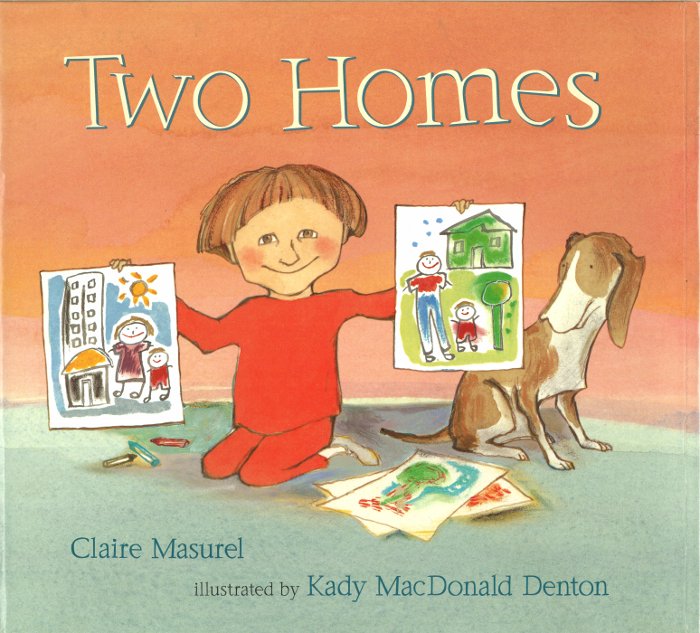
The word that most came to mind as I was reading Claire Masurel's Two Homes was "comforting". Regardless of the circumstances, whether friendly or hostile, divorce is a life altering experience for a child, one that cannot be soothed away with trite, authorial reassurances. Given this, Masurel makes a nice choice in having Alex, the protagonist of Two Homes, address the reader directly as one who's arrived on the other side of divorce and survived with both relationships intact. The narrative's dual structure helps reinforce the strength of his relationships to each parent. Each home balances the other - "I have two rooms. My room at Daddy's. My room at Mommy's." Both are shown as being equally important to Alex, while the illustrations picture Alex being equally happy in both.
The list of things Alex has two of - favorite chairs, toothbrushes, front doors etc. - are comforting in their everyday-ness, making it clear that, though Alex has two homes, both are very stable. Kady MacDonald Denton's illustrations add to that sense of well-being. Both parents are portrayed as warm and engaged, while Alex is never pictured as being upset, confused or missing the parent that isn't there. In fact, he seems like a very well-adjusted kid with artwork of both parents up in both homes. The story is tremendously reassuring. It feels like a kid addressing another kid, until the end when both parents in, one voice, tell Alex that they love him wherever he is. A simple, satisfying message in an honest, lovely book - the best on divorce that I've come across for this age group.
By Claire Masurel
No Author Site
Illustrated by Kady MacDonald Denton
http://www.kadymacdonalddenton.ca/
2-4 Preschool Primary Candlewick 40 pp.
978-0763619848 Paperback $6.99
Fiction
The word that most came to mind as I was reading Claire Masurel's Two Homes was "comforting". Regardless of the circumstances, whether friendly or hostile, divorce is a life altering experience for a child, one that cannot be soothed away with trite, authorial reassurances. Given this, Masurel makes a nice choice in having Alex, the protagonist of Two Homes, address the reader directly as one who's arrived on the other side of divorce and survived with both relationships intact. The narrative's dual structure helps reinforce the strength of his relationships to each parent. Each home balances the other - "I have two rooms. My room at Daddy's. My room at Mommy's." Both are shown as being equally important to Alex, while the illustrations picture Alex being equally happy in both.
The list of things Alex has two of - favorite chairs, toothbrushes, front doors etc. - are comforting in their everyday-ness, making it clear that, though Alex has two homes, both are very stable. Kady MacDonald Denton's illustrations add to that sense of well-being. Both parents are portrayed as warm and engaged, while Alex is never pictured as being upset, confused or missing the parent that isn't there. In fact, he seems like a very well-adjusted kid with artwork of both parents up in both homes. The story is tremendously reassuring. It feels like a kid addressing another kid, until the end when both parents in, one voice, tell Alex that they love him wherever he is. A simple, satisfying message in an honest, lovely book - the best on divorce that I've come across for this age group.
April 24, 2012
The Good-Bye Book
The Good-Bye Book
By Judith Viorst
No Author Site
Illustrated by Kay Chorao
http://www.kaychorao.com/
3-4 Preschool Primary Atheneum 32 pp.
978-0780788572 Hardcover $16.25
Fiction
The Good-Bye Book is not so much a story, as a child's reaction to being left with a sitter while his parents go out to dinner. The boy, illustrated by Kay Chorao with just the right blend of vulnerability and stubbornness, does not want his parents to go to a French restaurant. He begs, wheedles, yells and even offers to go to the restaurant with them rather than be left at home with a dreaded sitter, whom he imagines as an old lady with too much make-up who makes him eat vegetables and watch boring TV. When that doesn't work, he decides that he's sick, ("I mean, maybe I'm dying") and asks for "one more book. Okay, half a book. A poem?" Meanwhile, his parents continue to get dressed, (though the sting of this is softened by their concerned looks and patient expressions). Finally, the boy refuses to say good-bye just as the sitter, (a young man with a stack of picture books) arrives. The boy begins to smile and ends up waving good-bye to his parents, perched on his sitter's shoulders.
The Good-Bye Book is interesting in that it's written entirely in the 2nd person, with the boy addressing the soliloquy to his parents. It makes the situation feel very immediate, mimicking the immediacy of his distress. Viorst allows her young protagonist to run the entire emotional gamut without ever going over the top so that, while funny in places, (the boy imagines being attacked by the celery the sitter might force on him), his distress always rings emotionally true. Just as important is the fact that his turn-around in the face of the real sitter feels organic and unforced. The end result is a book that acknowledges the difficulties of saying good-bye, while allowing the protagonist (and the reader) to naturally conclude that it will be all right. A reassuring message made all the more reassuring by the voice of the boy and the strength of his initial worries at being left at home.
By Judith Viorst
No Author Site
Illustrated by Kay Chorao
http://www.kaychorao.com/
3-4 Preschool Primary Atheneum 32 pp.
978-0780788572 Hardcover $16.25
Fiction
The Good-Bye Book is not so much a story, as a child's reaction to being left with a sitter while his parents go out to dinner. The boy, illustrated by Kay Chorao with just the right blend of vulnerability and stubbornness, does not want his parents to go to a French restaurant. He begs, wheedles, yells and even offers to go to the restaurant with them rather than be left at home with a dreaded sitter, whom he imagines as an old lady with too much make-up who makes him eat vegetables and watch boring TV. When that doesn't work, he decides that he's sick, ("I mean, maybe I'm dying") and asks for "one more book. Okay, half a book. A poem?" Meanwhile, his parents continue to get dressed, (though the sting of this is softened by their concerned looks and patient expressions). Finally, the boy refuses to say good-bye just as the sitter, (a young man with a stack of picture books) arrives. The boy begins to smile and ends up waving good-bye to his parents, perched on his sitter's shoulders.
The Good-Bye Book is interesting in that it's written entirely in the 2nd person, with the boy addressing the soliloquy to his parents. It makes the situation feel very immediate, mimicking the immediacy of his distress. Viorst allows her young protagonist to run the entire emotional gamut without ever going over the top so that, while funny in places, (the boy imagines being attacked by the celery the sitter might force on him), his distress always rings emotionally true. Just as important is the fact that his turn-around in the face of the real sitter feels organic and unforced. The end result is a book that acknowledges the difficulties of saying good-bye, while allowing the protagonist (and the reader) to naturally conclude that it will be all right. A reassuring message made all the more reassuring by the voice of the boy and the strength of his initial worries at being left at home.
April 23, 2012
Where Are Maisy's Friends?
By Lucy Cousins; illus. by author
http://www.maisyfunclub.com
0-3 Preschool Candlewick 12 pp.
978-0763646691 Board $5.99
Non Fiction
Where Are Maisy's Friends? invites toddlers and preschoolers to play a game of hide-and-seek with Lucy Cousins's famous mouse. The book features Cousins's standard illustrative style with bold primary color acrylics outlined in black on clean white backgrounds. Meanwhile, the text follows a pleasantly predictable question-answer pattern. The book begins with an explicitly stated invitation to play, so that young readers know exactly what to expect when they turn the page, and the repetition of the phrase "Who's that hiding [under the bed, in the closet, etc.] provides beginning readers with a narrative foundation on which to build their understanding of the text. Even pre-readers will benefit from hearing the repeated words and sounds followed by the surprise of discovery. All of the characters are hiding in easily recognizable household objects, (under tables and beds, in closets), and the flaps are sturdy enough to withstand rough handling. The exclamation points that accompany the discovery of each of the hiding characters ("it's Charley!"; "It's Eddie!" etc.) gives the book a sort of real life Surprise!!! quality that kids will no doubt love. A good, interactive title for pre-readers and beginning readers, Where Are Maisy's Friends? offers developmentally appropriate fun for these young seekers.
By Lucy Cousins; illus. by author
http://www.maisyfunclub.com
0-3 Preschool Candlewick 12 pp.
978-0763646691 Board $5.99
Non Fiction
Where Are Maisy's Friends? invites toddlers and preschoolers to play a game of hide-and-seek with Lucy Cousins's famous mouse. The book features Cousins's standard illustrative style with bold primary color acrylics outlined in black on clean white backgrounds. Meanwhile, the text follows a pleasantly predictable question-answer pattern. The book begins with an explicitly stated invitation to play, so that young readers know exactly what to expect when they turn the page, and the repetition of the phrase "Who's that hiding [under the bed, in the closet, etc.] provides beginning readers with a narrative foundation on which to build their understanding of the text. Even pre-readers will benefit from hearing the repeated words and sounds followed by the surprise of discovery. All of the characters are hiding in easily recognizable household objects, (under tables and beds, in closets), and the flaps are sturdy enough to withstand rough handling. The exclamation points that accompany the discovery of each of the hiding characters ("it's Charley!"; "It's Eddie!" etc.) gives the book a sort of real life Surprise!!! quality that kids will no doubt love. A good, interactive title for pre-readers and beginning readers, Where Are Maisy's Friends? offers developmentally appropriate fun for these young seekers.
Charlotte Jane Battles Bedtime
By Myra Wolfe
Illustrated by Maria Monescillo
No Author / Illustrator Sites
3-4 Preschool Primary Harcourt 32 pp.
978-0152061500 Hardcover $16.99
Fiction
Charlotte Jane Battles Bedtime is a fabulous read, with a feisty protagonist and a straightforward but cleverly executed message. Charlotte Jane is born into a family of pirates. Even as a baby her parents could see that she has lots of "oomph," a fact born out by the illustration of her parents (dad has an eyepatch and mom a saucy bandana) smiling over the howling Charlotte. Charlotte Jane grows and so does her oomph. Soon both are sturdy and bold, and bent on getting "all of the juice" out the day. But sleep is not juicy, so she battles bedtime until one night, she doesn't go to sleep at all. The cost of her victory is high - as a result, Charlotte Jane loses her "oomph". Though her parents look everywhere, including the neighbor's recycling bin, her oomph remains missing. But then, while glaring at her bed, Charlotte Jane realizes that sleep might be "for landlubbers" but dreams, particularly piratical dreams, can be "rip-roarers," so Charlotte Jane dreams and wakes up with her formidable oomph in tact.
There are a lot of elements that make Charlotte Jane Battles Bedtime so good. The dialogue sprinkled with pirate-isms is just plain fun (Charlotte Jane refers to her parents as "me buckos" and her father calls her his "little doubloon"), the illustrations are clever, (Charlotte Jane and her parents live in a boat-shaped house in an otherwise regular neighborhood, hinting at the possibility that Charlotte Jane's imagination may be at work on the pirate theme) and the story is well-paced and tight. Especially nice was the fact that Charlotte Jane finds the solution to her problem by herself - she learns that sleep feeds her oomph and that "hearty" dreams are a good excuse to sleep - without authorial moralizing. Charlotte Jane Battles Bedtime is one of the most original bedtimes stories I've recently read. Great for storytime and bedtime and any time in between, this is one story with formidable oomph.
By Myra Wolfe
Illustrated by Maria Monescillo
No Author / Illustrator Sites
3-4 Preschool Primary Harcourt 32 pp.
978-0152061500 Hardcover $16.99
Fiction
Charlotte Jane Battles Bedtime is a fabulous read, with a feisty protagonist and a straightforward but cleverly executed message. Charlotte Jane is born into a family of pirates. Even as a baby her parents could see that she has lots of "oomph," a fact born out by the illustration of her parents (dad has an eyepatch and mom a saucy bandana) smiling over the howling Charlotte. Charlotte Jane grows and so does her oomph. Soon both are sturdy and bold, and bent on getting "all of the juice" out the day. But sleep is not juicy, so she battles bedtime until one night, she doesn't go to sleep at all. The cost of her victory is high - as a result, Charlotte Jane loses her "oomph". Though her parents look everywhere, including the neighbor's recycling bin, her oomph remains missing. But then, while glaring at her bed, Charlotte Jane realizes that sleep might be "for landlubbers" but dreams, particularly piratical dreams, can be "rip-roarers," so Charlotte Jane dreams and wakes up with her formidable oomph in tact.
There are a lot of elements that make Charlotte Jane Battles Bedtime so good. The dialogue sprinkled with pirate-isms is just plain fun (Charlotte Jane refers to her parents as "me buckos" and her father calls her his "little doubloon"), the illustrations are clever, (Charlotte Jane and her parents live in a boat-shaped house in an otherwise regular neighborhood, hinting at the possibility that Charlotte Jane's imagination may be at work on the pirate theme) and the story is well-paced and tight. Especially nice was the fact that Charlotte Jane finds the solution to her problem by herself - she learns that sleep feeds her oomph and that "hearty" dreams are a good excuse to sleep - without authorial moralizing. Charlotte Jane Battles Bedtime is one of the most original bedtimes stories I've recently read. Great for storytime and bedtime and any time in between, this is one story with formidable oomph.
April 22, 2012
But Not the Hippopotamus
By Sandra Boynton; illus. by author
http://www.sandraboynton.com
0-4 Preschool Primary Little Simon 12 pp.
978-0671449049 Board $5.99
Fiction
It's easy to feel out of step with the world, especially when you're a shy hippopotamus. Once again, Sandra Boynton addresses a serious topic - in this case, feeling left out - in terms of such fun and silliness that toddlers will have their emotional horizons gently broadened without even realizing it's happened.
The eponymous hippopotamus looks on alone as different pairs of animals engage in variety of activities. "A hog and a frog to a dance in the bog" and "a moose and a goose together have juice" and on and on. But just when it seems that she is destined to loneliness simply because it's hard to rhyme "hippopotamus", the other animals come back and say, "hey! Come join the lot of us!" And after a moment's hesitation, the hippopotamus does... but "not the armadillo."
The rhyme scheme and illustrations make But Not the Hippopotamus a solid choice, even for pre-verbal babies. Though rhythmically less predictable than some of her other stories, But Not the Hippopotamus scans poetically and is, if anything, more interesting because its rhymes don't fall into the sing-songy pattern of many baby books. Meanwhile, the titular key phrase guides the reader through and provides an element of narrative structure. The way that Boynton ends up rhyming "hippopotamus" with "the lot of us", (thus ensuring her hippo's inclusion), is nothing but terribly clever.
As with many of her books, Boynton uses humor a vehicle for genuine emotion. Her hippopotamus looks lonely and unsure, garnering the sympathies of young readers and engendering a sense of relief when she's finally included - but only if a child is emotionally mature enough to do so. But Not the Hippopotamus works on multiple levels. For younger toddlers, the tale is just funny, which is fine too, and even very little ones will enjoy hearing the rhythms and seeing the pictures. But Not the Hippopotamus is silly and funny and surprisingly deep. A lovely surprise of a book, it has as much to offer a baby as it does a toddler, and will grow with a baby as the baby grows up.
By Sandra Boynton; illus. by author
http://www.sandraboynton.com
0-4 Preschool Primary Little Simon 12 pp.
978-0671449049 Board $5.99
Fiction
It's easy to feel out of step with the world, especially when you're a shy hippopotamus. Once again, Sandra Boynton addresses a serious topic - in this case, feeling left out - in terms of such fun and silliness that toddlers will have their emotional horizons gently broadened without even realizing it's happened.
The eponymous hippopotamus looks on alone as different pairs of animals engage in variety of activities. "A hog and a frog to a dance in the bog" and "a moose and a goose together have juice" and on and on. But just when it seems that she is destined to loneliness simply because it's hard to rhyme "hippopotamus", the other animals come back and say, "hey! Come join the lot of us!" And after a moment's hesitation, the hippopotamus does... but "not the armadillo."
The rhyme scheme and illustrations make But Not the Hippopotamus a solid choice, even for pre-verbal babies. Though rhythmically less predictable than some of her other stories, But Not the Hippopotamus scans poetically and is, if anything, more interesting because its rhymes don't fall into the sing-songy pattern of many baby books. Meanwhile, the titular key phrase guides the reader through and provides an element of narrative structure. The way that Boynton ends up rhyming "hippopotamus" with "the lot of us", (thus ensuring her hippo's inclusion), is nothing but terribly clever.
As with many of her books, Boynton uses humor a vehicle for genuine emotion. Her hippopotamus looks lonely and unsure, garnering the sympathies of young readers and engendering a sense of relief when she's finally included - but only if a child is emotionally mature enough to do so. But Not the Hippopotamus works on multiple levels. For younger toddlers, the tale is just funny, which is fine too, and even very little ones will enjoy hearing the rhythms and seeing the pictures. But Not the Hippopotamus is silly and funny and surprisingly deep. A lovely surprise of a book, it has as much to offer a baby as it does a toddler, and will grow with a baby as the baby grows up.
Global Babies
Global Babies
By The Global Fund for Children
http://www.globalfundforchildren.org/
0-2 Preschool Charlesbridge 18 pp.
978-1580891745 Board $6.95
Non Fiction
Global Babies is simple in its message - that babies, regardless of culture, are united by the fundamental fact that they are loved - and straightforward in its presentation. Taking into account that babies love to look at faces, particularly the faces of other babies, Global Babies features 17 color portraits of babies from around the world, (in many cases wearing the traditional garb of their countries). Each portrait is also labeled with the baby's country of origin, places that range in diversity from Greenland and India to Rwanda and the United States. The accompanying text is likewise straightforward, ("wherever they live, wherever they go[...] babies everywhere are beautiful, special and loved"), just patterned enough to be rhythmic without feeling false or forced. Unlike many board books that are really picture books for older children mushed into board book form, Global Babies is specifically designed with infants and toddlers in mind. It is a beautiful and colorful introduction to the idea that there are many different kinds of faces and people, but that, while the faces may be different, love is still the fundamental connection between them all.
By The Global Fund for Children
http://www.globalfundforchildren.org/
0-2 Preschool Charlesbridge 18 pp.
978-1580891745 Board $6.95
Non Fiction
Global Babies is simple in its message - that babies, regardless of culture, are united by the fundamental fact that they are loved - and straightforward in its presentation. Taking into account that babies love to look at faces, particularly the faces of other babies, Global Babies features 17 color portraits of babies from around the world, (in many cases wearing the traditional garb of their countries). Each portrait is also labeled with the baby's country of origin, places that range in diversity from Greenland and India to Rwanda and the United States. The accompanying text is likewise straightforward, ("wherever they live, wherever they go[...] babies everywhere are beautiful, special and loved"), just patterned enough to be rhythmic without feeling false or forced. Unlike many board books that are really picture books for older children mushed into board book form, Global Babies is specifically designed with infants and toddlers in mind. It is a beautiful and colorful introduction to the idea that there are many different kinds of faces and people, but that, while the faces may be different, love is still the fundamental connection between them all.
Duck and Goose: How Are You Feeling?
By Tad Hills; illus. by author
http://tadhills.com/
0-4 Preschool Schwartz & Wade 22 pp.
978-0375846298 Board $6.99
Non Fiction
Duck and Goose: How Are You Feeling? is the third installment of Tad Hills's popular Duck and Goose series. This time, the duo is back in board book form to address the subject of feelings. Unlike the previous two Duck and Goose books (Duck and Goose and Duck, Duck, Goose), How Are You Feeling? does not feature a plot. Rather, each page contains a one-word feeling ("selfish", "angry", "happy") and an illustration modeling that emotion. It's a well-used conceit and one that mostly works here. I say mostly because, though effective with concrete emotions like "scared" (Duck and Goose huddled together in the dark during a thunderstorm), it is less effective with abstract emotions like "hopeful" (Duck and Goose staring at a tiny green plant with their bills open, presumably watching it grow). Toddlers will undoubtedly recognize feelings like "happy", "frustrated" and "sad", all of which Duck and Goose model well, but emotions like "hopeful" and "selfish" may be slightly beyond their conceptual reach. That said, there's no harm in introducing the concepts and using the pictures to talk about them.
Though Duck and Goose, being water fowl, have a limited repertoire of facial expressions, Hills illustrates them in such a way that they manage to communicate a wide variety of feelings. He also uses the trick of making the environment mirror the featured emotion, ("sad" features a cloudy day, "happy" has sunshine and butterflies), providing the reader with even more context - especially helpful for toddlers just learning to recognize and name emotions. It also serves as a nice beginning reader for preschoolers, as sight words, ("sad" and "happy") appear with challenging words, ("loving") and all are paired with illustrations designed to interpret the words. Overall, Duck and Goose: How Are You Feeling? is a friendly introduction to the complicated territory of feelings and one that will likely appeal.
By Tad Hills; illus. by author
http://tadhills.com/
0-4 Preschool Schwartz & Wade 22 pp.
978-0375846298 Board $6.99
Non Fiction
Duck and Goose: How Are You Feeling? is the third installment of Tad Hills's popular Duck and Goose series. This time, the duo is back in board book form to address the subject of feelings. Unlike the previous two Duck and Goose books (Duck and Goose and Duck, Duck, Goose), How Are You Feeling? does not feature a plot. Rather, each page contains a one-word feeling ("selfish", "angry", "happy") and an illustration modeling that emotion. It's a well-used conceit and one that mostly works here. I say mostly because, though effective with concrete emotions like "scared" (Duck and Goose huddled together in the dark during a thunderstorm), it is less effective with abstract emotions like "hopeful" (Duck and Goose staring at a tiny green plant with their bills open, presumably watching it grow). Toddlers will undoubtedly recognize feelings like "happy", "frustrated" and "sad", all of which Duck and Goose model well, but emotions like "hopeful" and "selfish" may be slightly beyond their conceptual reach. That said, there's no harm in introducing the concepts and using the pictures to talk about them.
Though Duck and Goose, being water fowl, have a limited repertoire of facial expressions, Hills illustrates them in such a way that they manage to communicate a wide variety of feelings. He also uses the trick of making the environment mirror the featured emotion, ("sad" features a cloudy day, "happy" has sunshine and butterflies), providing the reader with even more context - especially helpful for toddlers just learning to recognize and name emotions. It also serves as a nice beginning reader for preschoolers, as sight words, ("sad" and "happy") appear with challenging words, ("loving") and all are paired with illustrations designed to interpret the words. Overall, Duck and Goose: How Are You Feeling? is a friendly introduction to the complicated territory of feelings and one that will likely appeal.
Labels:
assignment 6,
concept book,
infant/toddler,
storytime
April 20, 2012
The House in the Night
By Susan Marie Swanson
No Author Site
Illustrated by Beth Krommes
http://bethkrommes.com/
2-4 Preschool Primary Houghton Mifflin 40 pp.
978-0618862443 Hardcover $17.00
Fiction
Here is the key to the house. In the house burns a light. In that light rests a bed. On that bed waits a book. In that book flies a bird.
The heart of The House in the Night is its cumulative narrative structure, one that has been made familiar by nursery rhymes and stories ("The House that Jack Built" and "The Keys to the Kingdom") for generations. It is dangerous territory that Swanson treads with this structure. Done badly, it can render a story sing-songy and trite. But done well - and Swanson does it very well - it leads the reader compulsively on, into the house, to the light and into the book where the bird flies. From there the narrative expands as the girl imagines herself flying on the bird's back into the starry sky past the smiling moon and into the cosmos. Then, with expert control, Krommes contracts the narrative focus, bringing the reader back to earth, back to the house in the night.
Swanson's prose and use of structure place the book in the company of traditional tales, even as she lays the foundation for Krommes's inventive scratchboard illustrations, (for which she won the Caldecott Medal in 2009). The freshness and balance of Krommes's pictures, all black and white save for judicious dollops of gold, place The House in the Night in an aesthetic category all its own while Swanson's seemless narration provides the guiding light. Together, they create a book of enduring resonance that will likely becomes a classic. The House in the Night is a rare thing - a picture book that is both traditional and unexpected. A beautiful bedtime story, it soothes with language that ebbs and flows and illustrations that are, quite honestly, too perfect to be sufficiently described. It is a book that reassures little ones that, while the universe is mysterious and large, there is a place in it for them, in their room, and their bed and their house in the night.
By Susan Marie Swanson
No Author Site
Illustrated by Beth Krommes
http://bethkrommes.com/
2-4 Preschool Primary Houghton Mifflin 40 pp.
978-0618862443 Hardcover $17.00
Fiction
Here is the key to the house. In the house burns a light. In that light rests a bed. On that bed waits a book. In that book flies a bird.
The heart of The House in the Night is its cumulative narrative structure, one that has been made familiar by nursery rhymes and stories ("The House that Jack Built" and "The Keys to the Kingdom") for generations. It is dangerous territory that Swanson treads with this structure. Done badly, it can render a story sing-songy and trite. But done well - and Swanson does it very well - it leads the reader compulsively on, into the house, to the light and into the book where the bird flies. From there the narrative expands as the girl imagines herself flying on the bird's back into the starry sky past the smiling moon and into the cosmos. Then, with expert control, Krommes contracts the narrative focus, bringing the reader back to earth, back to the house in the night.
Swanson's prose and use of structure place the book in the company of traditional tales, even as she lays the foundation for Krommes's inventive scratchboard illustrations, (for which she won the Caldecott Medal in 2009). The freshness and balance of Krommes's pictures, all black and white save for judicious dollops of gold, place The House in the Night in an aesthetic category all its own while Swanson's seemless narration provides the guiding light. Together, they create a book of enduring resonance that will likely becomes a classic. The House in the Night is a rare thing - a picture book that is both traditional and unexpected. A beautiful bedtime story, it soothes with language that ebbs and flows and illustrations that are, quite honestly, too perfect to be sufficiently described. It is a book that reassures little ones that, while the universe is mysterious and large, there is a place in it for them, in their room, and their bed and their house in the night.
Subscribe to:
Posts (Atom)